
The fastest way to cut energy costs in a Singapore restaurant is to combine three moves: replace ageing refrigeration and cooking equipment with energy-efficient models, tighten operational controls like demand-control ventilation, and fund the upgrade through the Energy Efficiency Grant. Together these typically save 20% to 40% on electricity bills. Check your eligibility on the Business Grants Portal before you order anything.
TL;DR:
- Replacing outdated refrigeration and cooking equipment often yields the largest savings, especially in tropical climates where compressors run longer.
- Prioritizing maintenance, operational controls, and quick, free operational changes can generate immediate savings before investing in equipment upgrades.
- The Energy Efficiency Grant covers up to 70% of eligible equipment costs, but application timing is crucial to avoid losing funding.
- Refrigeration costs make up most energy expenses in Singapore kitchens, so checking unit age and condition before replacements is essential.
- Conducting regular maintenance and staff training on energy-saving procedures reinforces savings and prevents efficiency loss over time.
Table of Contents
- Ranked energy-saving moves for restaurant energy savings in Singapore
- Equipment upgrades that move the needle in Singapore kitchens
- Maintenance and operational controls that protect your savings
- Quick wins you can start this week
- Applying for the Energy Efficiency Grant without losing your funding
- How Superior Kitchen Equipment supports Singapore kitchen upgrades
- What Singapore restaurants get wrong about energy savings
- Get grant-eligible equipment and expert help from Superior Kitchen Equipment
- Where to check the rules and technical standards
- Sources
- FAQ
Ranked energy-saving moves for restaurant energy savings in Singapore
Not every improvement carries the same weight, so prioritise by payback speed and grant eligibility rather than by whatever looks impressive on a spec sheet. Here is how the moves stack up for restaurant energy savings in Singapore:
- LED lighting retrofit. No or low capex, payback often under a year. ENERGY STAR notes LED conversion can cut lighting energy use by a substantial margin, typically between 70% and 90%. Not usually EEG-eligible on its own, but cheap enough that it barely matters.
- Refrigeration tune-up or replacement. Low to medium capex; medium payback. Strong EEG Base Tier candidate given how much cooling costs dominate a tropical-climate kitchen.
- Induction or combi oven swap. Medium to high capex, medium to long payback, but high EEG likelihood.
- Demand-control ventilation and hood scheduling. Medium capex, quick payback through lower extraction and make-up air demand.
- Start-up and shutdown staging. Zero capex, immediate savings, no grant needed.
- Variable frequency drives on motors. Low to medium capex, solid payback on fans and pumps.
- Hot water system upgrades. Medium capex, payback depends heavily on current usage patterns.
The rule of thumb: fix maintenance and behaviour first for quick, free wins, then use the EEG to fund the equipment replacements that need real capital.
Equipment upgrades that move the needle in Singapore kitchens
Refrigeration is usually the biggest single opportunity in a tropical climate, because compressors run harder and longer here than almost anywhere else. Before replacing anything, check the age of the unit, the condition of door seals, whether it has floating head pressure controls, and whether it complies with NEA’s Minimum Energy Performance Standards for commercial storage refrigerators. A unit with worn gaskets or a failed anti-sweat heater control can quietly add a third to its running cost without any visible sign of trouble. A well-specified four-door chiller and freezer combination with modern controls is a sensible benchmark to compare against when assessing an older unit.
On the cooking line, induction transfers heat directly into the pan rather than heating the surrounding air, so it wastes far less energy than open-flame gas burners. Combi ovens cut standby losses compared with separate steamers and convection ovens, and a well-specified electric convection oven holds temperature more consistently than older gas equivalents, reducing reheating cycles. Fryers matter too. Older open-vat fryers lose heat constantly; a modern electric deep fryer with better insulation and recovery time uses noticeably less energy per batch.
For hot water, heat pump systems suit kitchens with steady, moderate demand, while tankless units make more sense where hot water use is sporadic.
Before buying anything, run through this checklist:
- Ask the supplier for a kWh/day estimate under realistic load, not just nameplate wattage.
- Check the energy label and Energy Efficiency Index rating against NEA’s published thresholds.
- Confirm a service plan is available, since efficiency degrades without maintenance.
- Verify EEG eligibility for that specific model before you commit to an order.
Pro Tip: Ask two suppliers for kWh/day estimates on the same model and compare their numbers side by side. A supplier who cannot produce a credible figure usually cannot service the unit properly either.
Maintenance and operational controls that protect your savings
New equipment loses its efficiency edge fast without upkeep. CIBSE’s TM50 guidance on commercial kitchens treats planned preventative maintenance as central to keeping energy use close to nameplate figures, not optional housekeeping.
Build a routine around these checks:
- Clean condenser coils quarterly, more often in dusty or high-grease kitchens.
- Inspect door gaskets and seals monthly, and replace at the first sign of cracking.
- Test defrost controls and recalibrate thermostats every quarter.
- Check refrigerant levels and hood filters on the same quarterly cycle.
Hood and HVAC controls deserve equal attention. Demand-control ventilation adjusts extraction rate to actual cooking load rather than running hoods at full speed all shift, and staged start procedures that avoid firing up every appliance simultaneously reduce peak demand charges, which matters more for larger or multi-outlet operators.
Staff habits close the gap. Write down a start-up and shutdown sequence, assign someone to own the daily checklist, and make switching off idle fryers and holding cabinets part of the closing routine rather than an afterthought.
Pro Tip: Fit a simple plug-in kWh monitor on your two or three highest-draw appliances for a month. Most managers are surprised by which piece of equipment is actually the worst offender.
Quick wins you can start this week
Some of the biggest gains cost nothing beyond staff time. These are the moves to action immediately, while you sort out grant paperwork for the bigger replacements:
- Swap remaining incandescent or fluorescent bulbs for LEDs. Near-immediate payback, saves 70% to 90% on lighting energy.
- Switch off idle fryers, warmers, and ovens between rushes rather than leaving them on standby all day.
- Check walk-in fridge and freezer gaskets for gaps, and replace any that let cold air escape.
- Install strip curtains on walk-in doors to cut cold air loss during service.
- Reduce unnecessary preheating times and lower holding temperatures where food safety margins allow.
None of these require capital. Assign one person to run through the list daily for the first 30 days, log any bill or usage change, and use that early data to decide which bigger upgrade to tackle first.
Applying for the Energy Efficiency Grant without losing your funding

The EEG can cover up to 70% of the cost of pre-approved energy-efficient equipment for eligible SMEs, capped at S$30,000 per company under the Base Tier, with the scheme open until 31 March 2027. Getting the sequence wrong is the most common way operators lose that funding.
Eligibility basics for food services businesses require:
- Registration in Singapore under SSIC classification 56 or 68104.
- A valid Singapore Food Agency licence.
- At least 30% local shareholding and group turnover under S$500 million.
The sequence matters more than the paperwork itself. Submit your application through the Business Grants Portal and receive approval before placing any order or paying a deposit. Retroactive claims get rejected outright, no exceptions. The Base Tier covers up to S$30,000; the Advanced Tier offers more but carries carbon-abatement requirements that suit larger operators better than a single outlet. Get itemised kWh savings estimates from your vendor before submitting, and where it makes sense, group several equipment purchases into one submission rather than filing separately for each item.
How Superior Kitchen Equipment supports Singapore kitchen upgrades
The company supplies restaurant owners with equipment across several categories associated with significant energy savings, including refrigeration, combi ovens, induction cookers, and fryers.
- A showroom where interested buyers can inspect models beforehand.
- Product ranges that include refrigeration, cooking equipment, food warmers, and stainless steel fixtures.
- Guidance on Energy Efficiency Grant eligibility and the application sequence.
- An approach that prioritizes fixing low-cost operational issues before moving to larger equipment replacements once funding approval is secured.
Customers researching upgrades can also follow company updates on grant windows and new product arrivals.
What Singapore restaurants get wrong about energy savings
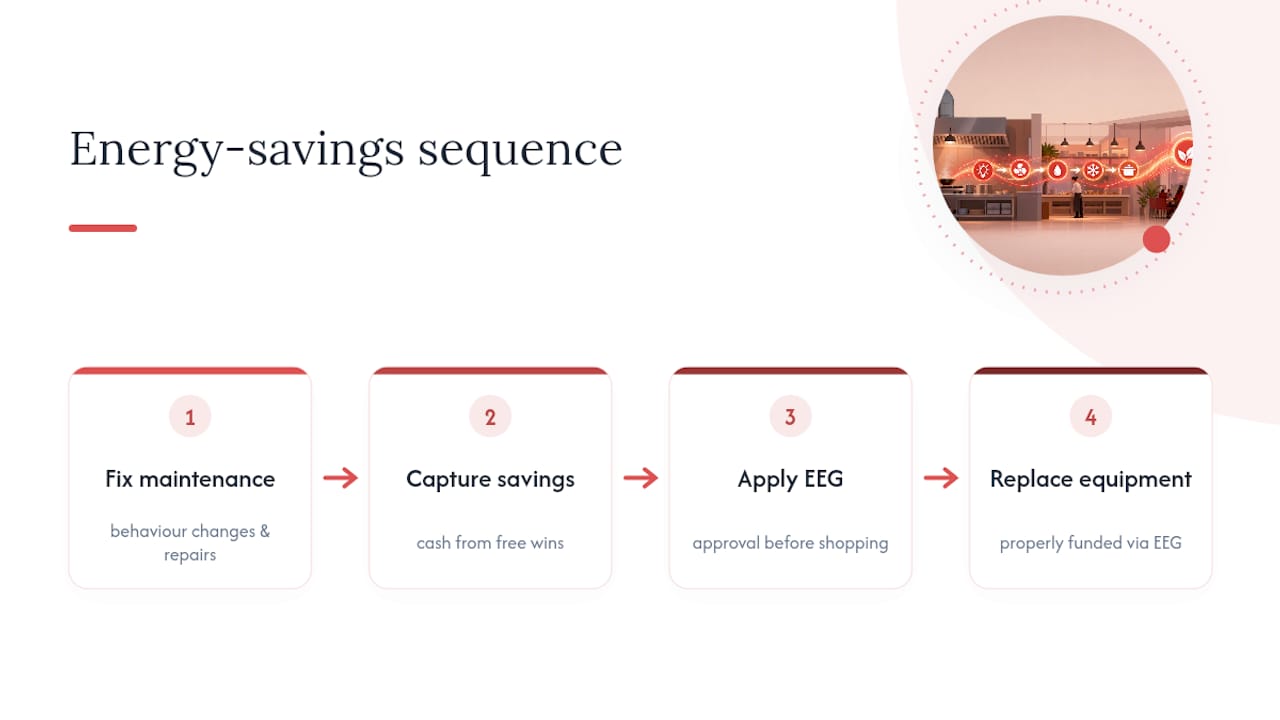
Most advice on this topic treats energy efficiency as a shopping list: buy LEDs, buy a new fridge, done. That misses the sequencing problem entirely. The businesses that actually save money are the ones who fix maintenance and behaviour first, generating cash from the free wins, then use that breathing room to fund the equipment replacements properly through the EEG.
The conventional wisdom also underweights refrigeration. Everyone focuses on flashy induction cookers, but in Singapore’s climate, cooling runs almost continuously, so a tired compressor or a cracked gasket costs more over a year than most people expect. Ventilation gets ignored too. Hood extraction is rarely tuned to actual cooking load, and that oversight burns money every single shift.
If you take one thing from this, apply for EEG approval before you shop, not after. Missing that sequence is the single most expensive mistake owners make, and it is entirely avoidable.
— David
Get grant-eligible equipment and expert help from Superior Kitchen Equipment
Superior Kitchen Equipment is the practical alternative to piecing together equipment research and grant paperwork on your own. As a Singapore supplier with its own showroom, the company lets you see energy-efficient refrigeration, ovens, and cooking equipment in person, and helps you work through Energy Efficiency Grant eligibility before you commit to an order.
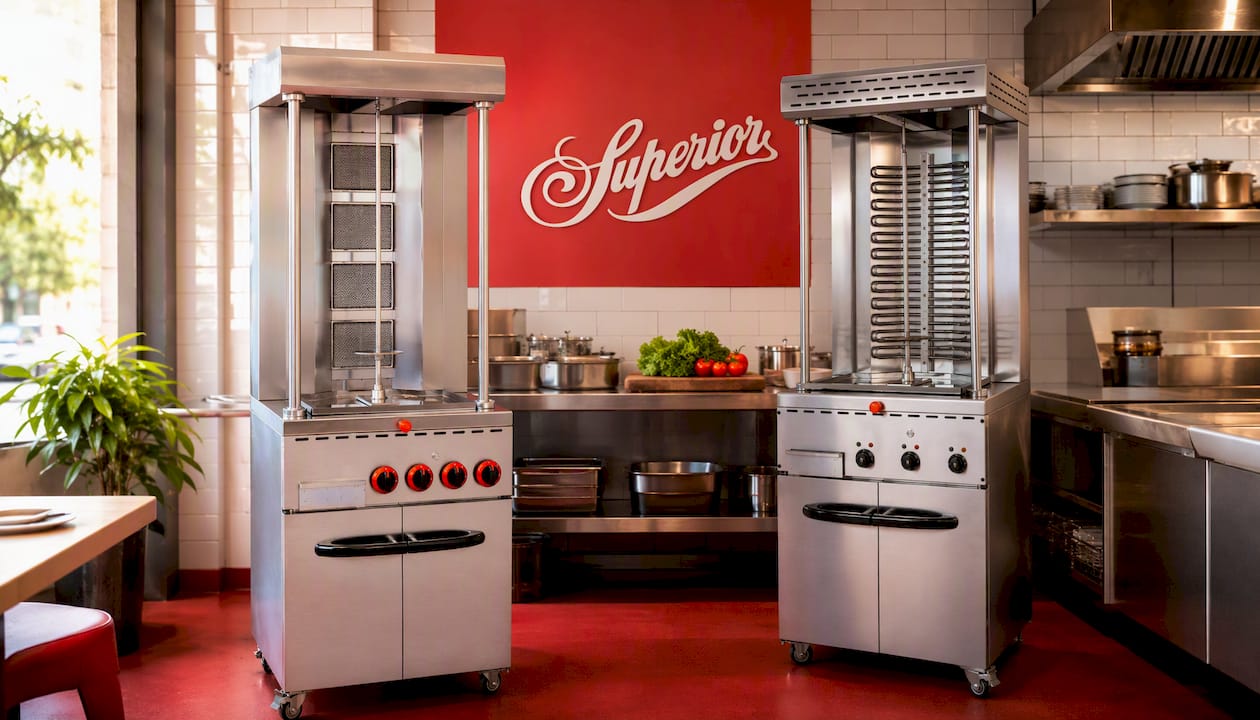
The catalogue covers the categories that matter most for restaurant energy savings in Singapore, including refrigeration, ovens, and induction cookers, along with speciality equipment like the standing gas kebab machine and standing electric kebab machine for kitchens looking to expand their menu without expanding their power bill. Book a showroom visit or get in touch for an EEG-eligible quote before you finalise your next equipment order.
Where to check the rules and technical standards
- Energy Efficiency Grant | GoBusiness confirms funding tiers and caps.
- Business Grants Portal application guide covers the exact submission sequence.
- NEA energy labelling guidance sets the MELS/MEPS thresholds for equipment.
- CIBSE TM50 details maintenance best practice for commercial kitchens.
Sources
- Energy Efficiency Grant (EEG) | GoBusiness
- Energy efficiency in commercial kitchens (TM50) | CIBSE
- ENERGY STAR guide for restaurants and commercial kitchens
FAQ
Does induction cooking equipment qualify for the EEG?
Induction cookers can qualify for the Energy Efficiency Grant when they appear on the pre-approved equipment list and the application is approved before purchase. Check the current list on the Business Grants Portal before ordering, since retroactive claims are rejected.
How long does an LED lighting retrofit take to pay back?
Most LED retrofits pay back within a year, sometimes faster, since ENERGY STAR notes LEDs can cut lighting energy use by 70% to 90%. The exact timeline depends on current bulb type and hours of operation.
How often should commercial kitchen equipment be serviced?
Condenser coils should be cleaned quarterly, with gasket and seal checks monthly, following the preventative maintenance approach outlined in CIBSE’s TM50 guidance. Thermostat recalibration and refrigerant checks fit the same quarterly cycle.
What is the maximum EEG funding available to a restaurant?
The Energy Efficiency Grant Base Tier covers up to 70% of the cost of pre-approved equipment, capped at S$30,000 per company. The Advanced Tier offers higher support but requires meeting carbon-abatement conditions.
Can I get help choosing EEG-eligible equipment in Singapore?
Superiorkitchenequipment offers showroom visits and guidance on EEG-eligible equipment across refrigeration, ovens, and cooking equipment. Current product pricing is listed on the company’s site rather than quoted generically here.