

Choose a solid-door fridge for back-of-house storage, raw ingredients, and light-sensitive laboratory samples where steady temperatures matter most. Choose a glass-door fridge for customer-facing display, beverage service, and grab-and-go points where visibility speeds up staff and cuts unnecessary door openings. Most well-run kitchens and labs use both, and you can arrange a showroom inspection of either type before you commit.
TL;DR:
- Glass-door refrigerators significantly reduce door openings and energy costs in retail and high-traffic display areas, especially when fitted with heated glass for humid environments.
- Solid-door units excel at maintaining stable temperatures for raw ingredients and light-sensitive samples, lowering spoilage risk in back-of-house and laboratory settings.
- Both door types have similar energy efficiency potential, with costs largely driven by usage patterns and door-opening frequency rather than material alone.
- Regular maintenance of gaskets, hinges, condensers, and heated-glass components is essential to minimize failures and total ownership costs.
- Combining both types in a hybrid setup maximizes visibility and protection, with site-specific conditions guiding the optimal choice for each storage area.
Table of Contents
- Solid vs glass fridge: what glass-door units do better
- Solid vs glass fridge: where solid doors still win
- Which door type costs less to run?
- What breaks first: maintenance and durability
- How to choose the right fridge for your kitchen or lab
- How Superiorkitchenequipment verifies these claims
- Does door type affect food preservation and shelf life?
- Safety risks: breakage, UV exposure and what to watch for
- When to use both types together: recommended mixed setups
- Upgrade your refrigeration with Superiorkitchenequipment
- Sources
- FAQ
Solid vs glass fridge: what glass-door units do better
A glass-door refrigerator earns its place wherever staff or customers need to see contents without opening the door. That single feature changes behaviour on the floor: fewer opens, faster picks, less time with warm kitchen air pouring into the cabinet. Being able to see contents without opening the door reduces unnecessary door openings and the running costs that come with them, which matters more in a busy service period than most managers assume.
The old objection to glass, that it leaks heat compared with a solid panel, has weakened considerably. Modern double and triple glazing on cooler doors narrows the energy-efficiency gap significantly and can cut heat transfer compared with older single-pane units. Heated glass elements now solve the condensation problem that used to plague glass doors in humid kitchens, keeping the viewing surface clear without constant wiping down.
Glass doors work best for:
- Retail and grab-and-go chillers where shoppers self-select
- Beverage display fridges in front-of-house service areas
- Staff-access points where quick visual stock checks save time
- Bakery and dessert cabinets where the product is the advertisement
Pro Tip: If your site runs humid or is near a kitchen extraction system, ask specifically for heated glass. It is a modest addition that removes the fogging problem entirely rather than managing it.
Solid vs glass fridge: where solid doors still win
Solid-door units hold their advantage where stability and protection matter more than visibility. Solid-door refrigerators generally insulate better than glass-door equivalents, which means steadier internal temperatures and less compressor cycling over a shift. For raw meat, dairy, and anything with a tight food-safety holding window, that consistency reduces spoilage risk without extra effort from staff.
There’s also a simple mechanical case for solid doors: no glass panel means nothing to crack, no seal to fog, and one less point of failure in a kitchen where trolleys and crates are moving constantly.
Solid doors suit:
- Back-of-house bulk storage for raw ingredients and prepped batches
- Laboratory samples that need dark, light-protected, stable conditions
- High-traffic kitchens where impact risk is a real concern
- Large-format chiller/freezer combinations used for overnight holding
Pro Tip: For laboratory storage where light exposure can degrade samples, a solid door isn’t just the sturdier option, it’s the correct one. Glass, even tinted, admits light that solid insulated panels block entirely.
Which door type costs less to run?
Neither door type wins outright on running cost. It depends on glazing quality and how the unit is actually used. The insulation gap between glass and solid doors has narrowed considerably with modern double and triple-glazed cabinets, so the decision increasingly comes down to where the unit sits and how staff open it rather than the door material alone, according to industry glazing analysis from TPRS Glass.
Door-open frequency drives a large share of real-world energy use. A glass-fronted beverage fridge that gets opened rarely, because staff can see stock levels through the door, can outperform a solid-door unit that gets opened constantly out of habit. With correct design and routine maintenance, glass-door units can match solid-door performance on temperature-holding and food-safety compliance.
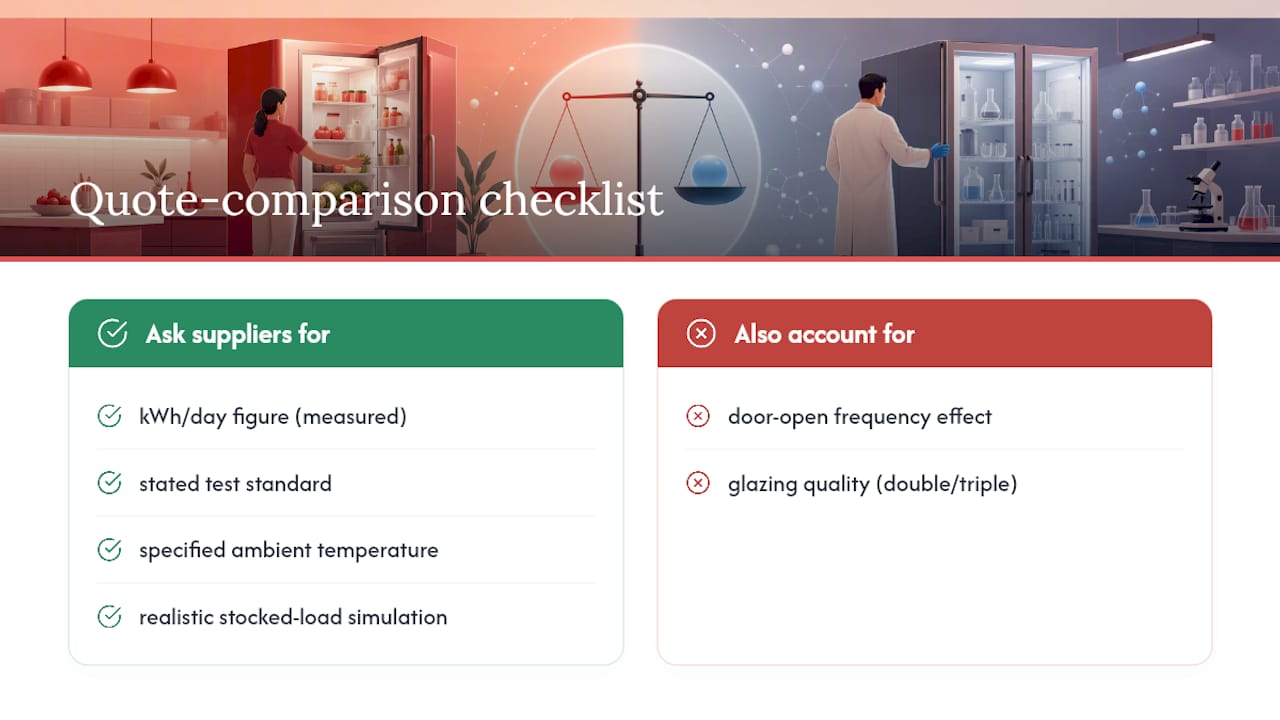
When comparing quotes, ask suppliers for kWh/day figures measured under a stated test standard, at a specified ambient temperature, with a realistic load simulation rather than an idle-cabinet figure. Vendor energy claims vary by test conditions, so two units quoted at similar wattage can behave very differently once stocked and opened all day.
What breaks first: maintenance and durability
Total cost of ownership hinges more on maintenance discipline than on door material. Routine condenser cleaning and gasket checks prevent the majority of premature failures across both glass and solid units, so a service schedule matters regardless of which you choose.
- Gaskets degrade on both types but fail faster on high-traffic solid doors that get slammed shut.
- Glass panels rarely crack under normal use but heated-glass elements can fail and need electrical diagnosis, not just a seal replacement.
- Condensers need clearing of grease and dust every few months in a kitchen environment, or compressors work harder on both door types.
- Hinges on heavier solid doors wear sooner under constant use and should be checked at every service visit.
Build service contracts around these four items, and confirm what the warranty actually covers before signing, particularly for heated-glass components, which are often excluded from standard cover.
How to choose the right fridge for your kitchen or lab
Start with location, not door type. A unit near a service pass that customers can see benefits from glass; a walk-in adjacent storage room rarely does. Humidity and heat exposure at the site also shift the calculation toward heated glass or away from glass altogether.
Next, weigh the product itself. Light-sensitive stock, whether that’s dairy, pharmaceuticals, or lab reagents, points towards solid doors regardless of location. High-turnover retail stock points towards glass almost every time.
Before signing a quote, request these specifics from any supplier:
- Glazing type and number of panes, plus whether heated glass is standard or optional
- Tropical or Class T rating, relevant for kitchens running in consistently high ambient heat
- Measured energy figures with the test standard and ambient temperature stated
- Warranty length and what it covers, including electrical glazing components
Pro Tip: Bring this checklist to your showroom visit rather than relying on a spec sheet alone. Standing next to both door types side by side makes the visibility and insulation trade-offs obvious in a way no data sheet communicates.
How Superiorkitchenequipment verifies these claims
David at Buyers can walk through both door types on the showroom floor, where energy claims and glazing quality can be checked directly rather than taken on a spec sheet. Showroom inspection also lets procurement teams compare energy-efficient models side by side before ordering.
To verify any refrigeration purchase properly:
- Request the manufacturer’s spec sheet and measured energy figures, not marketing estimates
- Ask what test standard and ambient temperature the kWh figure was measured under
- Book a showroom visit to inspect glazing, gaskets, and hinge quality first-hand
- Ask about current grant eligibility for energy-efficient models before finalising a quote
Does door type affect food preservation and shelf life?
Door type affects shelf life mainly through temperature stability, not through any difference in the cooling mechanism itself. A unit that holds a steady setpoint with minimal fluctuation preserves perishables longer than one that swings a few degrees every time the door opens, regardless of whether that door is glass or solid.
This is where the practical difference between door types actually shows up. Solid doors, thanks to their superior insulation, tend to recover temperature faster after opening and drift less between openings. That consistency matters most for raw proteins, dairy, and anything with a narrow safe-holding band, where a few degrees of variation over a shift can shorten usable life measurably.
Glass doors can hold their own here too, provided they’re specified correctly. With proper glazing and door seals, glass-door units can match solid-door units on temperature-holding performance and food-safety holding compliance. The risk isn’t the glass itself, it’s a poorly sealed or single-glazed unit left in a hot kitchen environment, where warm air infiltration on every open shortens the compressor’s recovery window.
For laboratory samples, the calculation shifts. Light exposure through even a well-sealed glass door can degrade certain reagents and biological samples over time in ways that have nothing to do with temperature. Solid doors remove that variable entirely, which is why most labs default to solid storage for anything light-sensitive and reserve glass, if used at all, for display or teaching samples rather than working stock.
Safety risks: breakage, UV exposure and what to watch for
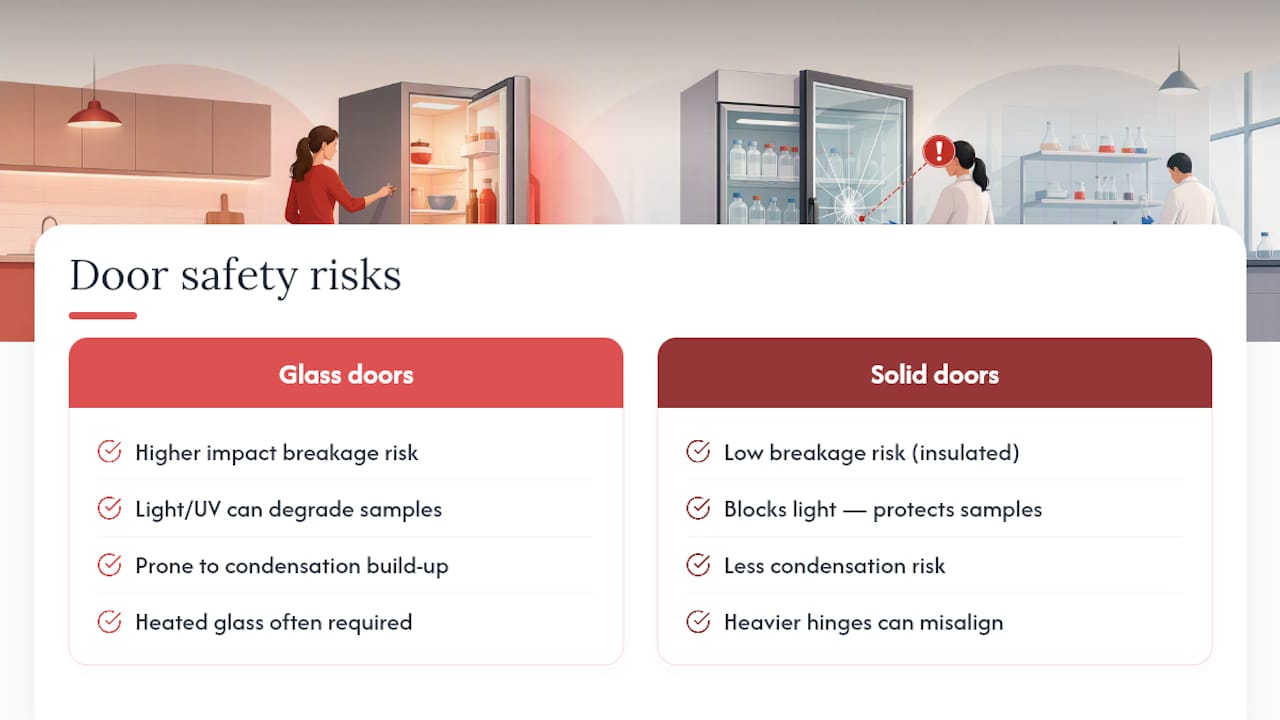
Glass doors carry a mechanical risk that solid doors simply don’t: breakage. In a busy kitchen with trolleys, crates, and fast-moving staff, a glass panel is more vulnerable to impact damage than an insulated steel one. Commercial glazing is toughened and rated for this environment, but it isn’t immune, and a cracked door panel means an emergency repair and a unit out of service until it’s fixed.
UV and light exposure is the second consideration, more relevant to laboratories than kitchens. Certain reagents, pharmaceuticals, and biological samples degrade under prolonged light exposure, even through tinted or UV-filtered glass. If your operation stores anything light-sensitive, that’s a straightforward argument for solid doors regardless of how good the glazing is.
Condensation presents a slower-burn safety issue rather than an acute one. In humid environments, manufacturers note that glass doors are prone to condensation build-up, with heated glass recommended as the effective fix. Left unmanaged, condensation pooling near door seals or electrical components can become a slip hazard on the floor or, over time, a wiring concern near the heating element itself.
Solid doors avoid both the breakage and UV risks by design, but they’re not risk-free either. Heavier doors on hinges under constant use can develop alignment issues that lead to poor sealing, which in turn drives temperature instability and higher energy draw. Whichever door type you run, factor these failure modes into your maintenance schedule rather than waiting for a breakdown to reveal them.
When to use both types together: recommended mixed setups
Most efficient kitchens run a hybrid layout: glass for display and fast-pick points, solid for bulk and light-sensitive storage, reducing wasted energy while keeping visibility where it earns its keep. Self-closing doors, a gasket-check routine, and basic staff training lift performance across both. Phase replacements unit by unit to avoid disrupting service.
— David
Upgrade your refrigeration with Superiorkitchenequipment
Commercial refrigeration suppliers offer both glass and solid-door options, so you’re not locked into one door type before you’ve compared them against your actual site conditions. Whether you need a display unit for front-of-house or a workhorse for bulk back-of-house storage, the range covers both, and models can often be inspected in person at a showroom before ordering.
Some suppliers offer guidance on energy-efficient models and grant eligibility, helping food businesses reduce both the upfront cost and the ongoing electricity bill of a refrigeration upgrade. If you’re weighing a glass display chiller against a bulk solid-door freezer, browsing the full refrigeration collection side by side is the fastest way to see what fits your kitchen. Book a showroom visit to compare units in person before you decide.
Sources
- Glass door vs solid door refrigerators – TPRS Glass
- Glass door vs solid door bar fridge: Which is better? – King Cave
FAQ
What are the disadvantages of glass-door refrigerators?
Glass doors carry a higher breakage risk than solid panels and can suffer from condensation build-up in humid kitchens, though heated glass largely solves the fogging problem. Older single-glazed units also lose more heat than solid doors, though modern double and triple glazing narrows that gap considerably.
Which type of refrigerator is better, glass door or solid door?
Neither is universally better; it depends on the role. Solid doors suit back-of-house storage and light-sensitive stock thanks to steadier insulation and temperature control, while glass doors suit display and fast-pick points where visibility cuts down on unnecessary door opening.
What type of refrigerator has the least problems?
Solid-door units generally have fewer mechanical failure points since there’s no glass panel or heating element to maintain, making them the lower-maintenance choice for constant back-of-house use. Both door types still need regular gasket and condenser checks to avoid premature faults.
What refrigerator should I stay away from?
Avoid any unit, glass or solid, where the supplier can’t provide measured energy figures under a stated test standard and ambient temperature, since vendor claims vary widely by test conditions. Also be cautious of single-glazed glass units without heated glass options if your kitchen runs hot or humid, as condensation and heat loss will be more pronounced. Superiorkitchenequipment can walk you through spec sheets and showroom units to avoid this pitfall before you buy.