

For most commercial kitchens, an EC fan is the more efficient choice wherever the fan runs for long hours or at varying speeds. An EC (electronically commutated) fan has a permanent-magnet motor with its own control electronics. An AC fan uses a conventional induction motor that is most efficient at one operating point. Fans in refrigeration, ventilation and cooling equipment often run around the clock, so the motor type affects the electricity bill every month. Equipment that is efficient as a whole, fan included, is also what Superior Kitchen Equipment supplies to Singapore restaurants, caterers and food manufacturers.
TL;DR
- An EC fan runs on AC mains supply but converts it internally, so it can change speed without an external drive. An AC fan normally needs a separate variable frequency drive (VFD) to do so.
- Published figures put EC motor efficiency at up to 90%, against 20% to 70% for conventional AC motors.
- Singapore’s National Environment Agency (NEA) reference manual cites efficiency gains of about 40% for EC motors in suitable applications.
- ECM fans are the electronically controlled alternative to shaded-pole fans in display cases, chillers and small refrigeration units.
- Check airflow, static pressure, operating hours, ambient heat and the control signal before choosing either type.
Table of Contents
- What the two fan types are
- EC fan vs AC fan at a glance
- Why partial load decides the comparison
- How much can an EC fan save?
- ECM fans vs shaded-pole fans
- Where fans sit in a Singapore food business
- What to check before choosing
- Retrofit or buy new equipment
- Our view on fans and energy use
- Efficient equipment for your kitchen
- FAQ
- Sources
What the two fan types are
AC fans
An AC fan has an asynchronous induction motor. It is connected to the mains and runs at a speed set by the supply frequency and the motor’s design. It is durable, familiar and found in a very wide range of equipment. Its limitation is that the motor is at its best near full load. At lower speeds, efficiency falls away. AC motors are most efficient at full load and generally need external VFDs for variable speed.
Two common ways of slowing an AC fan are cutting its voltage and fitting a VFD. The first wastes energy in the motor. The second adds a component to buy, install and maintain.
EC fans
An EC fan is built around a brushless permanent-magnet motor with integrated electronics. It can be connected directly to an AC mains supply, and its efficiency varies relatively little across the speed range. Because the electronics are inside the fan, speed control is stepless and needs no external control unit.
Technical guidance states that EC motors can commonly be turned down to 20% of full speed while retaining 85% efficiency, and accept 0 to 10 V, PWM or 4 to 20 mA control signals. In a kitchen, that means a thermostat, a sensor or a building controller can set the fan speed directly.
EC fan vs AC fan at a glance
| Criterion | EC fan | AC fan |
|---|---|---|
| Motor type | Permanent-magnet, electronically commutated | Asynchronous induction |
| Speed control | Built in, stepless | External VFD or voltage control |
| Efficiency across speeds | Stays high at partial load | Highest near full load |
| Typical motor efficiency | Up to 90% | 20% to 70% |
| Noise at reduced speed | Falls markedly | Fixed-speed units stay louder |
| Power range in HVAC use | Generally below 22 kW | Suits high power and harsh environments |
| Purchase price | Often higher at the start | Often lower at the start |
The efficiency row comes from a manufacturer brochure on EC retrofits. The power-range and price rows come from a comparison of AC and EC motors, which notes that EC fans may cost more initially and are generally limited to ranges below 22 kW.
Why partial load decides the comparison
A kitchen is rarely at full load. A chiller cycles, an exhaust hood handles a lunch peak and an idle afternoon, and a cold room sees doors opening and closing. A fan that can slow down with demand saves energy that a fixed-speed fan cannot.
An Australian professional training document gives a clear example: at 60% speed, a voltage-controlled AC motor consumes 550 W, whereas an EC motor consumes 200 W.

A worked example
Take the 350 W difference between those two figures and assume the fan runs 16 hours a day for 365 days.
- 350 W × 16 h = 5.6 kWh a day
- 5.6 kWh × 365 days = 2,044 kWh a year, per fan
Multiply this by the number of fans in the premises and by your own tariff to see the effect on your bill. The figure is arithmetic on a published comparison, not a guarantee for any particular kitchen. Your results depend on the actual speed profile and operating hours.
Noise at lower speeds
Noise matters in open kitchens, food courts and shop units. According to one manufacturer’s Singapore brochure, reducing fan speed to halve airflow improves noise by 15 dB, whereas switching off half the fans reduces it by about 3 dB. In a cooling-unit example from another manufacturer, running four units at 73% load instead of three at full load with one on standby cut power from 24.0 kW to 12.4 kW and noise from 65 dB(A) to 59 dB(A).
How much can an EC fan save?
Published figures vary with the application, so treat them as a range rather than a promise.
- EC motors consume on average about 30% less electricity than conventional AC motors, and variable-speed control can give up to 80% savings against staged fan operation.
- Singapore’s NEA, in its Motors and Drive Systems Reference Manual (2018), notes efficiency gains of about 40% for EC motors compared with conventional AC motors in suitable applications.
- Technical guidance states that EC fans can consume up to 70% less energy than conventional fans, and that savings should be evaluated case by case.
The savings come from two sources: a more efficient motor, and the ability to match speed to demand. The second source is larger where the load changes during the day. Running continuously at reduced speed can outperform fixed-speed on/off operation.
ECM fans vs shaded-pole fans
This comparison applies mainly to small fans inside refrigeration equipment: evaporator fans in display chillers, counter units and cold rooms.
A shaded-pole motor is a simple, low-cost motor with low starting torque. It suits light-duty uses such as small fans, small pumps and household appliances. An ECM (electronically commutated motor) is the small-motor version of EC technology. The same source reports that ECM motors are 70% to 83% more efficient than shaded-pole or PSC motors and give variable-speed operation.
The duty cycle explains why this matters. A US regional power council’s retrofit measure notes that display-case evaporator fans commonly run almost 24 hours a day, and that ECMs deliver the same 9 to 25 W output range more efficiently than shaded-pole motors. A small saving per fan, repeated every hour of the year and across several units, becomes a visible part of the bill.
Both motor types remain standard in commercial refrigeration. Shaded-pole and ECM motors are listed as standard choices in refrigerated counters, refrigerated cells and small evaporating or condensing units, so a quotation for a chiller or freezer is worth reading for the fan motor type as well as the compressor.

Where fans sit in a Singapore food business
Fans appear in several places, and the choice differs by place.
- Refrigeration. Evaporator and condenser fans run for long hours. ECM or EC motors suit this duty because the load is continuous and the speed can follow the temperature.
- Kitchen exhaust and make-up air. These fans move large volumes of air and their load changes between service peaks and quiet periods. Speed control is valuable here.
- Ventilation and cooling of the premises. Fan-coil and ducted systems benefit from EC blowers, which suit fan-coil and ducted air-conditioning use.
- High-temperature or high-power duty. Here the motor’s temperature limit and power range need checking before choosing a type.
Exhaust rules to keep in view
The NEA’s Code of Practice on Environmental Health (2024) requires that kitchen fumes in food shops be extracted immediately, treated to capture particulate matter, grease, oil and water vapour, and discharged outdoors, with the treated exhaust not facing adjacent buildings. The same code requires the entire exhaust duct and hood to be degreased and cleaned at least once every 12 months by a specialist, with records kept, and refers operators to SCDF requirements and SS 553 for kitchen ventilation.
A fan change in the exhaust system therefore belongs in a wider plan with your ventilation contractor. For the planning side, an overview of restaurant ventilation requirements helps owners prepare the right questions before a site visit.
What to check before choosing
Use this list when comparing quotations for equipment or a fan replacement.
- Airflow and static pressure. The fan must deliver the required air volume against the resistance of the ducting or coil. This applies whichever motor type is chosen.
- Operating hours. The longer a fan runs, the faster a lower power draw repays any higher purchase price.
- Load pattern. A fan that spends much of its time below full speed gains most from EC control. A fan at full speed all day gains less.
- Control signal. Confirm how the fan will be controlled: thermostat, 0 to 10 V, PWM or a building system.
- Power range. EC motors in HVAC generally cover power up to approximately 6 kW in that source, and are typically below 22 kW elsewhere. Very large fans may still be AC.
- Ambient temperature. Permanent magnets have a temperature limit, so check the rated operating temperature against the fan’s location.
- Maintenance. EC motors have no carbon brushes, which reduces maintenance and prolongs service life, and the integrated electronics remove the need for external components.
- Efficiency class. Typical EC motors reach at least IE4, and some newer designs are rated above IE5, according to one manufacturer.
Retrofit or buy new equipment
A retrofit swaps an old fan for an EC unit. It avoids belt-drive losses and the need for separate frequency control, while offering compact design and easy installation. It suits ventilation and air-handling units that are otherwise sound.
For refrigeration, buying new efficient equipment is usually the cleaner route, because the compressor, fans, controls and insulation are designed together. Superior Kitchen Equipment’s articles on reducing kitchen heat loads and on payback for efficient commercial fridges in Singapore set out how to weigh running cost against purchase price.
Our view on fans and energy use
Owners often ask us about one component, the fan. The better question is how the whole appliance uses electricity over a year. A fan is one part of that answer, alongside the compressor, the controls and the insulation.
In a Singapore kitchen, heat and long operating hours put every appliance under load. That is why we focus on energy-efficient equipment for restaurants, caterers and food manufacturers. Lower consumption reduces the monthly bill, and in some cases qualifies a purchase for government energy efficiency grants of up to 70% of the original cost, which we can guide you through.
When you compare fan types, ask for the efficiency of the whole unit and not only the motor. Our team can walk you through the range in our showroom.
David
Efficient equipment for your kitchen
Superior Kitchen Equipment supplies energy-efficient refrigerators, chillers and freezers, fryers, ovens, induction cookers and other commercial appliances, with guidance on claiming government energy efficiency grants. Our own claim is that efficient equipment can reduce electricity bills by up to 40%. You can view the range in our showroom or online.
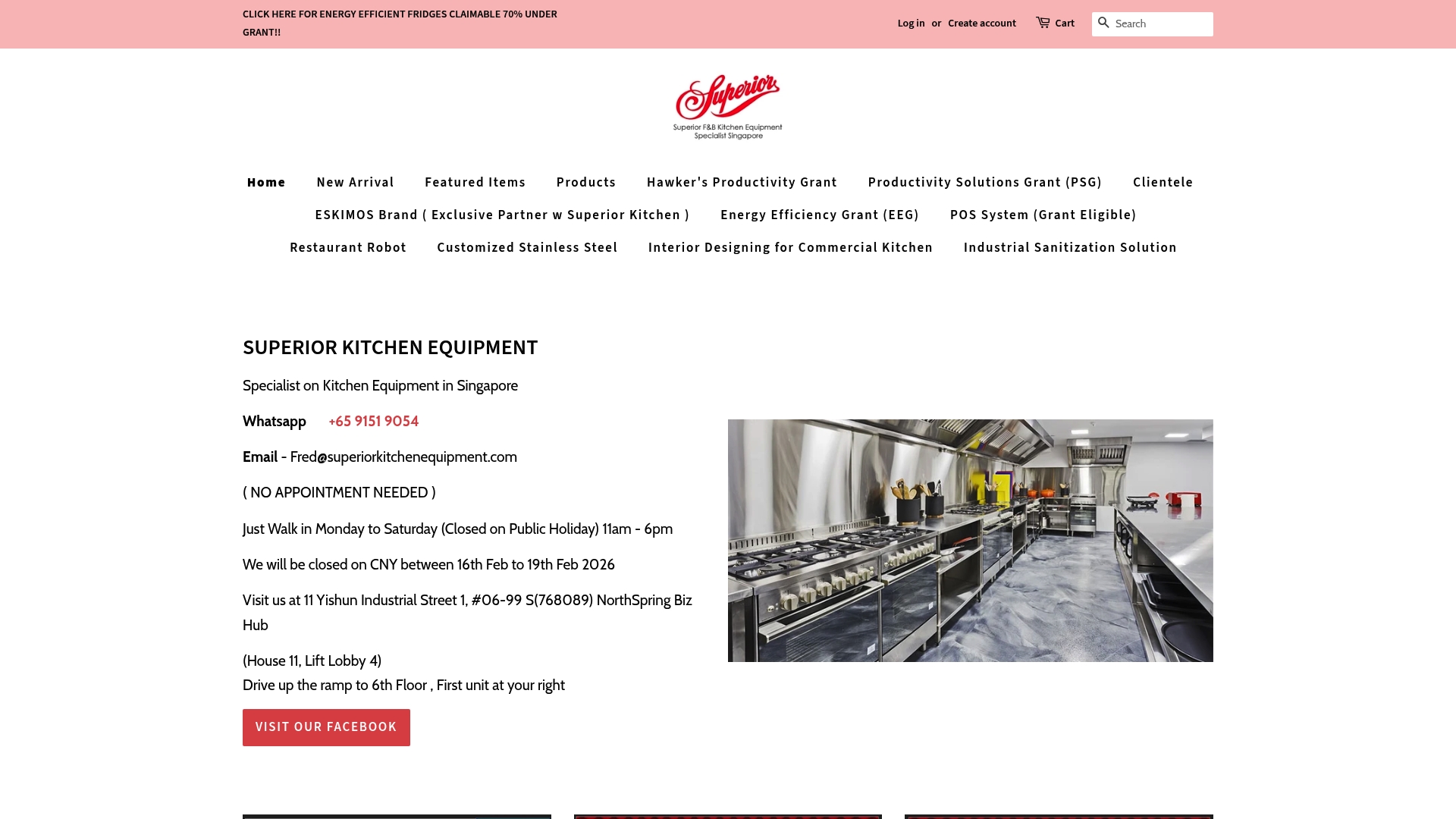
Start with the commercial fridges, chillers and freezers collection, or see the full product range for ovens, induction cookers and fryers.
FAQ
Is an EC fan always better than an AC fan?
Not for every duty, but it is the stronger choice where a fan runs long hours or at varying speeds. Very high-power or harsh-environment applications may still use AC motors, as EC motors are typically limited to below 22 kW. For refrigeration and most kitchen ventilation, the EC option is the efficient one.
Can an EC fan run on normal mains power in Singapore?
Yes. An EC fan can be connected directly to an AC mains supply, because it converts the supply internally. Confirm the voltage and phase on the fan’s rating plate with your electrician before ordering.
What does ECM mean in a chiller or display case?
ECM stands for electronically commutated motor. It is the small-motor form of EC technology used for evaporator and condenser fans in refrigeration. It replaces the older shaded-pole motor and provides the same output at lower power draw, as the retrofit measure cited above describes.
Do EC fans need a separate speed controller?
No. The control electronics are inside the fan. You only need to supply a control signal such as 0 to 10 V or PWM, or run it at a set speed. An AC fan generally needs an external VFD to vary its speed.
Which should a new food business prioritise?
Prioritise the appliances that run all day, mainly refrigeration, and ask for the energy performance of the complete unit. Our team can advise on efficient models and on grant eligibility when you plan your equipment list.
Sources
- EC Upgrade brochure, Singapore (GreenIntelligence)
- The Complete Guide To EC Motors
- EC vs. AC: Efficiency, Controllability, and System Benefits
- What is an Electronically Commutated EC Motor?
- EC Fan Retrofit brochure
- EC Motors, AIRAH skills workshop
- NEA Motors and Drive Systems Reference Manual 2018
- NEA Code of Practice on Environmental Health 2024
- Electric Motors for TAB and Commissioning, NEBB
- Display Case Evaporator Fan Motor Retrofit
- The differences between AC and EC motors
- What Are EC Motors, Danfoss
- EC or AC fan, airwalls
- Commercial refrigeration motor information
- Restaurant ventilation requirements