

Expect to spend roughly S$30,000 to S$60,000 on core kitchen equipment for a small café or cloud kitchen, and S$100,000 to S$200,000 for a full-service restaurant, since equipment typically represents 20 to 30% of total setup costs. Fit-out work, particularly ventilation and mechanical and electrical (M&E) upgrades, is usually budgeted separately and can rival or exceed the equipment line itself.
TL;DR:
- A typical small café or cloud kitchen should allocate S$30,000 to S$60,000 for core equipment, while full-service restaurants may need S$100,000 to S$200,000, with equipment costs representing 20 to 30 percent of total setup expenses.
- Major kitchen appliances like gas ranges range from S$1,800 to over S$8,000, and refrigeration units designed for Singapore’s climate cost S$1,500 to S$5,000, with tropical-rated models reducing long-term repair costs.
- Buying second-hand equipment can save 30 to 50 percent but involves risks like limited warranties and uncertain parts availability, especially for major appliances such as ovens and refrigeration.
- Fit-out costs—including ventilation, electrical work, and approvals—can add significantly to expenses, with renovations averaging S$200 to S$350 per square foot depending on the restaurant’s concept and site specifics.
- Prioritize purchasing refrigeration and cookline equipment first, consider energy-efficient units with grants to reduce total ownership costs, and verify warranty and service support before committing to any supplier.
Table of Contents
- How much does restaurant equipment cost in Singapore?
- Should you buy new or second-hand kitchen equipment?
- What does a full restaurant setup budget look like?
- Which equipment should you buy first, and what does it really cost to own?
- What should you ask suppliers about warranty and servicing?
- What restaurant owners get wrong about equipment budgets
- How Superior Kitchen Equipment supports your setup budget
- Sources
- FAQ
How much does restaurant equipment cost in Singapore?
Restaurant equipment cost in Singapore varies by category, fuel type, and capacity, and operators can estimate costs based on typical ranges.
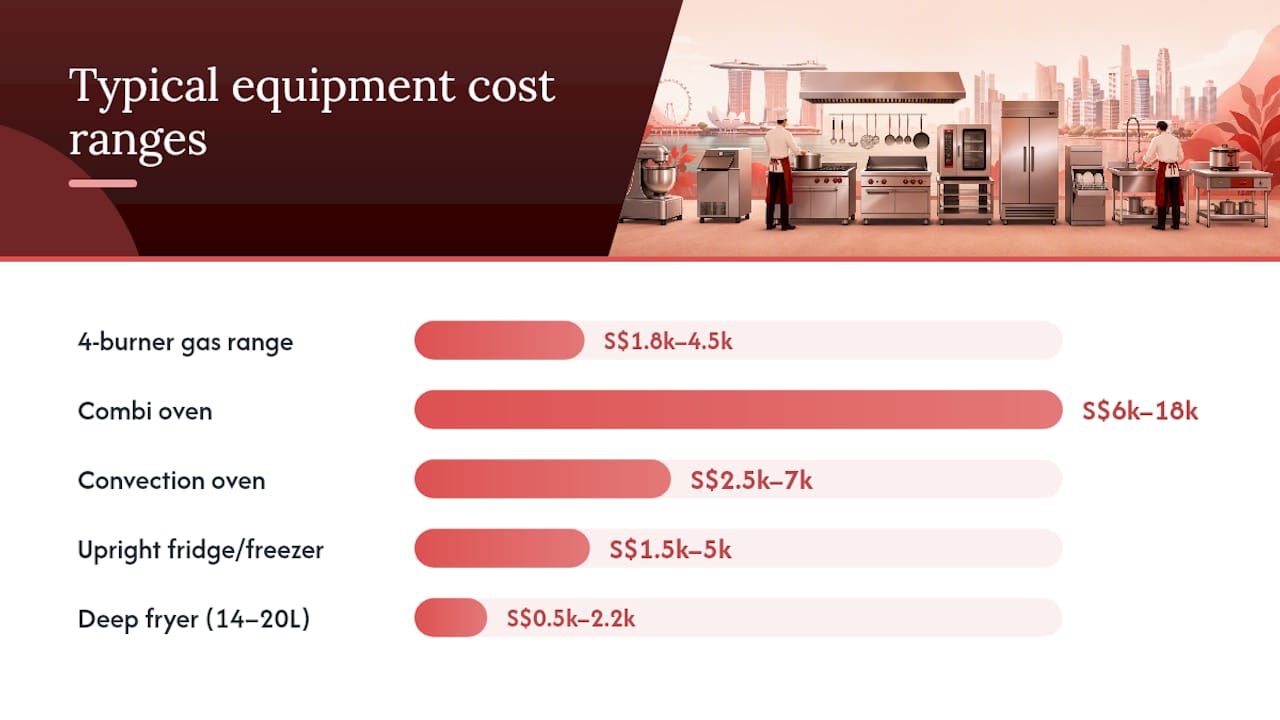
A four-burner gas range with oven typically runs S$1,800 to S$4,500, while a full six-burner commercial range with a heavy-duty griddle can reach S$8,000 or more. Combi ovens, prized for their versatility across baking, steaming, and roasting, sit between S$6,000 and S$18,000 depending on capacity, whereas a standard convection oven costs S$2,500 to S$7,000. Refrigeration is where tropical-rated compressors matter most: a commercial upright fridge or freezer costs S$1,500 to S$5,000, but units built for Singapore’s humidity and heat resist compressor strain far better than standard imports, cutting long-term repair costs, as explained by commercial refrigeration services in Fresno, CA.
Other core items to price into a Singapore kitchen equipment budget:
- Deep fryers (single basket, 14L to 20L): S$500 to S$2,200
- Commercial dishwashers: S$3,000 to S$12,000, with under-counter units at the lower end and conveyor systems at the top
- Stainless steel prep tables and sinks: S$300 to S$1,500 per unit
- Exhaust hoods and canopy systems: S$2,000 to S$15,000 depending on kitchen size and grease-extraction requirements
Gas equipment generally costs less upfront than electric equivalents but adds installation costs for gas piping and safety certification. Electric induction cookers, by contrast, install faster and often qualify for energy-efficiency incentives, though the units themselves carry a higher sticker price. Every gas connection, hood installation, or electrical upgrade adds to the final invoice, so price the installation alongside the appliance, not after it.
Should you buy new or second-hand kitchen equipment?
Second-hand commercial kitchen equipment typically saves 30 to 50% against new pricing, which makes it tempting for entrepreneurs stretching a tight opening budget. The savings are real, but they come with trade-offs: shorter or absent warranties, uncertain parts availability, and the risk of buying an inefficient compressor that quietly inflates your electricity bill for years.
Before paying for any used unit, run through this checklist:
- Visual inspection — check for rust, worn seals, and cracked hoses on gas equipment.
- Running test — operate the unit for at least 20 minutes and monitor temperature stability on fridges and ovens.
- Compressor hours — ask the seller for total run hours if the unit has a digital display; anything past 20,000 hours is nearing replacement territory.
- Certificates — confirm SCDF or NEA compliance documentation still exists for gas and ventilation equipment.
- Service history — request maintenance logs; a unit with no records is a bigger gamble regardless of price.
Tables, prep sinks, and non-critical cookware are generally safe to buy used since they carry no moving parts to fail. Refrigeration and major ovens are the opposite case: buy these new where possible, because compressor failure or uneven heating costs far more in lost stock and downtime than the upfront saving justified.
Pro Tip: Ask any second-hand seller for the original purchase invoice. It tells you the unit’s age precisely, which matters more than its cosmetic condition when judging remaining lifespan.
What does a full restaurant setup budget look like?
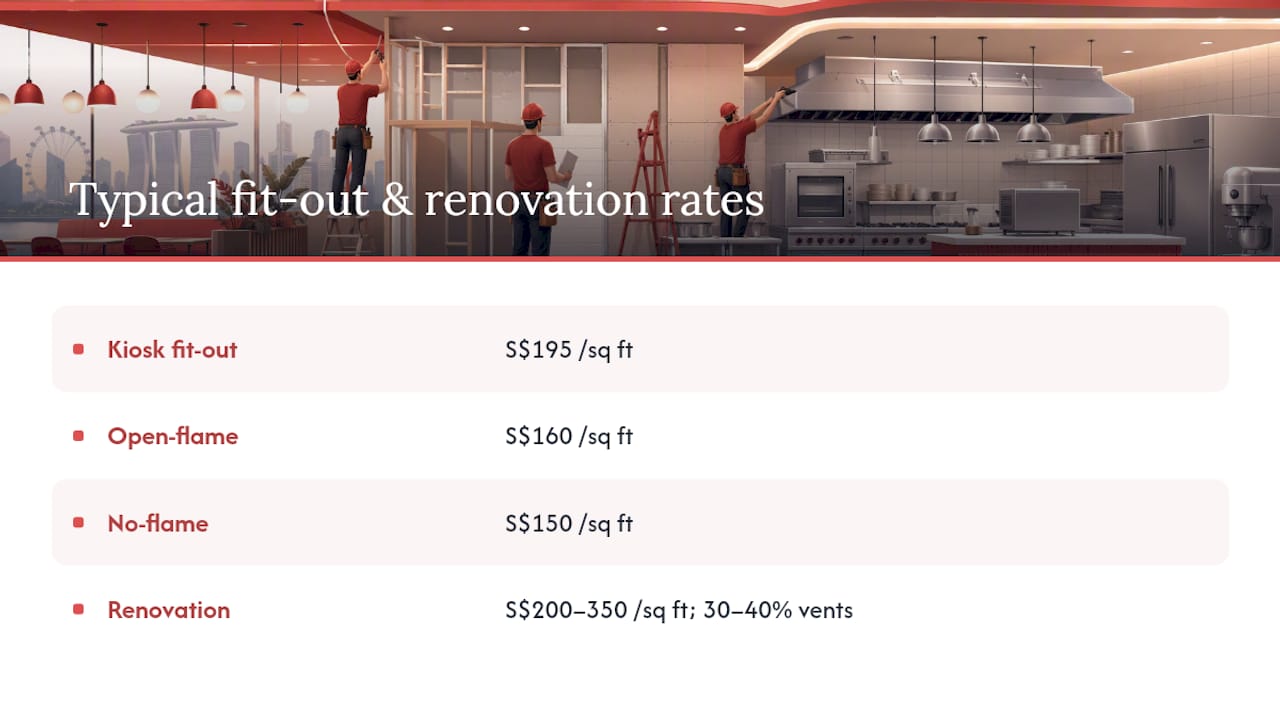
Fit-out costs in Singapore vary by site type and whether the kitchen uses open flame. SpaceCycle’s indicative rates put a food kiosk fit-out around S$195 per square foot, an open-flame restaurant around S$160 per square foot, and a no-open-flame restaurant around S$150 per square foot, though landlord-specific rules can shift these figures. Separately, renovation costs including ventilation and electrical work commonly range from S$200 to S$350 or more per square foot, with exhaust and ventilation systems alone consuming 30 to 40% of that renovation budget.
Here is how three typical Singapore setups compare once equipment, fit-out, and contingency are added together:
The hidden costs that catch new operators out sit inside the fit-out line, not the equipment line. Grease traps, hood ducting runs, and SCDF or NEA approvals for gas and fire safety can add weeks to your opening timeline if they are not scoped early. Engaging a fire-safety or M&E consultant before signing your lease, rather than after, avoids the rework costs that come from discovering ventilation shortfalls midway through fit-out.
Which equipment should you buy first, and what does it really cost to own?
Buy in this order: refrigeration and cookline first, dishwashing and prep stations second, specialty and display equipment last. Refrigeration and the cookline drive daily service capacity and food safety directly, so industry guidance consistently points procurement priority at these two categories before anything discretionary.
Total cost of ownership (TCO) is purchase price plus three years of running costs: energy use, servicing, and spare parts, minus any downtime losses. A worked example makes the gap clear:
- Standard fridge: S$2,000 purchase, roughly S$900 to S$1,200 annual energy cost, S$150 to S$300 annual servicing
- Energy-efficient equivalent: S$2,800 purchase (higher upfront), but energy savings of up to 40% on that unit’s running cost narrow the three-year gap to a few hundred dollars, sometimes reversing it
The BCA Energy Efficiency Grant can offset a meaningful share of the purchase price for qualifying equipment, which changes the calculation further in favour of efficient units. Check eligibility and application steps before you commit to a supplier, since the grant is tied to specific equipment categories and energy ratings.
Pro Tip: Factor local service availability into TCO, not just energy ratings. A cheaper-to-run unit that needs a technician flown in for repairs will cost you more in downtime than the electricity it saves.
What should you ask suppliers about warranty and servicing?
Downtime, not purchase price, is what actually erodes restaurant margins once equipment ages. Before signing any supplier quote, confirm:
- Warranty length on compressors, motors, and heating elements specifically, not just the general unit warranty
- On-site response time for breakdowns, particularly during peak service hours
- Spare-parts lead times for the exact model, not a “similar” replacement
- Whether technicians are factory-authorised or third-party contracted
Singapore’s humidity punishes equipment that was never designed for tropical conditions, so a showroom visit where you can see units running under real load conditions is worth the trip before you commit. Document every service agreement in writing and build its annual cost into your contingency line, not as an afterthought once something breaks.
What restaurant owners get wrong about equipment budgets
The most common overspend I see is entrepreneurs buying on price alone, then discovering that the cheapest fridge on the floor draws double the electricity of a comparable energy-efficient model. That gap compounds over three years far faster than most first-time buyers expect.
Showroom visits change buying decisions more than any spec sheet. Seeing a unit run, and understanding what grant support actually applies to it, routinely shifts a buyer toward the option that costs less to own, not just less to buy.
— David
How Superior Kitchen Equipment supports your setup budget
Superiorkitchenequipment gives you a lower total cost of ownership than buying blind from a catalogue. Our showroom lets you see energy-efficient units running under real conditions before you commit a single dollar, and we guide you through BCA grant eligibility that can cut your net equipment spend substantially, alongside electricity savings of up to 40% on qualifying appliances.
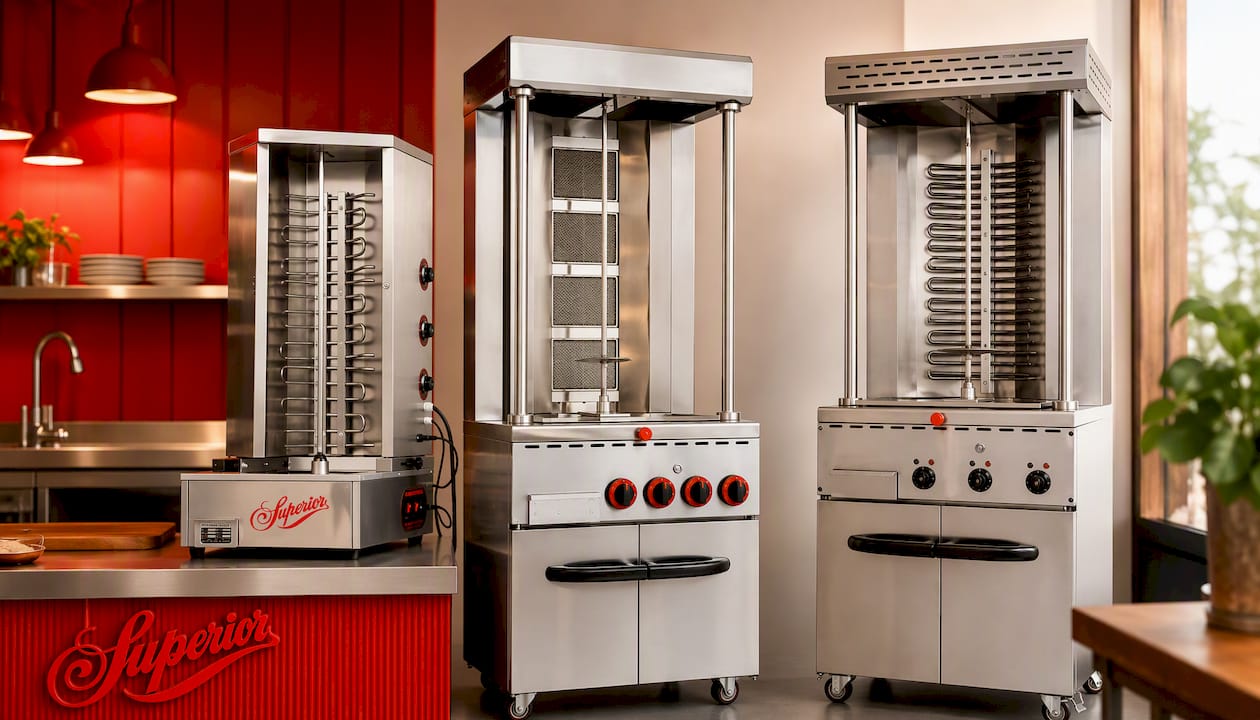
If your menu includes rotisserie or shawarma-style items, our kebab equipment range covers three common setups. The Tabletop Large Electric Kebab Machine suits compact kitchens without gas access that still need proper vertical-roasting capacity. Higher-volume kitchens with existing gas connections often prefer the Standing Gas Kebab Machine, while sites without gas hookups can get equivalent output from the Standing Electric Kebab Machine. Beyond kebab equipment, our range spans refrigeration, ovens including this electric convection oven, and fryers such as the 14L single deep fryer.
Request a quotation, book a showroom demo, or ask our team about EEG and PSG eligibility before you finalise your equipment list.
Sources
- Kitchen Renovation Cost Singapore: 2026 Smart Savings Guide
- Spacecycle
- BCA grants and funded programmes — Energy efficiency grant
- How to choose commercial kitchen equipment in Singapore
FAQ
What is the average cost of equipment for a restaurant in Singapore?
Small cafés and cloud kitchens typically budget S$30,000 to S$60,000 for core equipment, while full-service restaurants often need S$100,000 to S$200,000, depending on scale and menu complexity.
How much does it cost to open a restaurant in Singapore?
Total startup costs vary widely by site and concept, but equipment plus fit-out for a typical 1,000 sqft restaurant commonly fall within a broad range that depends on ventilation, M&E work, and contingency.
How much do restaurant owners make in Singapore?
Profitability depends heavily on cost control, with cost of goods typically at 25 to 35% of revenue and labour at 30 to 40%; most operators need S$30,000 to S$50,000 or more in monthly revenue to stay viable.
What is the typical price range for kitchen equipment in Singapore?
Individual items range from roughly S$300 for a prep sink to S$18,000 for a large combi oven, with most core appliances such as ranges, fryers, and refrigeration falling between S$1,500 and S$8,000 each.