
Buy new for anything that stops service if it fails, and buy used for anything that doesn’t. Core equipment such as refrigeration, the main cookline, dishwashers and combi ovens belongs in the “new” column because warranty cover and lower downtime risk usually beat the sticker price over a three to five year ownership period. Support items such as prep tables, shelving and non-critical small equipment are where used stock earns its savings, and outlet or scratch-and-dent units sit as a sensible middle ground when a supplier has them on the showroom floor.
TL;DR:
- Buying new is essential for core equipment like refrigeration, ovens, and dishwashers due to warranty support and lower downtime risk, especially during critical services.
- Used equipment can offer significant savings but carries higher risks of unknown service history and energy inefficiency, necessitating thorough pre-purchase inspection and documentation.
- Outlet or scratch-and-dent stock often provides factory-warrantied units at discounts, making them a good choice for support equipment when cosmetic flaws are acceptable.
- When comparing costs, consider energy consumption, repair likelihood, and downtime costs over the ownership period to determine if used or new is more cost-effective.
- Properly assessing equipment criticality, usage hours, service access, and grant eligibility allows for informed procurement decisions tailored to operational needs.
Table of Contents
- New vs used kitchen equipment: the case for buying new
- Used equipment: real savings, real risks, and how to check before you buy
- Scratch-and-dent and outlet stock: a middle path worth checking
- New vs used: a side-by-side comparison for procurement decisions
- How to decide: a step-by-step framework for every purchase
- Financing, grants and estimating your real running costs
- What Superior Kitchen Equipment brings to this decision
- An editorial take on buying decisions
- Buy the core kit new: what Superior Kitchen Equipment offers
- Sources
- FAQ
New vs used kitchen equipment: the case for buying new
“New” in commercial kitchen procurement covers three distinct tiers, and confusing them leads to bad comparisons. Factory-new stock is unopened, unused, and carries a full manufacturer warranty. Scratch-and-dent or outlet new is the same unit with a cosmetic flaw, a returned order, or a discontinued colour, still factory-warrantied, but sold at a discount. Genuinely used equipment is anything that has already run service hours in someone else’s kitchen, regardless of how well it’s been maintained.
Buying factory-new carries four practical advantages that matter more to a working kitchen than most buyers expect going in.
- Warranty and manufacturer support. A new fridge, oven or dishwasher typically comes with parts and labour cover for one to three years, which means a compressor failure in month eight is the manufacturer’s problem, not yours.
- Energy efficiency. Newer compressors, insulation and heating elements are usually built to tighter efficiency standards than equipment made a decade ago, which lowers the monthly electricity bill from day one.
- Predictability. You know the exact specification, the exact install requirements, and the exact service history, which is precisely nothing, because there isn’t one yet.
- Feature access. Programmable combi ovens, smart temperature logging and quieter compressors tend to arrive first in new product lines, not in the used market.
The obvious drawback is capital cost. New equipment asks for more money upfront, and it starts depreciating the moment it’s plugged in. For a business watching cash flow closely, that gap between new and used pricing is real, and it’s the reason the used and outlet markets exist at all.
When you’re sourcing new equipment, buy from a supplier who will quote installation, certification and after-sales service as part of the deal, not as an afterthought once you’ve already paid. Ask specifically what the warranty excludes (compressors and refrigerant lines are common carve-outs), whether the quote includes reconnection to gas, water or drainage, and what a service callout costs once the warranty period ends. A commercial oven or a wok-style induction cooker bought this way should arrive with a clear service contact, not just a delivery note.
Four categories consistently justify the new-equipment premium: primary refrigeration, the main cookline, dishwashers, and combi ovens. These are the machines that, if they fail mid-service, stop covers going out. Industry guides on commercial kitchen procurement consistently advise buying new for core units precisely because warranty cover, energy efficiency and lower downtime risk tend to make new equipment the cheaper option once you look past the purchase price to the full ownership period. A 3-tier convection oven that breaks on a Friday night service is not the place to have saved a few hundred dollars.
Used equipment: real savings, real risks, and how to check before you buy
Used equipment is where most of the “pros and cons of kitchen equipment” debate actually lives, because the savings are genuine and the risks are just as real. Refurbished and second-hand commercial kitchen gear typically sells for roughly 30 to 60% less than new, depending on the category and how the seller grades its condition.
That grading matters more than most first-time buyers realise. The used market generally sorts stock into tiers: new/factory-new, like-new, good, fair, and parts/as-is. A “good” grade unit has visible wear but working mechanicals and a reasonable remaining service life. A “fair” grade item might run fine today and need a compressor next year. “Parts/as-is” means exactly what it says, and should be priced (and treated) accordingly.
Where you buy used stock changes the risk profile substantially:
- Dealer-refurbished equipment. A commercial dealer that services and re-certifies units before resale usually offers a short warranty and some accountability if something fails in the first weeks. Expect to pay more than a private sale, but with far less guesswork.
- Auctions. Restaurant closures and business liquidations often go to auction, where pricing can be excellent but inspection windows are short and “sold as seen” is the norm. Bring a technician, not just a tape measure.
- Restaurant liquidations and direct sales. Buying straight from a closing kitchen can mean deep discounts and full service history if the previous owner kept records, but no recourse at all if something breaks the following week.
The risks cluster around three things: unknown service history, parts availability for older or discontinued models, and the energy inefficiency of equipment built to a decade-old standard, which quietly adds to your running costs every single month. Industry checklists are consistent on this point: never skip a pre-purchase inspection by a trusted technician before money changes hands.
Before you buy, insist on:
- A cold-test or run-test with the unit powered up and observed for at least 20 to 30 minutes, not just switched on and off.
- Service and repair records, even partial ones, and the name of the last technician who worked on it.
- Confirmation that replacement parts are still manufactured or stocked, not discontinued.
- A visual check for rust, refrigerant leaks (look for oily residue on lines), and non-original wiring or repairs.
- Written confirmation of what, if anything, is covered if the unit fails in the first weeks.
Pro Tip: Ask the seller to run the compressor or motor for the full inspection window rather than a quick 30-second demo. Most refrigeration faults only reveal themselves once the unit has been cycling for a while, and a seller who won’t leave it running is telling you something.
The safest used purchases are mechanically simple items with no refrigeration, boiler, or proprietary electronics: stainless steel worktables, shelving, sinks, bakeware and basic prep equipment. These categories have little to go wrong and no compressor to fail at 11pm on a Saturday, which is exactly why they’re the smart place to spend your savings.
Scratch-and-dent and outlet stock: a middle path worth checking
Outlet or scratch-and-dent stock is factory-new equipment sold at a discount because of a cosmetic dent, a cancelled order, a discontinued finish, or overstock the manufacturer needs to clear. The machine inside is identical to the full-price version; only the outside, or the sales history, is different.
This is often the best-value tier in the entire market, because it can combine the reliability of new equipment with a genuine discount. Outlet stock frequently carries the same factory warranty as full-price units, cosmetic flaw and all, which puts it well ahead of used equipment on risk while still saving real money.
What to expect and how to use it:
- Warranty stays intact in most cases, since the unit has never run service hours, only sat in a warehouse or showroom.
- Condition is cosmetic, not mechanical — a dented panel or a scuffed door, not a worn compressor.
- Availability is unpredictable, since outlet stock depends on what a manufacturer or supplier happens to be clearing that month.
- Best suited to core equipment you’d otherwise buy new, letting you get warrantied refrigeration or a combi oven at a used-equipment price point.
Checking outlet inventory regularly pays off, because good units move quickly once listed. If you’re negotiating, ask directly whether the discount reflects a genuine defect or simply an overstock situation. Overstock units, cosmetically perfect but discounted purely to clear floor space, are the best deals in the entire outlet category, and a supplier will usually tell you which is which if you ask plainly.
New vs used: a side-by-side comparison for procurement decisions
| Dimension | New | Used | Outlet / scratch-and-dent |
|---|---|---|---|
| Upfront price | Highest | Lowest (typically 30 to 60% less) | Discounted new pricing |
| Warranty and support | Full manufacturer cover | Rare, seller-dependent | Usually full factory warranty |
| Energy efficiency / running costs | Best available | Often higher running costs | Same as new |
| Reliability / downtime risk | Lowest | Highest, unknown service history | Low, mechanically unused |
| Best for | Core refrigeration, cookline, dishwashers, combi ovens | Support items: benches, shelving, sinks | Core items when budget is tight |
| Resale value / lifespan | Longest remaining life | Depends heavily on grade and age | Near-new lifespan |
The numbers only tell half the story until you model a failure. Take a mid-range commercial fridge. A new unit might cost more upfront than a comparable used one, but add three years of electricity at a lower efficiency rating, one likely repair call, and a single day of lost service if the compressor fails on a Friday, and the total often swings the other way. Industry worked examples on commercial kitchen procurement show that once energy, repairs and a single downtime event are factored in, a used fridge can end up costing more than a new one over a three-year ownership window.
To run this against your own numbers, take the purchase price gap between a new and used unit in the category you’re comparing, then add your estimated three-year electricity difference, one plausible repair cost pulled from a technician’s quote, and the revenue you’d lose during a realistic downtime scenario, say four hours of lost covers on a weekend service. If that combined figure closes the price gap, buy new. If the item rarely runs, has no refrigeration, and a failure costs you nothing but inconvenience, buy used and bank the difference.
How to decide: a step-by-step framework for every purchase
Run each piece of equipment through the same five questions before you commit either way.
- How critical is it to service continuity? If its failure stops food going out, that’s a strong pull towards new.
- How many hours a week does it run? High-use equipment wears faster and exposes weak used units sooner than light-duty items.
- How easy is it to get parts and service locally? If a technician can’t source parts for a model within a day or two, walk away regardless of price.
- What’s the energy and running-cost impact? Refrigeration and cooking equipment carry the largest efficiency gap between old and new; benches and shelving carry none.
- What’s your finance threshold? Some purchases genuinely need to be capital-light this quarter, and that’s a legitimate reason to buy used or outlet, provided the item isn’t mission-critical.
Use this as a quick accept/reject filter at the point of purchase:
- Accept used if the item has no refrigeration or complex electronics, service history is documented, and a technician has run a live test.
- Accept outlet if the flaw is confirmed cosmetic and the factory warranty is in writing.
- Reject any used unit if the seller won’t allow a run-test, can’t produce service records, or the model’s parts are discontinued.
- Reject any deal where downtime during peak service would cost more in lost covers than the price difference between new and used.
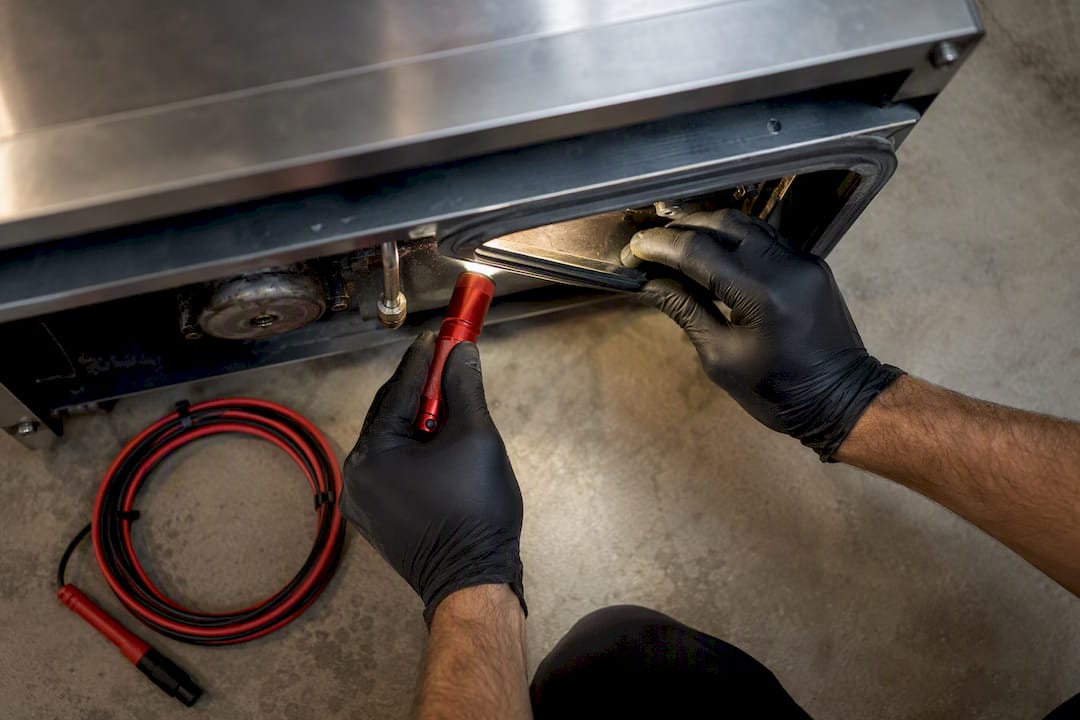
Before you hand over money, ask the seller three direct questions: how old is the unit, who serviced it last and when, and will they put the condition grade in writing. Ask any technician doing a pre-purchase check one more: is this a repair-and-monitor situation, or a walk-away.
Pro Tip: Get the pre-purchase inspection quote in writing before you view the equipment, not after you’ve already fallen for it. A technician’s report costs far less than a compressor replacement three months in, and sellers who refuse access to a third-party inspector are telling you exactly what you need to know.
Financing, grants and estimating your real running costs
How you pay for equipment can change the new-versus-used decision as much as the equipment itself. Leasing suits operators who want to preserve cash and upgrade every few years; a chattel mortgage suits those who want ownership and are comfortable with a fixed repayment; vendor finance through the supplier can bundle installation and service into one line, which is useful for core cookline purchases where continuity matters.
Grants change the maths further. Singapore-based operators can apply for energy-efficiency funding through EnterpriseSG, which reduces the upfront capital cost of qualifying energy-efficient equipment and shortens the payback period considerably compared with a straight cash purchase. Superior Kitchen Equipment’s guidance on the Energy Efficiency Grant and the Productivity Solutions Grant walk through eligibility for operators weighing this route.
Grants narrow the price gap that pushes buyers towards used equipment. A grant that offsets a meaningful share of a new unit’s cost can make the “new” column cheaper than it first appears, particularly on refrigeration and cooking equipment where energy savings compound month after month.
To estimate running costs on any candidate purchase, take the unit’s rated power consumption, multiply by realistic daily run hours, and compare that figure across a new and a used model of the same category. The gap, multiplied out over a year, often dwarfs the purchase-price difference on high-use equipment.
What Superior Kitchen Equipment brings to this decision
Superior Kitchen Equipment works with operators through every stage of this decision, not just the point of sale.
- A showroom where customers can inspect build quality, run demonstrations, and compare energy-efficient models before committing capital.
- Guidance on applying for energy-efficiency grants can help ensure the “new” column in your comparison reflects the real, post-grant cost rather than the sticker price.
- Support with installation and after-sales service is available, which matters most on the core equipment categories this article recommends buying new.
- A product range includes energy-efficient commercial kitchen equipment, aligned with the total cost of ownership approach used throughout this decision framework.
An editorial take on buying decisions
The mistake most operators make isn’t choosing new or used badly, it’s applying one answer to the entire kitchen. Treat every purchase individually, and the sticker price stops mattering nearly as much as what happens if the thing breaks on a Saturday night.
Three things worth doing this week: score every major piece of equipment on criticality and usage hours before your next purchase decision, prioritise new for anything on the main cookline or in primary refrigeration, and check grant eligibility before assuming new is out of budget. Whatever you decide, document the condition grade, the service contact, and the inspection date for every unit you buy. Six months from now, that record is worth more than the receipt.
— David
Buy the core kit new: what Superior Kitchen Equipment offers
One supplier’s approach follows the logic this article argues for: buy new where downtime is expensive, and buy it from a showroom you can walk into and test before paying. For operators expanding a kebab or grill menu, the Standing Electric Kebab Machine suits high-volume production lines, while the Tabletop Large Electric Kebab Machine fits smaller kitchens or lower-throughput service without sacrificing output quality.
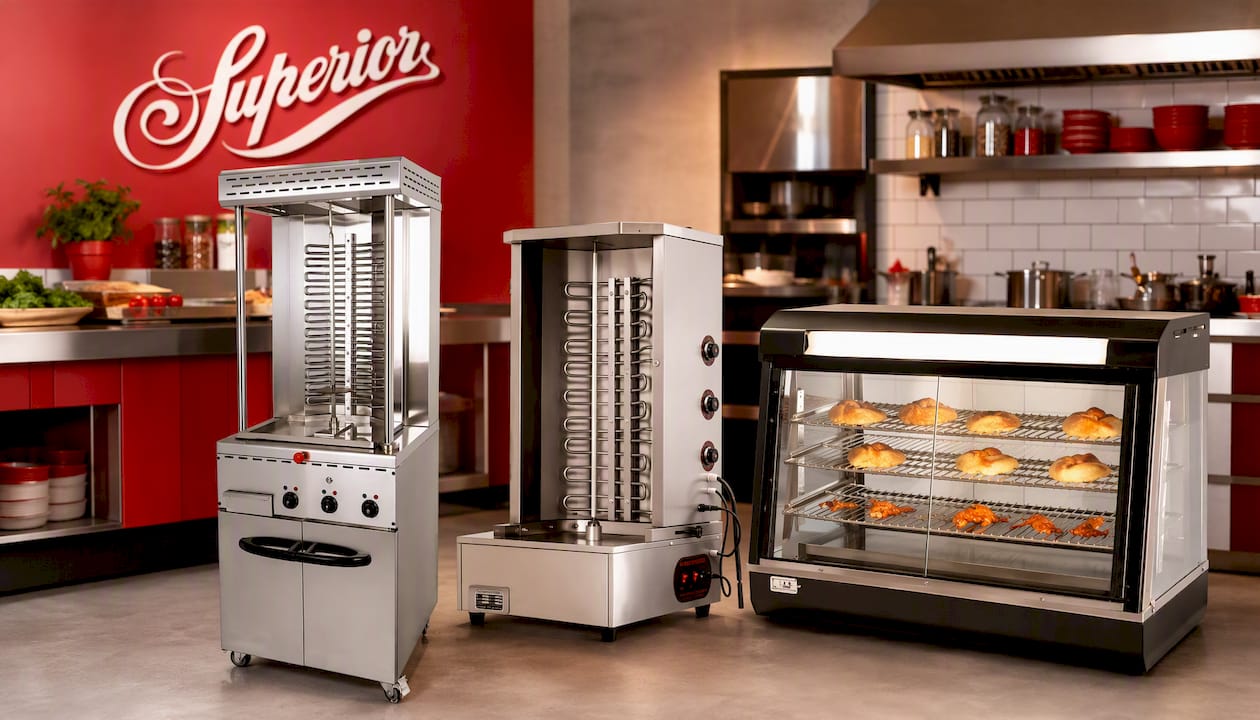
On the service side, a Convection Warmer keeps cooked food at temperature reliably, an area where equipment condition ties directly to food safety compliance rather than just convenience. Support for grant applications, delivery and installation, and after-sales servicing is provided, reinforcing the importance of warranty coverage discussed throughout this article. Visit the Superior Kitchen Equipment showroom to inspect these models in person, or browse the product range online to get a quote and check current grant eligibility before you buy.
Sources
FAQ
Is buying used kitchen equipment worth it?
It’s riskier for refrigeration, cooklines and dishwashers, where downtime and energy inefficiency can erase the savings within a few years.
What is the most used kitchen equipment in a commercial setting?
Refrigeration units, ovens, cooktops and dishwashers see the heaviest daily use in most commercial kitchens, which is exactly why their condition and reliability matter most.
What are the latest trends in kitchen equipment?
Energy-efficient refrigeration, induction cooking and programmable combi ovens are driving replacement decisions, partly because grant schemes like EnterpriseSG’s Energy Efficiency Grant make upgrading more affordable.
What are the different types of kitchen equipment used for?
Commercial kitchen equipment splits broadly into core production gear (refrigeration, cooklines, ovens, dishwashers), service and holding equipment (warmers, holding cabinets), and support items (worktables, shelving, sinks), each carrying different priorities for new versus used buying.
Does Superior Kitchen Equipment help with grant applications?
Yes, Superior Kitchen Equipment provides guidance on applying for energy-efficiency grants and productivity funding to reduce the upfront cost of qualifying new equipment.