

A typical commercial upright freezer draws roughly 8–15 kWh per day, and a chest freezer sits lower, around 4–8 kWh per day. Running 24/7, that adds up fast on a utility bill. The three levers that most notably reduce energy use are routine maintenance, a correctly set thermostat, and, when the unit is older, replacement with a model using inverter-driven compressors.
TL;DR:
- Proper maintenance, correct thermostat settings, and inverter compressor upgrades can significantly reduce energy consumption in commercial freezers.
- Realistic energy costs depend on the unit’s actual kWh per day or year, not wattage, and can range from a few dollars to over three thousand dollars annually per large unit.
- Factors such as door type, frost buildup, ambient temperature, and seal quality play critical roles in a freezer’s energy efficiency.
- Routine checks like cleaning coils and inspecting gaskets can save hundreds of dollars annually, especially on older or poorly maintained units.
- When replacing or upgrading freezers, prioritize models with inverter technology, proper insulation, and verified energy efficiency ratings to minimize lifetime operating costs.
Table of Contents
- Commercial freezer energy use: units, ranges and reading the spec sheet
- What factors most affect a freezer’s energy use?
- How do you estimate what a freezer costs to run?
- Practical energy-saving measures operators can implement today
- What to check when buying or replacing a freezer
- Getting practical support on replacements and grants
- What actually moves the needle on freezer running costs
- Cutting running costs with an inverter freezer upgrade
- Sources
- FAQ
Commercial freezer energy use: units, ranges and reading the spec sheet
Wattage tells you the instantaneous draw; kilowatt hours (kWh) tell you what you actually pay for, because a freezer’s compressor cycles on and off rather than running flat out. Multiply the rated kW by the hours it actually runs (the duty cycle, not 24) to estimate daily kWh.
ENERGY STAR’s domestic-scale certified benchmarks give a useful anchor: certified chest freezers use around 215 kWh a year and certified uprights about 395 kWh a year, with certified units at least 10% more efficient than the federal minimum. Commercial units scale up considerably from there depending on size and door count.
| Freezer type | Typical daily use | Typical annual use |
|---|---|---|
| Small commercial chest freezer | 4–8 kWh/day | 4–8 kWh/day |
| Commercial upright freezer | 8–15 kWh/day | 8–15 kWh/day |
| Large walk-in freezer | 20–40+ kWh/day | thousands of kWh annually |
Larger commercial refrigeration equipment can run into thousands of kWh annually depending on compressor size and how often doors open. Look for the kWh/24hr or kWh/year figure on the equipment’s data plate or spec sheet rather than relying on wattage alone, since wattage overstates real consumption once cycling is accounted for.
What factors most affect a freezer’s energy use?
Some variables are fixed once you’ve bought the unit; others you control every shift. Here’s what moves the needle most:
- Temperature setpoint – each degree colder than necessary adds measurable load; most frozen storage is safe at −18°C, and running colder wastes energy for no food-safety benefit.
- Capacity and internal volume – bigger cabinets have more surface area to keep cold, but a half-empty large unit is less efficient per item stored than a well-loaded smaller one.
- Door openings and door type – glass doors lose more cold through the panel than solid doors, and frequent opening lets in warm, humid air that the compressor then has to remove.
- Defrost method and frost buildup – frost acts as insulation on the evaporator coil, forcing the compressor to work harder; manual-defrost units need discipline, automatic ones trade some efficiency for convenience.
- Ambient temperature, siting and ventilation – a freezer next to an oven or in a poorly ventilated corner works harder than one with clear airflow around the condenser.
- Maintenance condition – dirty condenser coils, worn door gaskets, and low or leaking refrigerant charge all quietly inflate consumption.
Pro Tip: Check door gaskets with a strip of paper. Close the door on it and pull. If it slides out easily, the seal has gone and cold air is leaking out constantly, even when nobody’s touching the freezer.
Siting deserves particular attention. Guidance from Australia’s energy rating authority confirms that even modest ambient temperature rises near a unit increase compressor run time, and recommends proper ventilation clearances around condensers rather than pushing cabinets flush against walls or other hot appliances.
How do you estimate what a freezer costs to run?
The maths is simple once you have a genuine kWh figure rather than a wattage guess:
- Find the daily or annual kWh figure from the spec sheet, or estimate using the ranges above.
- Multiply by your electricity tariff (price per kWh).
- For daily cost: kWh/day × tariff = cost per day. For annual cost: kWh/year × tariff = cost per year.
Take a small upright at 10 kWh/day. At a tariff of $0.30/kWh, that’s $3.00 a day, or roughly $1,095 a year. Scale that up to a large walk-in freezer at 30 kWh/day and the same tariff, and you’re looking at $9.00 a day, close to $3,285 a year, for one piece of equipment.
A poorly maintained freezer can quietly cost hundreds of dollars more per year than the same model in good condition — frost buildup, dirty condensers, and failing gaskets all push actual consumption well above the manufacturer’s rated figure, sometimes by 20% or more on older units.
Duty cycle matters here too. A freezer rated for continuous operation at its nameplate wattage would cost far more than the worked examples above; real-world kWh figures already account for the compressor cycling off, which is why spec-sheet kWh, not wattage, should always drive your calculation.
Practical energy-saving measures operators can implement today
Most of the savings available to you cost nothing beyond a bit of routine attention. Others are small operational habits worth building into a shift checklist.
Maintenance, done weekly or monthly:
- Vacuum or brush condenser coils and check the fan spins freely and quietly.
- Inspect door gaskets for cracks, gaps, or compression loss, and replace them as soon as sealing fails.
- Check that door hinges close fully and automatically without staff needing to push them shut.
Defrost discipline: manual-defrost units should be defrosted before frost builds up past around 6mm thick, since beyond that point ice acts as an insulating layer that forces the compressor to run longer for the same result. Energuide’s guidance makes the same point: even a thin frost layer measurably raises consumption.
Stocking and door management: keep freezers reasonably full, since a fuller cabinet retains cold better and reduces the volume of warm air that rushes in each time the door opens. HowStuffWorks recommends using inert fillers such as water bottles in under-used sections to achieve the same thermal benefit without overstocking stock you don’t need.
Control upgrades: thermostats with accurate digital readouts, door-open timers that alert staff, and inverter compressors that modulate speed rather than switching fully on and off all reduce consumption without any change in staff behaviour.
Pro Tip: Log daily kWh readings for two weeks before and after any change, whether it’s a gasket replacement or a new stocking routine. Without a baseline, you can’t tell whether a fix actually worked.
What to check when buying or replacing a freezer
The purchase price is rarely the real cost. Lifetime running costs frequently exceed what you paid for the unit, so the specs below matter more than the sticker price:
- kWh/day or kWh/year figure – ask for this explicitly rather than relying on wattage; it’s the number that determines your actual bill.
- Inverter compressor technology – modulates cooling output instead of cycling fully on and off, cutting peak demand and wear.
- Refrigerant type and GWP – lower global-warming-potential refrigerants are increasingly the standard for new commercial units.
- Insulation thickness and door type – thicker insulation and solid doors outperform thin panels and glass for pure energy efficiency.
- Gasket quality and serviceability – seals that are easy to replace keep running costs low for the unit’s whole working life.
- Grant eligibility – energy-efficient replacements can often qualify for government efficiency grants that offset the upfront cost.
Getting practical support on replacements and grants
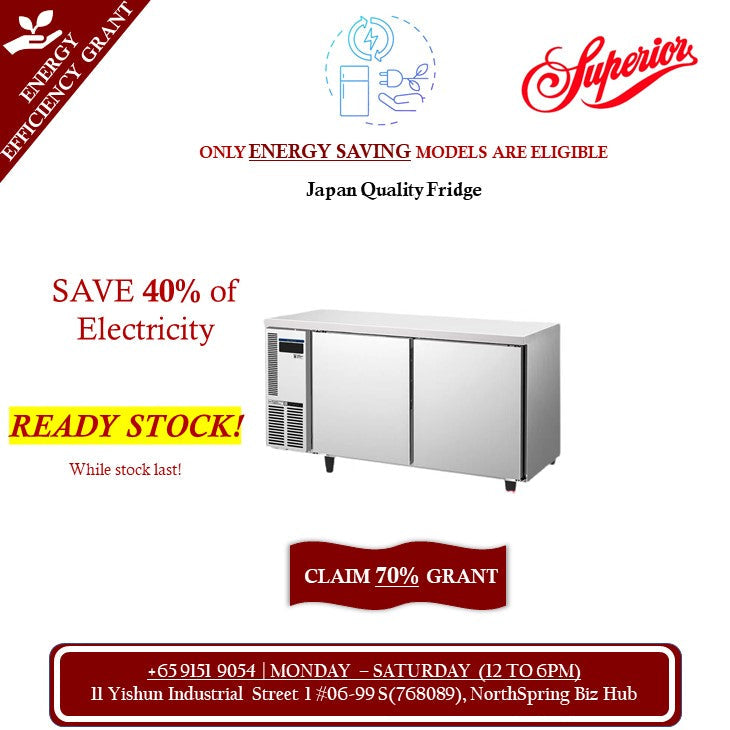
Superiorkitchenequipment works specifically with the food service sector, pairing kitchen equipment knowledge with energy-efficiency guidance. Before committing, ask for spec-sheet kWh figures, compare lifetime running costs across models, and book a showroom visit to see units in person.
What actually moves the needle on freezer running costs
Measure your current kWh use before changing anything. Prioritise maintenance over new equipment, then evaluate replacement only where the payback period is genuinely short. Trial changes in one unit before rolling them out across the kitchen.
— David
Cutting running costs with an inverter freezer upgrade
Older fixed-speed compressors cycle fully on and off, wasting energy every time they restart. Some inverter counter chiller and freezer ranges solve that specific problem by modulating compressor speed to match the actual cooling load, rather than lurching between full power and standby.
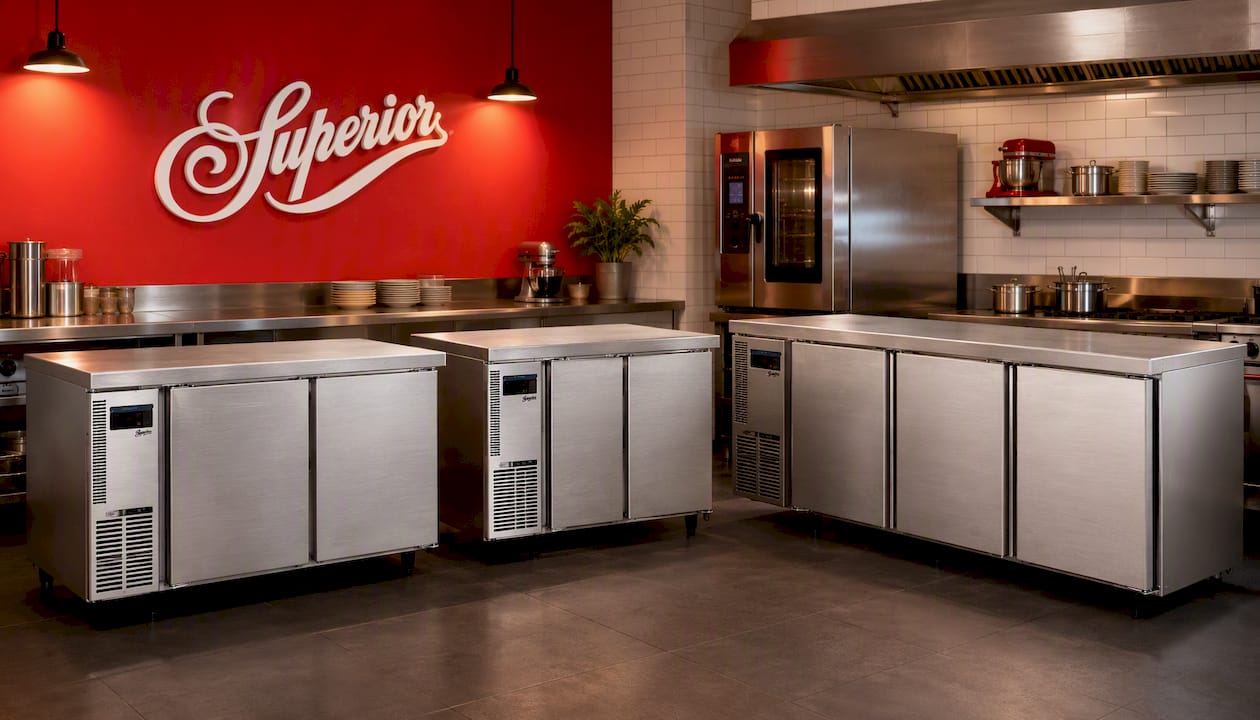
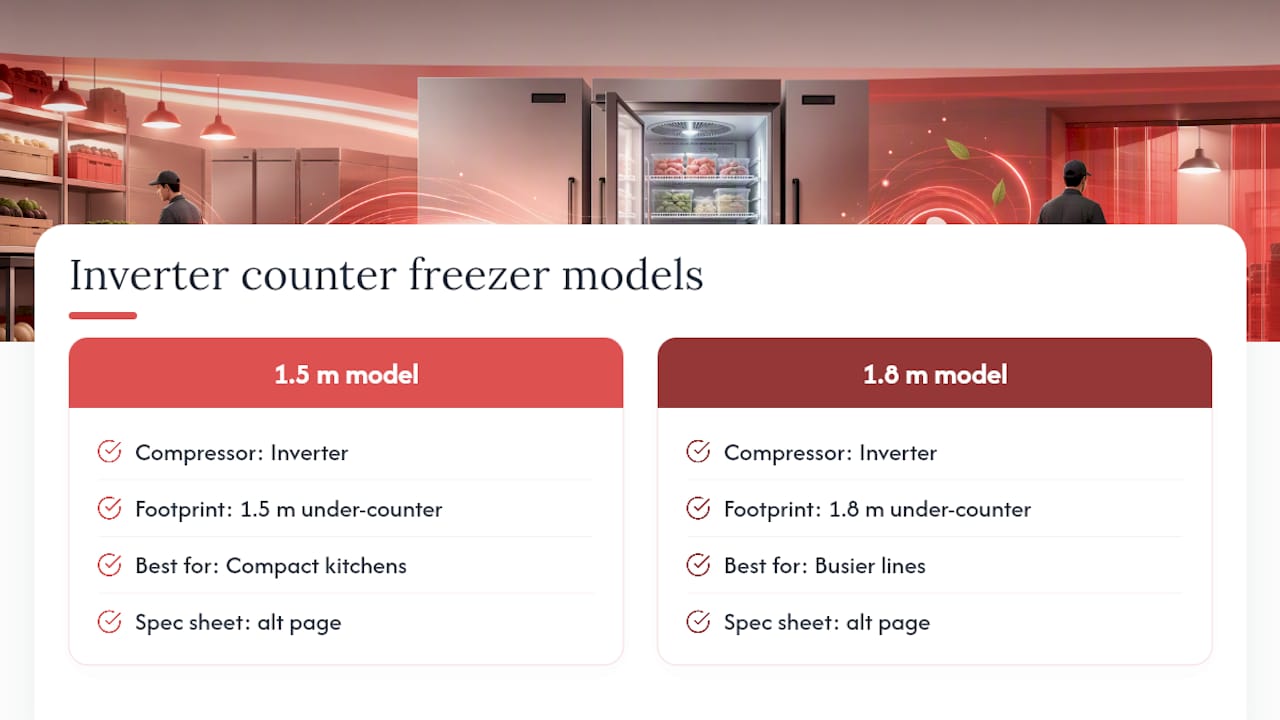
The 1.5m Superior Inverter Counter Chiller / Freezer suits kitchens needing compact under-counter storage without sacrificing efficiency, while the larger 1.8m Superior Inverter Counter Chiller / Freezer fits busier lines needing more capacity in the same footprint. Both are also available via an alternate specification page with full technical details for comparison against your current unit’s kWh figures.
Visiting a showroom allows inspection of build quality and door seals, and staff can provide information about grant eligibility for energy-efficient replacements. Request a spec sheet or a quote for the model that fits your kitchen’s layout before your next equipment budget is set.
Sources
Key references: ENERGY STAR freezer benchmarks, ENERGY STAR commercial guidance, and Virginia Cooperative Extension defrost guidance.
- Virginia Cooperative Extension guidance on refrigeration maintenance
- Refrigerated cabinets – energy rating (Australia)
FAQ
How much electricity does a commercial freezer use?
Most commercial freezers use between 4 and 40+ kWh per day depending on size and type, with chest freezers at the lower end and large walk-ins at the upper end.
How much energy does a freezer use a day?
A small commercial chest freezer typically uses 4–8 kWh a day, while a commercial upright freezer uses roughly 8–15 kWh a day under normal operating conditions.
What is the power consumption of a 200 litre freezer?
A freezer of that size typically falls in the small-to-mid commercial chest or upright category, using somewhere around 4–10 kWh per day depending on insulation, ambient temperature, and door type.
How much does it cost to run a freezer for 24 hours?
Multiply the unit’s daily kWh figure by your electricity tariff; a small upright at 10 kWh/day on a $0.30/kWh tariff costs around $3.00 for 24 hours of operation.