

Most commercial ovens waste the largest share of their electricity while idling, not while cooking. If you tackle idle time first, right-size equipment to your production volume, and keep gaskets and insulation in proper repair, you can cut oven-related energy costs with no capital spend at all. ENERGY STAR and FEMP guidance, along with grant support such as the Energy Efficiency Grant (EEG), can then extend those savings further when you are ready to replace equipment.
TL;DR:
- Most energy costs come from ovens idling at high temperature rather than active cooking, often consuming the majority of total energy usage.
- Commercial ovens with higher efficiency ratings and lower idle energy rates can significantly reduce operating costs, especially when paired with proper maintenance and operational routines.
- Simple operational changes, such as switching ovens to standby outside service hours and batch cooking, can deliver quick energy savings without capital expenditure.
- Upgrading to correctly sized, ENERGY STAR-certified ovens, supported by grants like the EEG, shortens payback periods and maximizes long-term savings.
- Automated controls that include standby setbacks, usage logging, and adaptive recovery further improve efficiency and minimize reliance on staff discipline.
Table of Contents
- How commercial ovens use energy: preheat, cooking and idle
- What metrics and standards actually measure oven efficiency?
- High-return operational tactics to cut oven energy now
- How do you estimate energy use and calculate a simple ROI?
- How supplier choice and grants speed up payback
- Operational training and best practices for staff to reduce energy use
- Can smart controls and automation cut oven energy further?
- Author perspective: what to fix first in a small kitchen
- Get a quote, visit the showroom, check EEG eligibility
- Sources
- FAQ
How commercial ovens use energy: preheat, cooking and idle
An oven’s energy consumption splits into three distinct phases, and understanding each one changes how you troubleshoot a high electricity bill.
- Preheat is the burst of energy needed to bring the chamber to target temperature before service starts.
- Cooking, including recovery, covers active baking or roasting plus the extra energy spent recovering temperature after the door opens or a cold tray goes in.
- Idle is energy consumed simply holding temperature with no food inside, often for hours between services.
Idle time is usually where the money disappears. Field monitoring of high-speed ovens found sites where units were only actively cooking for 8 to 13% of their total on-time, with idling consuming the bulk of total energy draw at some sites. That is not a one-off anomaly. Two kitchens running near-identical ovens can post very different energy profiles purely because one crew switches off or drops to standby between rushes and the other leaves the oven at full temperature all afternoon.
This is why utilisation matters more than raw wattage when you’re diagnosing a bill. An oven rated at a modest 6kW that sits hot for 14 hours a day can easily cost more to run than a larger model that’s switched on for six. Logging actual hours on and the proportion spent actively cooking, even with a basic power meter, tells you far more than the spec sheet ever will.
What metrics and standards actually measure oven efficiency?
Two figures matter more than any brochure claim: cooking energy efficiency and idle energy rate. Cooking energy efficiency measures how much of the energy an oven draws actually goes into the food, versus how much is lost to the surrounding kitchen. Idle energy rate measures how much power the oven pulls per hour just to hold temperature with the door shut and nothing inside.
ENERGY STAR-certified commercial ovens carry defined thresholds for both metrics, and they matter because they translate directly into a running-cost gap you can calculate.
Certified efficiency, quantified: ENERGY STAR certified commercial ovens are on average significantly more energy efficient than standard models, based on published cooking-efficiency and idle-rate thresholds.
A few points worth checking before you sign a purchase order:
- Ask suppliers for the specific idle energy rate figure, not just an “energy-efficient” label.
- Multiply the rated idle draw by your typical idle hours per day to see the annual kWh cost of standby alone.
- Check whether local utility rebates or the EEG apply to the specific model, since certified units are often the ones that qualify.
FEMP acquisition guidance backs this up from the buyer’s side, recommending improved insulation, tighter door gaskets, forced convection and better controls as the features to specify, precisely because lifecycle energy savings in high-use kitchens usually outweigh a higher sticker price within a few years.
High-return operational tactics to cut oven energy now
Before you spend a dollar on new equipment, operational changes can shift your energy bill meaningfully within a single billing cycle. None of these require capital investment, and most take a single staff briefing to implement.
- Set a start-up and shut-down schedule. Map your actual service windows and switch ovens to standby or off outside them rather than leaving them hot “just in case”.
- Batch and load properly. Group similar bake or roast items so you fill racks fully rather than running a half-empty chamber twice.
- Match the appliance to the task. Don’t fire a large deck oven for two portions when a smaller oven or an air fryer handles the job with a fraction of the energy draw.
- Use convection mode where the menu allows it. Convection cuts cook time by roughly 20 to 25%, which lowers both energy draw and recovery losses on many bake and roast items.
- Limit door openings. Every open door dumps heat and forces a recovery cycle; train staff to check through the window or use a timer instead of a visual peek.
- Run a maintenance checklist. Test gasket compression, check door alignment, inspect element surfaces, and deep-clean the chamber on a fixed schedule rather than waiting for a visible fault.
Worn seals are an underestimated cost. Degraded gaskets let heat escape continuously, forcing the oven into more frequent recovery cycles, and guidance from the Department of Energy links poor seals to measurable increases in energy draw. A £15 gasket replacement can quietly outperform far larger investments elsewhere in the kitchen.
Pro Tip: Run a two-week log where whoever opens up in the morning writes down the time the oven goes on and the time it first gets used. You’ll often find 45 minutes to an hour of pure preheat waste that a tighter opening routine eliminates immediately.
How do you estimate energy use and calculate a simple ROI?
You need four inputs to estimate what an oven actually costs to run: its rated power in kW (or BTU/h for gas), the hours it’s switched on each day, the rough percentage of that time spent actively cooking versus idling, and your electricity or gas unit price.
A workable formula looks like this:
Daily energy (kWh) = Rated power (kW) × Hours on × [idle % × idle draw factor + cooking % × full draw factor]
Take a generic example. Multiply that by your unit price and you have a daily running cost you can compare against a replacement model’s rated idle and cooking figures.
Field and lab data modelling high-speed oven upgrades found significant energy savings source against baseline units, with payback around 4.2 years under the study’s specific electricity price and incremental cost assumptions. Real payback varies with your own tariff and usage pattern, but the range gives you a sanity check against any supplier’s savings claim.
- Rated power/BTU output
- Daily hours switched on
- Idle versus active cooking split
- Local unit price for electricity or gas
How supplier choice and grants speed up payback
The supplier specialises in energy-efficient kitchen appliances, and the sizing advice above only pays off if the replacement equipment itself is genuinely efficient. The business has built its catalogue around that gap, stocking ovens like the Commercial Oven 70L, the 3 Tier Full Convection Fan Blower Oven, the Electric Convection Oven, and the Double Deck Oven, each suited to a different production volume rather than a one-size-fits-all deck.
That kind of support changes the ROI maths substantially, particularly for medium-use kitchens where a straight cash purchase might otherwise sit near the margin of worthwhile. A showroom visit lets you compare chamber sizes and control panels side by side before committing, which matters far more for oven purchases than it does for most other kitchen equipment, since the wrong capacity choice is the single biggest driver of ongoing waste.
Operational training and best practices for staff to reduce energy use
Equipment efficiency only shows up on the bill if staff use the equipment efficiently. A brand-new ENERGY STAR oven run on old habits, doors left open, ovens fired an hour before the first order, will underperform a well-managed older unit.
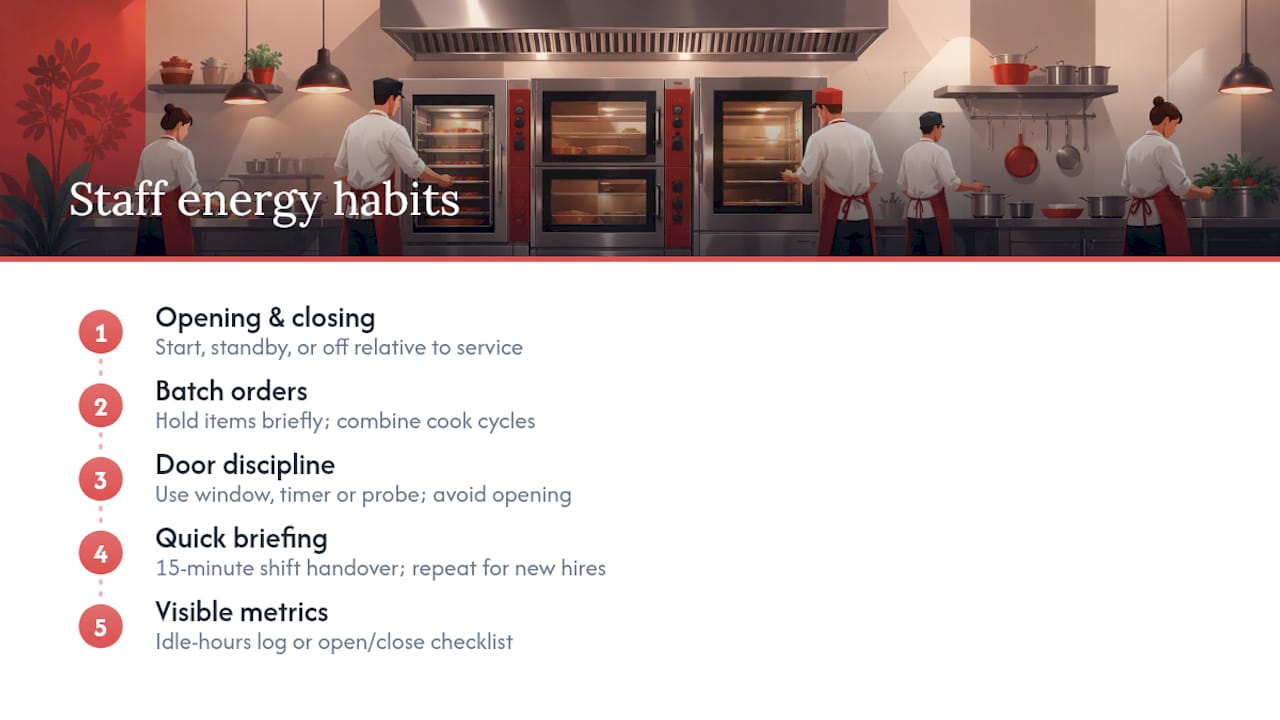
Build a short training routine around three habits. First, teach opening and closing procedures explicitly: which ovens go on at what time relative to first service, and which go to standby or off during a lull rather than staying at full temperature. Second, train staff to batch orders where the menu allows it, holding items briefly rather than running separate cook cycles for each ticket. Third, make door discipline a stated rule, not an assumption. Checking through a window, using a timer, or trusting a probe thermometer beats opening the door to look.
None of this needs a formal course. A fifteen-minute briefing at a shift handover, repeated for new hires, covers it. What makes training stick is pairing it with a visible metric: a printed idle-hours log by the oven, or a simple checklist ticked at open and close, turns an abstract instruction (“don’t leave it on”) into a habit someone can be held to. Kitchens that combine a written start-up and shut-down schedule with door discipline routinely see the energy savings from behaviour changes compound with the savings from any equipment upgrade, rather than one cancelling out the other.
Can smart controls and automation cut oven energy further?
Advanced controls close the gap that human habit alone can’t. Programmable ovens with automatic setback modes drop to a lower holding temperature after a set period of inactivity and return to full temperature ahead of the next scheduled use, which removes the guesswork of manual standby management entirely.
Some models pair this with usage logging, recording actual on time, idle time, and active cooking cycles automatically. That solves the diagnostic problem directly: instead of running a manual two-week log with a clipboard, the oven’s control panel gives you the idle percentage on demand, which is exactly the figure you need for the ROI calculation covered earlier.
Forced convection with automated fan control, adaptive recovery that senses chamber temperature and adjusts element output rather than firing at full power on every recovery cycle, and door-open sensors that pause heating automatically all reduce the reliance on staff remembering to do the right thing every single time. For a kitchen with high staff turnover, that reliability is often worth more than the marginal efficiency gain on paper, because it protects savings against the inevitable gaps in training compliance. When you’re comparing models, ask specifically whether standby setback and usage logging are built in, rather than assuming any oven labelled “smart” includes them.
Author perspective: what to fix first in a small kitchen
Most efficiency guides jump straight to buying new equipment. That’s backwards. Fix operating routines first, tackling idle time costs nothing and often delivers the biggest single reduction on the bill. Maintenance comes second: gaskets, door alignment, and a proper clean are cheap and fast. Equipment upgrades, ideally with grant support, come third, once you’ve confirmed routines and maintenance alone haven’t already solved the problem.
Staff training gets underrated because it looks too simple to matter. It’s usually the highest-return fifteen minutes you’ll spend this month.
— David
Get a quote, visit the showroom, check EEG eligibility
Cutting idle time and tightening maintenance will take you a long way, but the biggest single jump in efficiency usually comes from replacing an ageing, oversized oven with a correctly sized, certified model, and that’s where Superiorkitchenequipment fits into the plan you’ve just built. The Energy Efficiency Grant (EEG) can offset a substantial share of the equipment cost, which shortens the payback period on exactly the kind of upgrade this article has walked through.
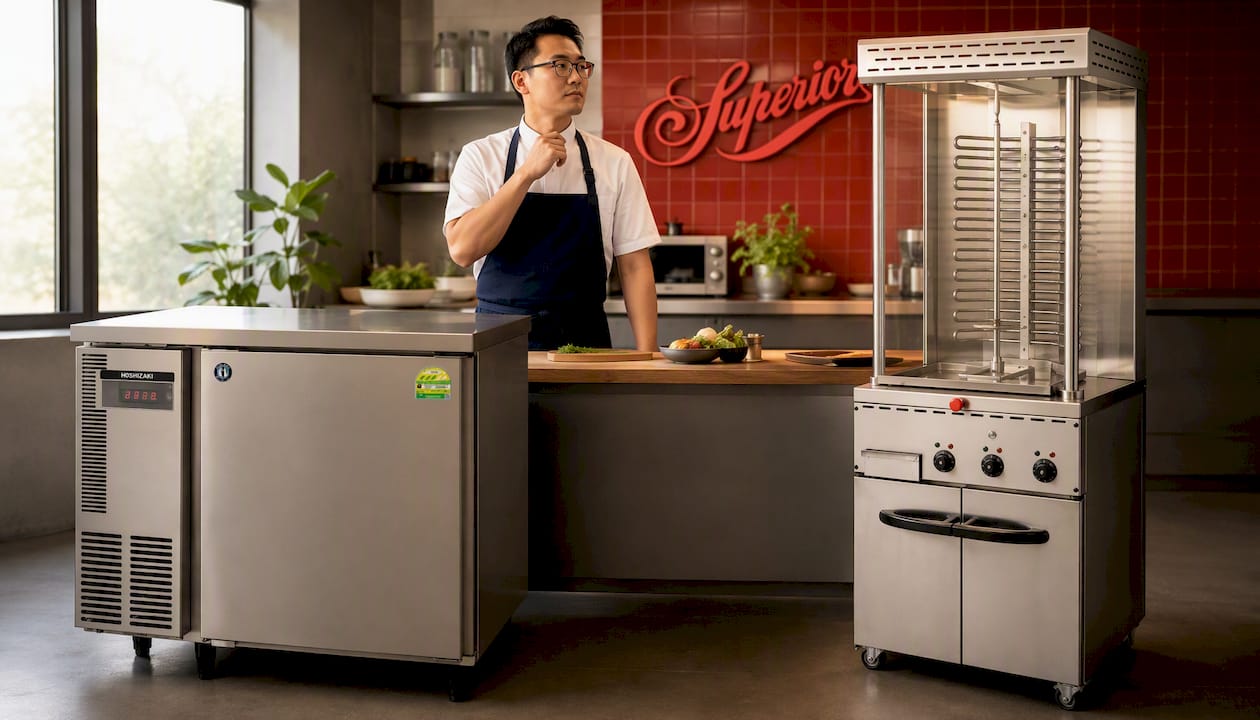
A showroom visit is the fastest way to match oven capacity to your real production volume rather than guessing from a spec sheet, and the same visit lets you look at complementary equipment while you’re there, from a 0.9m Hoshizaki Counter Chiller for cold storage efficiency to a Standing Electric Kebab Machine if your menu calls for it. Bring your current oven’s rated power and your typical service hours, and assistance can be provided to check EEG eligibility and prepare a quotation.
Sources
- Purchasing Energy-Efficient Commercial Ovens | Department of Energy
- ET24SWE0057_High-Speed Oven Energy Use Field Monitoring for the Commercial Foodservice Industry_Final Report
FAQ
What causes the highest commercial oven energy consumption?
Idle time is usually the biggest driver. Field monitoring found ovens actively cooking for as little as 8 to 13% of on-time, with idling consuming most of the energy at monitored sites.
How much more efficient are ENERGY STAR ovens?
ENERGY STAR certified commercial ovens are on average significantly more energy efficient than standard models, based on defined cooking-efficiency and idle-rate thresholds.
Does oven size affect energy costs even when it’s not in use?
Yes. An oversized oven still draws idle power to hold temperature across its full chamber, so FEMP guidance recommends matching capacity to actual production volume rather than buying for peak-day headroom.
Can grants reduce the cost of upgrading to an efficient oven?
The Energy Efficiency Grant (EEG) can cover a large portion of equipment cost, which often makes an upgrade cost-effective even for kitchens with moderate usage rather than only high-volume operations.
Does convection mode really save meaningful energy?
Convection typically cuts cook time by 20 to 25%, which reduces both active cooking energy and the number of recovery cycles needed after door openings.