

The most effective way to protect stock, cut energy waste, and avoid emergency callouts is to run a preventive maintenance programme organised strictly by task frequency, from daily operator checks through to an annual technician overhaul. Start today with two things: a daily temperature log and a visual gasket check on every unit. Add condenser coil cleaning, door seal inspection, and alarm verification as your first-week priorities, then build outward from there. The full daily-to-annual checklist below, with the exact fields each line needs, gives you the structure to make that programme audit-ready.
TL;DR:
- Daily checks should include temperature logging and gasket inspection to catch issues early before they lead to compressor failures.
- Monthly coil cleaning and drain pan maintenance are critical for preventing system overwork and odor problems.
- Using equipment with easy access to coils and standard parts can significantly reduce maintenance time and costs.
- Schedule inspections based on run-hours rather than calendar dates, especially for highly used units, to optimize maintenance intervals.
- For any refrigerant leaks, electrical faults, or extended temperature excursions, escalate directly to a technician instead of troubleshooting alone.
Table of Contents
- Building your commercial refrigeration maintenance checklist by frequency
- How do walk-ins, reach-ins, and ice machines differ?
- When should you call a technician instead of troubleshooting yourself?
- Setting frequencies and keeping records that survive an audit
- Why serviceable design matters as much as the checklist itself
- What a maintenance shift actually looks like
- Choosing equipment that makes maintenance easier
- Sources
- FAQ
Building your commercial refrigeration maintenance checklist by frequency
A workable commercial refrigeration maintenance checklist does not treat every task the same way. Daily jobs belong to whoever opens the kitchen or store; monthly and above should sit with a qualified technician. That split matters because a preventive maintenance programme reduces unexpected downtime and extends equipment life precisely because someone catches the small problems before they become compressor failures.
Every line on your checklist should carry six fields: asset, task, frequency, spec or tolerance, safety step, and sign-off with a timestamp. Skip any of these and the record becomes useless the moment an auditor, insurer, or food-safety inspector asks for evidence.
1. Daily (operator level)
- Record display and product temperature against setpoint; flag anything outside ±2°C.
- Visually inspect door gaskets for gaps, tears, or frost build-up along the seal.
- Check for standing water, unusual noise, or refrigerant odour near the unit.
- Confirm alarm systems are active and not in a silenced or fault state.
- Sign off the log with initials and time, even when everything reads normal.
2. Weekly (operator or lead hand)
- Wipe down the condenser air intake to remove loose dust and lint.
- Clear condensate and defrost drains of debris to prevent backup.
- Inspect gaskets more closely for compression loss; a gasket that no longer seals properly needs replacing soon.
- Check air filters on units fitted with them and clean or swap as needed.
3. Monthly (technician)
- Clean condenser and evaporator coils properly, not just the visible dust. Core PM tasks centre on this exact job because fouled coils are the single biggest driver of compressor overwork.
- Verify the defrost cycle starts, runs, and terminates on schedule, and inspect the defrost heater for scorching or corrosion.
- Inspect and tighten electrical connections at the control board and compressor terminal, following lockout/tagout (LOTO) before opening any panel.
- Clean drain pans; a monthly cadence is the minimum to avoid ice build-up, clogging, and odour.
4. Quarterly (technician)
- Perform leak detection on all refrigerant lines and fittings using an electronic sniffer.
- Measure superheat and subcooling where the system design allows, and compare against OEM spec.
- Run a thermographic scan on electrical panels to catch loose connections before they arc.
- Check safety devices: high and low pressure cutouts, pressure relief valves, and any interlock switches.
5. Annual (technician or contracted service)
- Service compressor and fan motors, including bearing lubrication where fitted.
- Calibrate thermostats and temperature sensors against a certified reference thermometer.
- Replace wear items proactively: gaskets nearing end of life, worn fan blades, ageing contactors.
- Issue a safety certification or completion report if your local food-safety regulator requires one.
Pro Tip: Batch your weekly and monthly tasks by zone rather than by unit. A technician who cleans every coil on the cook line in one pass, instead of returning three times, saves labour hours and reduces the number of times panels get opened, which lowers the risk of a loose screw or forgotten cover.
How do walk-ins, reach-ins, and ice machines differ?
The frequency schedule above is the backbone, but each asset type fails in its own way, and the checklist has to flex to catch it.
- Walk-in coolers and freezers: check the vapour seal around door frames and panel joints monthly; a compromised seal lets humid air in and forces the compressor to run far longer than the design intends. Inspect panel insulation for signs of moisture, verify door heater strips are warm to the touch in winter months, and test the emergency interior alarm and man-trap release on every walk-in, since these are life-safety items, not optional extras.
- Reach-in units and display cases: overloading shelves blocks the air curtain and creates warm spots even when the compressor is healthy. Check that stock sits below the load line marked inside the cabinet, inspect the gasket bead for a continuous, unbroken seal, and confirm the internal fan is distributing air evenly rather than short-cycling near the evaporator.
- Condensers, including remote or rooftop units: outdoor coils collect leaves, pollen, and grease-laden exhaust from nearby kitchen extraction. Inspect fin condition for bent or corroded sections, check fan blades for cracks or imbalance, and confirm the condenser fan motor starts cleanly without hesitation.
- Ice machines: replace water filters on the schedule the manufacturer sets, since scale build-up on the evaporator plate is one of the fastest ways to cut ice production in half. Run the sanitisation cycle at the interval specified for your model, manage scale with a descaling solution suited to your local water hardness, and verify the harvest cycle completes fully rather than leaving partial cubes stuck in the mould.
Cold stores carry an extra layer most kitchens overlook: the insulated envelope itself needs the same discipline as the machinery. Panel seals, vapour barriers, and structural insulation degrade quietly, and a neglected seal can cost more in wasted refrigeration capacity than a failed compressor.
When should you call a technician instead of troubleshooting yourself?
Not every warning sign needs an emergency callout, but waiting too long on the wrong sign can cost you an entire chiller of stock. Work through this quick sequence before you pick up the phone.
- Confirm the basics first. Check the setpoint hasn’t drifted, the unit has power, and the door was not left open during a delivery.
- Check your temperature log. If the excursion has lasted under 30 minutes and stock hasn’t crossed the danger zone, monitor and recheck rather than moving product immediately.
- Move perishable stock to a backup unit if the excursion is sustained or you cannot identify the cause within a few minutes.
- Escalate immediately for any of these: a temperature excursion lasting more than an hour, a suspected refrigerant leak (oily residue, hissing, or a sweet chemical smell), a burning electrical odour, or a tripped high/low pressure cutout that won’t reset.
- Note excessive frost or condensation on evaporator coils or door frames; both point to a failing door seal or defrost heater rather than a compressor fault, and a technician needs that context before arriving.
CO₂ systems deserve their own caution here. Because they operate at far higher pressures than standard HFC systems, any suspected leak or unusual noise from a CO₂ unit should escalate straight to a technician rather than a hands-on check.
Setting frequencies and keeping records that survive an audit
Start with the OEM manual’s recommended interval for each asset, then adjust based on run-hours rather than the calendar. A freezer running near-continuously in a busy cookline should be serviced more often than a lightly used backup unit on the same schedule, even if both left the factory with identical specs. Give yourself a 10% window either side of the due date; scheduling every task to the exact day creates a maintenance calendar nobody can realistically hit.
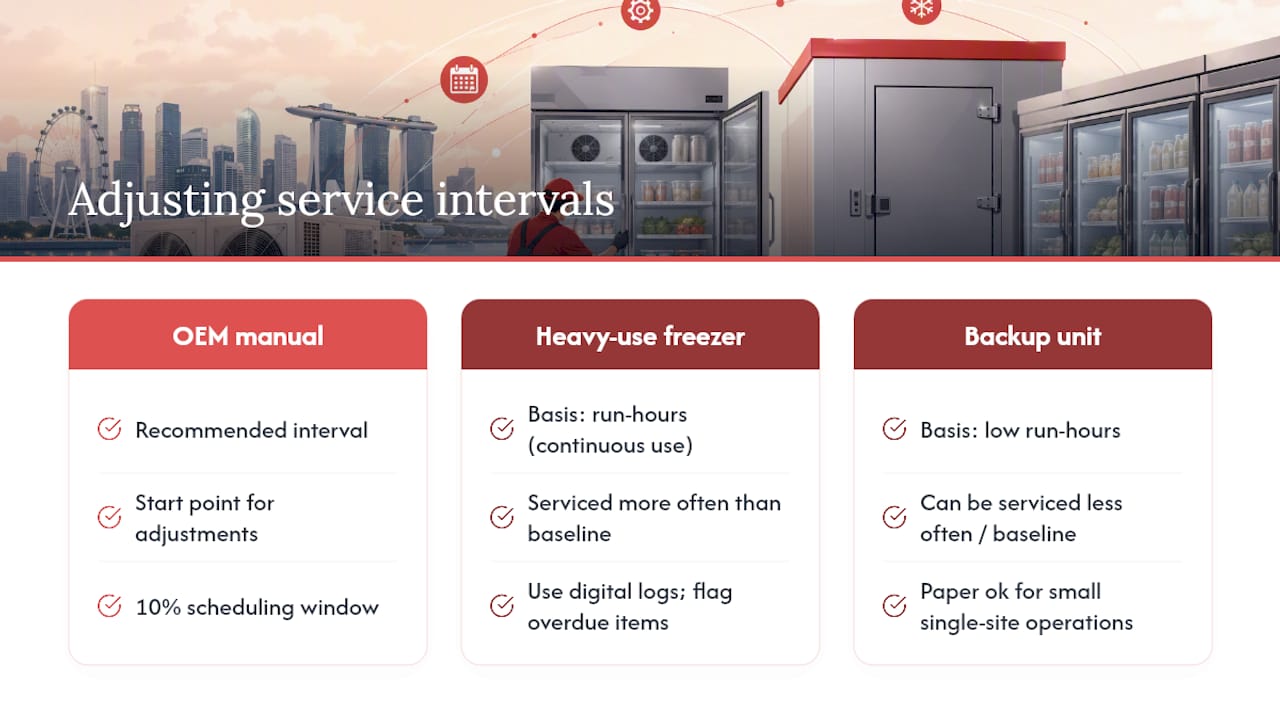
Your checklist line template stays consistent across every asset: asset | task | frequency | spec/tolerance | safety step | parts/tools | sign-off | timestamp. Paper logs work for small single-site operations but get unwieldy fast once you’re tracking multiple units; a simple spreadsheet or entry-level maintenance software cuts the time spent hunting for missed tasks and flags overdue items automatically.
Pro Tip: If you’re migrating from paper to digital, run both in parallel for one full month before retiring the paper log. It catches the data-entry habits that break a new system before they become permanent.
Retention rules vary by jurisdiction, so check your local food-safety regulator’s requirement for how long temperature logs and PM sign-offs must be kept on file, and default to keeping them longer rather than shorter when in doubt.
Why serviceable design matters as much as the checklist itself
Author: David, Superior Kitchen Equipment
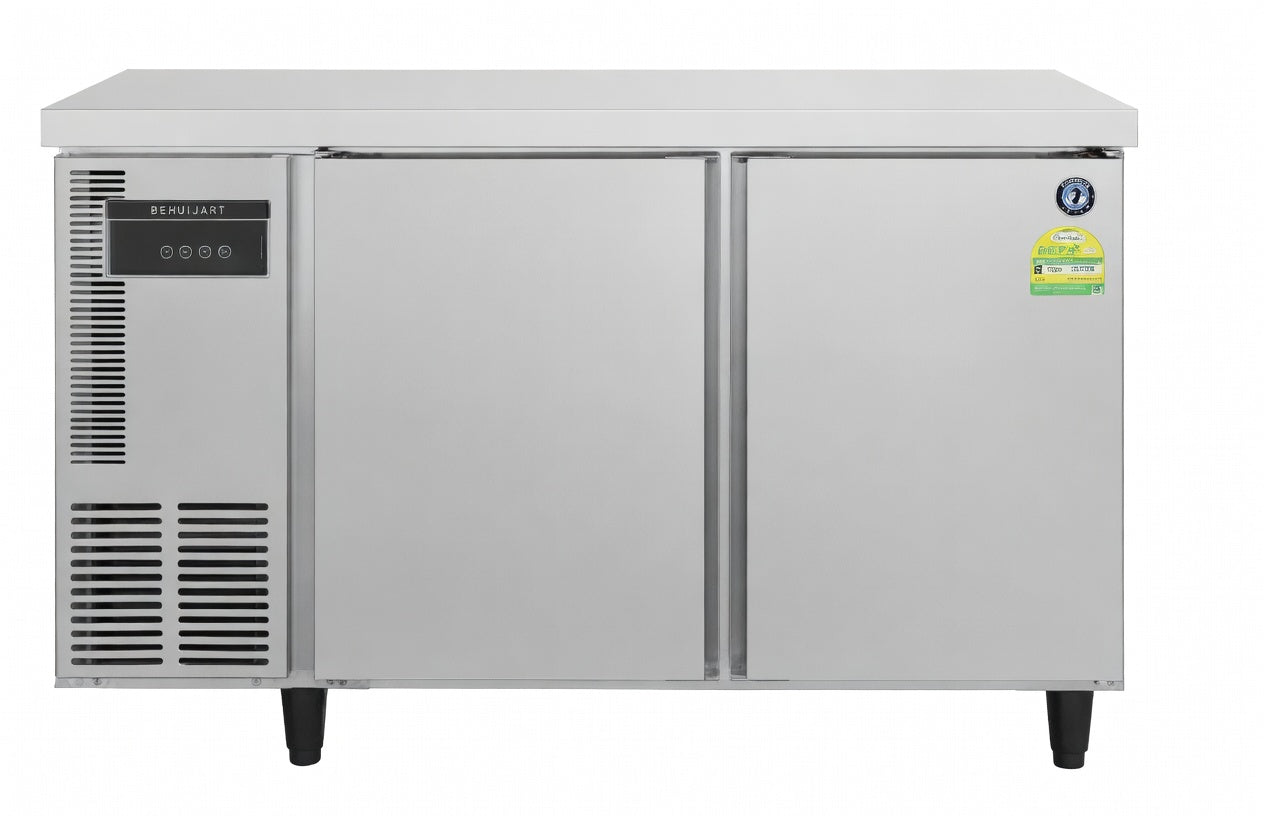
A checklist only works as well as the equipment lets it. Coil access, modular parts, and standard gasket sizes cut a monthly clean from an hour to fifteen minutes and turn a gasket swap into a five-minute job instead of a special order. Some providers stock energy-efficient, serviceable models specifically because lower maintenance time compounds: fewer callouts, fewer compressor hours, and less stress on parts that would otherwise wear out early. When a unit’s repair cost approaches half its replacement value, or breakdowns are recurring rather than incidental, moving to a more efficient model usually pays for the maintenance overhead it removes.
What a maintenance shift actually looks like
A start-of-shift routine takes five minutes: check the log, scan door seals, note anything unusual for the next shift. A monthly coil clean runs longer: stage parts and tools, apply lockout/tagout, complete the task, then sign off with a timestamp before the panel goes back on. That handover discipline is what separates a checklist that gets used from one that gathers dust in a drawer.
— David
Choosing equipment that makes maintenance easier
There are other routes to lowering your maintenance burden, from tightening your existing PM schedule to renegotiating service contracts. But the fastest structural fix is often the unit itself. A showroom lets you inspect coil access, gasket design, and serviceability in person before you commit, rather than guessing from a spec sheet.

If your current counter units are driving repeat callouts, look at the 1.5m Hoshizaki Counter Chiller (75cm) as a direct swap with easier coil access than older models. For freezer capacity on the same footprint, the 1.8m Hoshizaki Counter Freezer (75cm) fits the same maintenance rhythm without adding a second unit to your schedule. And where you need chiller volume across a longer counter run, the 1.8m Hoshizaki Counter Chiller (75cm) is built around the same energy-efficient, serviceable design philosophy. Many businesses can also claim grants covering a portion of the original cost when upgrading to energy-efficient models. These savings are alongside electricity savings over the unit’s lifespan. Visit the showroom or browse the full product range to compare coil access and gasket sizing before your next PM cycle is due.
Sources
For deeper technical reference, consult the preventive maintenance checklist template for the six-field line structure, and the Parts Town maintenance guide for detailed coil-cleaning technique and cadence.
- Preventive Maintenance Checklist (Free Template + Examples)
- Commercial Refrigeration Maintenance Tips | Parts Town
- Maintenance of refrigeration equipment
FAQ
What are the core elements of a maintenance checklist line?
Each line should record the asset, the task, its frequency, the spec or tolerance to check against, the required safety step, and a sign-off with a timestamp.
What should a commercial refrigerator maintenance checklist include?
It should cover coil cleaning, gasket and door seal inspection, drain pan clearing, temperature logging, electrical connection checks, and periodic leak detection, organised by how often each task needs doing.
What does scheduled maintenance typically check?
Scheduled maintenance typically checks temperature accuracy, coil cleanliness, gasket condition, defrost cycle timing, and electrical connection integrity, since these five areas account for most preventable breakdowns.
How often should commercial refrigeration be serviced?
Daily checks belong to operators, weekly light cleaning can be handled in-house, and monthly, quarterly, and annual tasks should go to a qualified technician, with the exact interval adjusted for the unit’s run-hours rather than the calendar alone.
Can Superior Kitchen Equipment help reduce maintenance overhead?
Superior Kitchen Equipment’s range focuses on energy-efficient, serviceable units with accessible coils and standard gasket sizes, which shortens routine maintenance time compared with harder-to-service older equipment.