

Gas fryers suit high-volume kitchens with existing gas lines and hoods, where fast recovery on frozen product matters most. Electric fryers suit precision-driven menus, smaller footprints, and sites without gas infrastructure. The decision comes down to three factors: recovery speed against your throughput, installation and whole-life cost, and menu fit. Some suppliers stock electric options for operators who land on that side of the decision.
TL;DR:
- Gas fryers recover faster, typically in 60 to 90 seconds, making them more suitable for high-volume kitchens with back-to-back frozen batches.
- Electric fryers take about 2 to 3 minutes to recover, which may impact throughput during busy periods, especially when frying large quantities.
- Running costs depend on utility rates and model efficiency; gas may be cheaper in low-cost gas markets, but electric models with ENERGY STAR ratings can be more economical overall.
- Installation costs vary significantly, with gas needing dedicated piping and ventilation, while electric units may require electrical upgrades, especially for high-kW models.
- Both fuel types have safety considerations; gas leaks pose fire risks, and electric units can have shock hazards, so proper staff training and safety systems are essential.
Table of Contents
- Gas vs electric fryer: how each transfers heat to the oil
- How fast do gas and electric fryers recover between loads?
- Which fryer costs less to run: gas or electric?
- What installation and maintenance costs should you plan for?
- Which fryer suits your menu and throughput?
- Which electric fryers suit electric-first kitchens?
- Is a gas or electric fryer safer to run?
- How does fuel choice affect kitchen layout and space?
- Which fryer has a smaller environmental footprint?
- Which fryer lasts longer under commercial use?
- How much noise does each fryer type add to service?
- What happens to your fryer during a power or gas outage?
- Menu fit beats fuel loyalty
- See Superior Kitchen Equipment’s electric fryer range
- Sources
Gas vs electric fryer: how each transfers heat to the oil
The mechanical difference explains almost every performance gap between the two fuel types. Gas fryers heat oil using external burners or tubes positioned beneath or within the vat, transferring heat through metal surfaces before it ever reaches the fat. Electric fryers use elements immersed directly in the oil, so the heat source and the cooking medium are in constant contact.
That direct contact is why electric units often deliver tighter, more even temperature control, particularly useful for delicate items where colour consistency counts. Gas burners create more localised hot spots near the tubes, which is efficient for volume but can complicate temperature uniformity across a full vat.
Fryer styles worth knowing before you compare specs:
- Open-pot fryers — simple, wide vat, good for varied menus, available in both fuels.
- Tube-style gas fryers — burner tubes submerged in oil, built for fast recovery on frozen product.
- Ribbon-element electric fryers — a coiled element creates a cold zone below it, trapping sediment away from the cooking area.
- Pressure fryers — sealed cooking chamber, mostly electric, used for bone-in chicken.
- Ventless electric fryers — self-contained filtration, designed for sites without a Type I hood.
Spec sheets typically list gas burners at 80,000 to 150,000 BTU and electric elements at 12 to 22 kW. Those numbers only mean something once you match them against recovery time and your menu, which is where the next section matters.
How fast do gas and electric fryers recover between loads?
Recovery time, not raw output, is what separates a fryer that keeps pace during a Friday rush from one that buckles under it. Gas fryers rated at 80,000 to 150,000 BTU commonly recover in 60 to 90 seconds, while electric fryers running 12 to 22 kW typically take around two to three minutes to return to set temperature under a comparable load.
Statistic: Gas fryers rated 80,000 to 150,000 BTU recover in roughly 60 to 90 seconds; electric fryers at 12 to 22 kW take about 2 to 3 minutes under similar loads.
That gap barely registers for a café doing light lunchtime volume. It becomes decisive the moment you’re dropping basket after basket of frozen fries during a lunch rush, where every extra minute of recovery means oil temperature drifts, batches turn out pale or greasy, and ticket times slip.
A few scenarios where recovery drives the decision:
- A fish and chip shop running back-to-back frozen batches leans towards gas for sustained throughput.
- A bakery-café frying occasional doughnuts or churros in small batches rarely notices the electric recovery gap.
- A fried chicken concept doing continuous hand-breaded orders benefits more from steady temperature than raw recovery speed.
Element geometry also shapes oil life. Tube-style gas fryers prioritise recovery but make sediment harder to clear from around the tubes. Ribbon-element electric fryers create a cold zone beneath the coil that traps crumbs and breading debris away from the main cooking zone, which tends to extend oil life on hand-breaded menus.
Which fryer costs less to run: gas or electric?
Cost comparisons that stop at the price tag miss where the real savings or losses happen: at the oil vat itself. Electric fryers generally transfer a higher share of input energy directly into the oil, since the element sits inside the fat. Gas fryers lose more heat to the surrounding kitchen air as it passes from burner to metal to oil, which is part of why gas equipment runs hotter ambient temperatures nearby.
Whether that efficiency gap translates into lower bills depends entirely on your local utility rates. Electric’s higher vat efficiency can still lose out to gas on a pure running-cost basis in a market where gas prices are low relative to electricity, so the fuel-efficient option on paper isn’t always the cheaper one on your utility bill.
Run this checklist before assuming either fuel wins on cost:
- Vat efficiency rating for the specific model, not a generic fuel-type average.
- Your actual kWh rate and gas tariff, not a national average.
- Idle energy loss during slow periods, since some designs waste more heat holding temperature than others.
- Ventilation and air-conditioning load, since gas’s ambient heat output adds to cooling costs.
- Ongoing maintenance and part-replacement costs for burners versus elements.
Certification matters more than most buyers expect. Models carrying ENERGY STAR or equivalent ratings are built to cut idle and heavy-load energy waste regardless of fuel type, so a certified gas unit can outperform an uncertified electric one on running costs, and vice versa.
Pro Tip: Ask any supplier for the fryer’s idle energy draw, not just its recovery time. A unit that sips power while sitting at temperature between rushes often saves more over a year than one with a faster recovery spec.
What installation and maintenance costs should you plan for?
Whole-life cost hides in the installation and compliance line items that buyers routinely underestimate before a quote arrives.
- Gas installations need a dedicated gas line, a Type I extraction hood, and often an interlock system that shuts gas flow if ventilation fails. High-output burners raise ventilation and air-conditioning demand, which increases both install cost and ongoing energy use, sometimes eroding the fuel-price advantage gas normally holds.
- Electric installations need sufficient electrical panel capacity and dedicated circuits. Higher-kW units, especially 18 kW and above, often require three-phase power, and older buildings may need a costly panel upgrade before a new electric fryer can even be wired in.
- Switching fuel types during a refit is rarely a minor job. Moving from electric to gas or the reverse commonly means new gas piping and hood work, or a full electrical upgrade, which can dominate the total project budget far more than the fryer’s purchase price.
- Maintenance patterns differ by fuel. Gas burners and tubes accumulate carbon deposits that need periodic cleaning to maintain efficiency. Many electric designs use removable elements that lift out for easier cleanout, though this varies by model.
- Service network access matters as much as the machine. A fryer that breaks down on a Saturday night needs a technician who knows the specific burner or element design, so check local service coverage before committing to either fuel.
Which fryer suits your menu and throughput?
Menu and volume should decide your fryer choice before fuel preference ever enters the conversation. Daily throughput gives you a reliable starting filter, and the thresholds are fairly consistent across kitchens.
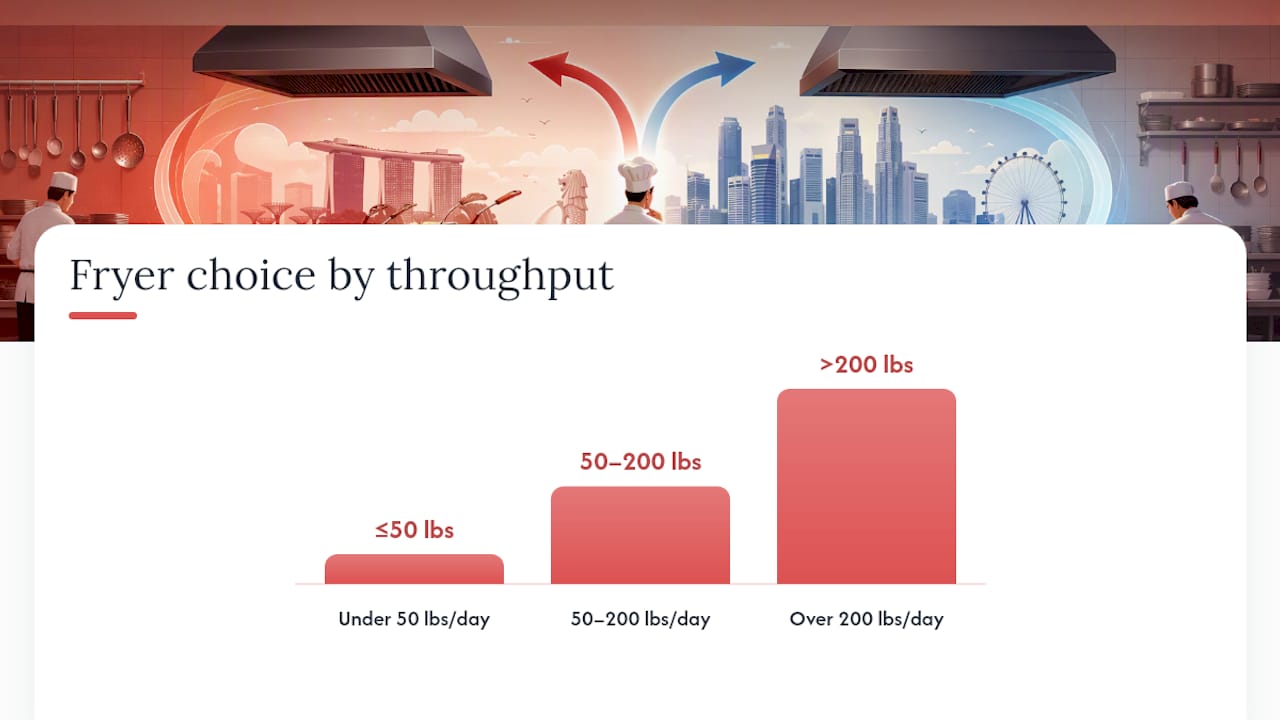
Below roughly 50 lbs of product a day, almost any well-specified fryer, gas or electric, keeps up comfortably. Between 50 and 200 lbs a day, recovery time starts to matter, and the choice narrows depending on whether your menu is frozen product or hand-breaded items. Above 200 lbs a day, sustained throughput generally demands a tube-style gas fryer or a pressure fryer built for continuous high-volume cycling.
Matching fryer family to menu type in practice:
- Tube-style gas fryers suit high-volume frozen product such as fries, onion rings, and mozzarella sticks, where recovery speed under constant basket drops is the priority.
- Ribbon-element electric fryers suit hand-breaded menus like chicken tenders or fish fillets, since the cold zone beneath the element traps breading sediment and extends oil life rather than letting debris scorch on exposed burner tubes.
- Pressure fryers suit bone-in chicken programmes, sealing moisture in while cooking faster than open-vat frying.
- Ventless electric fryers suit sites without a Type I hood, common in food halls, ghost kitchens, and retrofitted spaces where extraction work isn’t feasible.
- Open-pot fryers, available in either fuel, suit varied menus that don’t lean heavily on one product category.
Sediment handling affects your margins more than most buyers realise going in. A wrong pairing of burner geometry to menu type can accelerate oil breakdown, and oil replacement costs, compounded weekly, often outweigh whatever you saved on the fryer’s fuel price. It’s also worth knowing that taste differences between gas and electric frying are minimal; where kitchens notice a gap, it’s usually in appearance and texture rather than flavour, and oil condition tends to matter more than fuel type either way.
Which electric fryers suit electric-first kitchens?
Operators who land on electric after weighing recovery, installation, and menu fit have a genuine range to choose from, not a compromise. Some electric deep fryers suit operations that need double-vat capacity without a gas connection, positioned as direct electric alternatives to high-throughput gas units for kitchens splitting fried menu items across two oils.
For kitchens exploring induction-based cooking alongside or instead of traditional frying, the Standing Induction Cooker and Heavy Duty Kwali Induction offer high-heat electric cooking suited to wok-style and heavy-duty frying applications where a dedicated deep fryer isn’t the only tool needed.
Take this checklist to any showroom visit or spec consultation:
- Confirm the kW rating against your existing circuit capacity, not just your ideal output.
- Ask whether your panel supports single-phase or needs a three-phase upgrade.
- Estimate daily throughput honestly, using the volume bands above as a guide.
- Check warranty length and local service network coverage before signing.
- Request the specific grant eligibility paperwork relevant to your business type.
Pro Tip: Bring your electrical panel schedule to the showroom. A quick photo of your panel’s spare capacity saves a return visit and speeds up an accurate quote.
Is a gas or electric fryer safer to run?
Both fuels carry distinct hazards, and neither is inherently safer across every category. Gas fryers introduce the risk of gas leaks, which can occur at line connections, valves, or ageing flexible hoses, and a leak near an open flame or ignition source is a serious fire hazard. Interlock systems that cut gas flow if extraction fails reduce this risk but don’t eliminate the need for regular line inspection and staff training on gas shutoff procedures.
Electric fryers remove the leak risk entirely but introduce electrical hazards instead. Immersed heating elements operating near oil and water create shock risk if wiring, seals, or element casings degrade, particularly in wet-floor kitchen environments where spills are routine. Circuits carrying 18 kW or more need proper earthing and regular electrical safety checks, since a fault at that current level is far from trivial.
Oil-related hazards apply equally to both. Overheating, whether from a stuck gas valve or a faulty electric thermostat, can push oil past its flash point regardless of fuel source. Both fuel types need working high-limit safety switches that cut power or gas flow if the oil overheats, and neither should run without one functioning correctly.
Staff training matters more than fuel choice here. A kitchen team that knows how to spot a gas smell, check an element for exposed wiring, and respond to an oil fire correctly will run either fryer type more safely than an untrained team running the “safer” option on paper. Fire suppression systems rated for oil fires are non-negotiable for either fuel.
How does fuel choice affect kitchen layout and space?
Fryer choice shapes your kitchen layout more than most equipment decisions, mainly through what each fuel type demands around it rather than the footprint of the fryer itself.
Gas fryers need clearance for gas line routing, typically along a wall or floor path back to the meter, plus the ducting and extraction canopy that a Type I hood requires above the cooking line. That hood often needs to be wider and more powerful than an equivalent electric setup, which eats into ceiling height and can force compromises in an already tight kitchen.
Electric fryers, particularly ventless models, offer more layout flexibility. Without the need for extraction ducting to the outside, a ventless electric fryer can sit in a corner, on an island, or in a spot a gas unit could never occupy without expensive structural hood work. This matters most in retrofitted spaces, food halls, and ghost kitchens where cutting new ductwork through a ceiling or wall isn’t practical.
Floor space around the fryer itself differs less than people expect; most open-pot and tube-style units, gas or electric, occupy a similar footprint. The layout cost shows up above and behind the unit, in ventilation runs and electrical conduit, not beside it. If you’re fitting equipment into an existing line rather than designing from scratch, measure the hood and gas or electrical service points before the fryer itself, since those fixed elements usually decide what will and won’t fit.
Which fryer has a smaller environmental footprint?
Emissions comparisons between gas and electric fryers depend heavily on where your electricity comes from, which makes this a harder call than it first appears. Gas fryers burn fuel directly at the point of use, producing combustion emissions and consuming natural gas, a fossil fuel, continuously during operation.
Electric fryers produce no direct emissions in the kitchen, but their environmental impact shifts to the electricity grid supplying them. A kitchen drawing power from a grid weighted towards renewable or nuclear generation gets a genuinely low-emission fryer. A kitchen on a grid still dominated by coal or gas-fired power stations is effectively running an indirect fossil-fuel fryer, just with the emissions relocated to a power station rather than the kitchen itself.
Beyond direct emissions, gas’s higher ambient heat output indirectly increases environmental load by pushing up air-conditioning demand to keep the kitchen comfortable, adding electricity consumption on top of the gas already burned. Electric fryers avoid that compounding effect since immersed elements lose less heat to the surrounding room.
Idle energy efficiency plays into this too. Certified models built to reduce heavy-load and idle energy waste lower the environmental footprint of either fuel type over the equipment’s lifetime, which means the fuel choice alone doesn’t settle the environmental question, the specific model’s efficiency rating does. For operators weighing sustainability alongside cost, checking a model’s efficiency certification is a more reliable signal than fuel type in isolation.
Which fryer lasts longer under commercial use?
Lifespan differences between gas and electric fryers come down to how many moving or heat-exposed parts each design carries, and how those parts age under daily commercial abuse.
Gas fryers rely on burner tubes and ignition components that sit directly in the path of carbonisation and grease buildup. Without regular cleaning, carbon deposits reduce burner efficiency over time and can shorten the working life of tubes that eventually need replacement. Well-maintained gas fryers in busy kitchens commonly run for many years, but the maintenance burden to get there is real and ongoing.
Electric fryers use immersed heating elements that, in many designs, lift out for cleaning, reducing the carbonisation problem gas tubes face. Element failure tends to happen more predictably, gradual power loss or complete failure, rather than the slow efficiency decline seen in dirty gas burners. Because elements are typically a straightforward swap part, downtime for an electric fryer repair is often shorter than sourcing and fitting replacement gas components.
Neither fuel type has a decisively longer average service life; the deciding factor tends to be cleaning discipline and service access rather than the fuel itself. A gas fryer cleaned on schedule and an electric fryer with accessible elements can both run for years without major failure. The kitchens that see fryers fail early are usually the ones skipping routine maintenance, regardless of which fuel powers the unit.
How much noise does each fryer type add to service?
Noise rarely tops anyone’s fryer specification sheet, yet it shapes how comfortable a kitchen feels to work in during a long service, and the two fuel types differ here in ways worth knowing before you buy.
Gas fryers produce burner noise, a low combustion hum that varies with burner output, plus the noise from the extraction fan needed to handle the ambient heat and combustion byproducts. Higher-BTU units generally need more powerful extraction, which means a louder hood fan running throughout service, not just during active frying.
Electric fryers run largely silent at the unit itself, since there’s no combustion and no flame to manage. Any noise comes mainly from the kitchen’s general extraction system rather than the fryer itself, and ventless electric models eliminate even that, since they don’t vent to an external hood at all.
For kitchens where staff spend entire shifts standing near the fryer line, station lower noise levels reduce fatigue over a long shift and make verbal communication between cooks easier during a busy pass. Open-plan or exhibition kitchens where diners can see and hear the cooking line benefit particularly from electric’s quieter operation, since a loud gas burner and fan combination is far more noticeable to seated guests than most operators expect until they’ve experienced it.
Neither noise level is dangerous on its own, but cumulative exposure across a long shift is a real comfort factor worth weighing alongside recovery time and running costs when comparing the two fuel types.
What happens to your fryer during a power or gas outage?
Utility reliability rarely factors into a fryer purchase decision until the moment supply actually fails, and by then the choice has already been made for you.
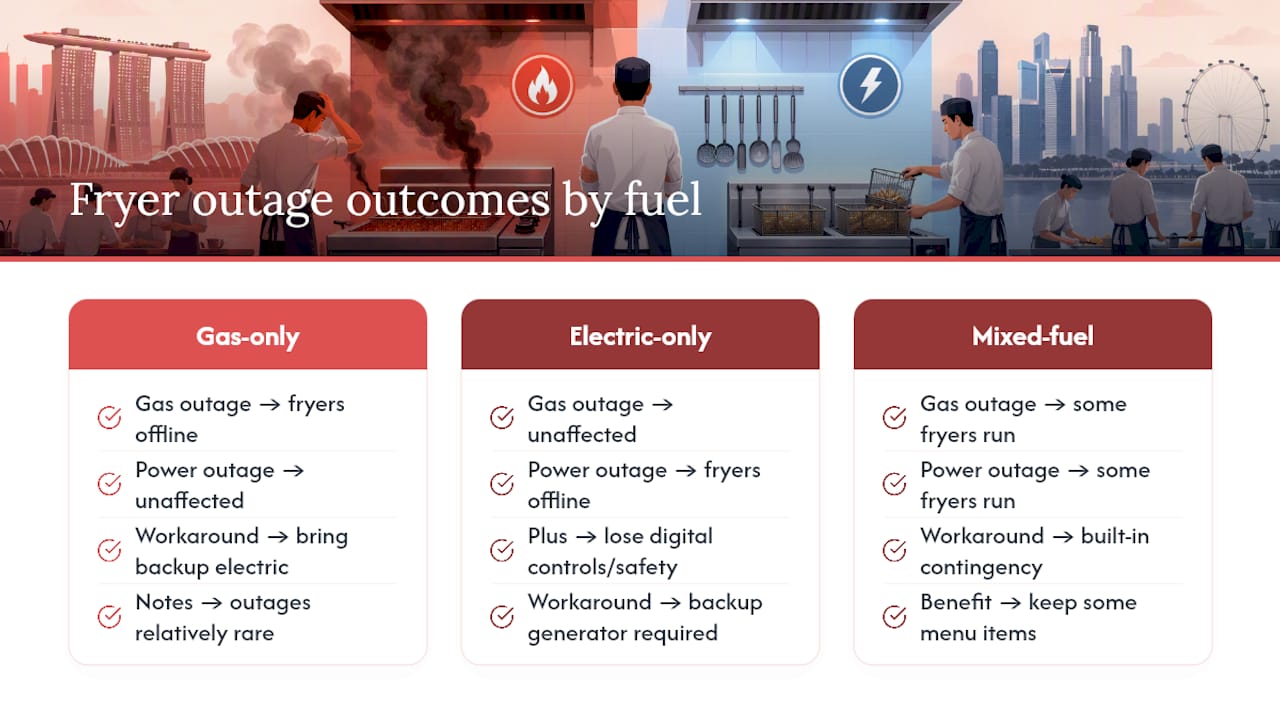
A gas outage takes gas fryers completely offline with no workaround beyond bringing in backup electric equipment. Gas supply disruptions are relatively rare in most serviced areas, but when they happen, typically due to network maintenance or, less commonly, supply issues, a kitchen running entirely on gas fryers has no fried menu at all until service resumes.
A power outage similarly takes electric fryers fully offline, and unlike a gas fryer, an electric unit also loses its digital controls and any connected safety systems simultaneously. Kitchens with backup generators can keep electric equipment running through a power cut, though generator capacity needs to cover the fryer’s full kW draw alongside everything else on the emergency circuit, which is worth confirming before assuming a generator will cover full fryer operation.
Mixed-fuel kitchens, running some gas and some electric equipment, build in a natural contingency that single-fuel kitchens don’t have. A kitchen with both a gas fryer and an electric fryer can usually keep at least some fried menu items available if one utility fails, which is a genuine operational argument for diversifying fuel types across your equipment line rather than committing entirely to one. For single-location, single-fuel operators, the practical response is knowing your local utility’s typical outage frequency and having a clear contingency plan, even if that plan is simply a shortened menu for the duration.
Menu fit beats fuel loyalty
Buyers spend far too long asking whether gas or electric fryers are “better” in the abstract, and not nearly long enough asking what their actual menu and throughput demand. That’s the wrong question from the start; a fryer isn’t better or worse in isolation, it’s better or worse for a specific combination of volume, product type, and utility access.
The industry commentary on ventilation costs eating into gas’s fuel-price advantage deserves more attention than it gets, because it quietly overturns the assumption that gas is automatically cheaper to run. Whole-life cost, not sticker price or fuel type, should decide most of these purchases.
If there’s one habit worth adopting before signing on any fryer, gas or electric, it’s asking your supplier for real oil-life data on your intended menu, not just a recovery-time spec sheet. Spec sheets tell you how fast a fryer heats. They rarely tell you how expensive that fryer will be to run once oil degradation and sediment handling enter the picture.
— David
See Superior Kitchen Equipment’s electric fryer range
If your kitchen has landed on electric, whether because gas infrastructure isn’t available, your throughput doesn’t need tube-style recovery speed, or you’re chasing the lower installation complexity electric offers, Certain kitchen equipment ranges are built around profiles such as electric-first operations, smaller-footprint kitchens, and businesses wanting to explore energy efficiency grants alongside their equipment purchase.
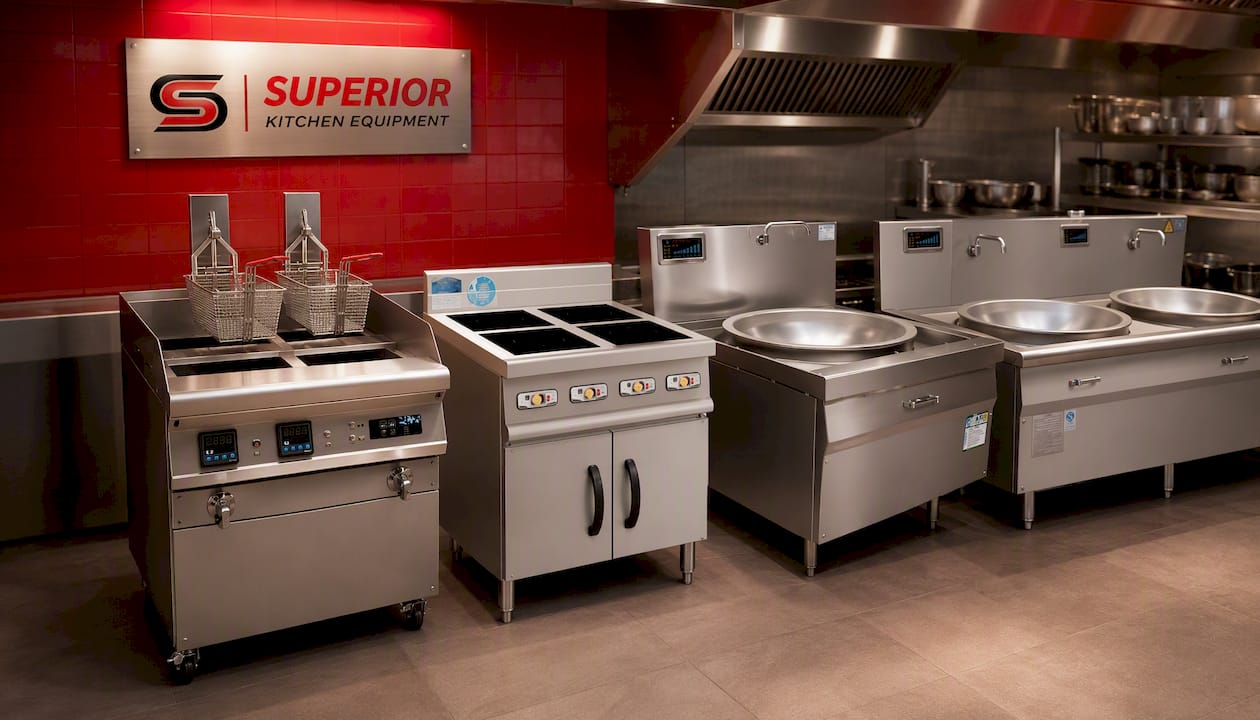
The Automated Standing Double Deep Fryer gives split-menu kitchens double-vat capacity without a gas line in sight, while the Standing Induction Cooker and Heavy Duty Kwali Induction cover heavy-duty electric cooking needs beyond deep frying alone. Smaller operations can look at the Electric Single Deep Fryer 12L or the more compact Electric Single Deep Fryer 6L, depending on daily volume, while medium-throughput kitchens running split menus might suit the Electric Double Deep Fryer 10L+10L better.
Interested parties can visit a showroom to see units running, discuss circuit capacity and expected throughput with the team, and get guidance on relevant energy efficiency grants. Book a spec consultation through the Automated Standing Double Deep Fryer product page to start the conversation.
Sources
- Commercial fryer buying guide
- The big fryer debate: should you buy gas or electric?
- Commercial fryer buying guide: open-pot vs tube-style vs ribbon vs pressure (2026)
- Gas vs. electric deep fryers: which is best for your kitchen?