

Aim for 75 dB or below at one metre in any customer-facing area; most unshielded commercial blenders run at 85 to 95 dB, loud enough to disrupt conversation and stress staff over a shift. If a sound-enclosed unit isn’t available for front-of-house use, reposition the blender out of customer earshot or fit an engineered enclosure. Back-of-house units at 85 to 95 dB need rotation schedules or hearing protection instead.
TL;DR:
- Most commercial blenders operate between 85 and 95 dB, with unshielded units producing sound levels loud enough to disrupt conversation and cause staff fatigue.
- Installing engineered sound enclosures and using vibration-absorbing mats can reduce noise by up to 20 dB, significantly improving work and customer environments.
- Measuring noise accurately involves placing a calibrated microphone one meter from the blender, running actual recipes, and analyzing both peak and continuous sound levels.
- Equipment designed with proper ventilation and insulation, as well as regular maintenance, helps maintain lower noise levels over time.
- Managing blender noise requires operational adjustments, such as repositioning machines farther from customers and rotating staff, alongside choosing certified low-noise models.
Table of Contents
- Understanding commercial blender noise levels and what the decibels mean
- What actually creates the noise: motors, blades and what you’re blending
- How to measure blender noise reliably before you commit to a purchase
- Proven ways to bring blender noise down in a working kitchen
- A procurement checklist for choosing a quieter commercial blender
- How Superiorkitchenequipment helps you manage blender noise in practice
- Why blender noise is a staff health issue, not just a customer comfort one
- Regulatory limits and workplace noise standards that apply to your kitchen
- What the noise numbers actually tell you
- Ready to see noise levels for yourself
- Sources
Understanding commercial blender noise levels and what the decibels mean
Decibels don’t work on a straight-line scale. Every 10 dB increase represents a tenfold rise in sound intensity, so the jump from 75 dB to 95 dB isn’t “a bit louder”, it’s roughly a hundredfold increase in actual sound energy. That’s why a blender that seems only moderately noisier on a spec sheet can dominate a room the way a jet engine drowns out a conversation.
Most commercial blenders without sound-dampening features sit between 85 and 95 dB during normal blending. Review testing of one full-size unit recorded a peak noise level comparable to common household appliances like a garbage disposal or a passing motorcycle. Ambient kitchen noise, by comparison, typically hovers around 60 to 70 dB, meaning a blender cycle doesn’t just add to the background hum. It overwhelms it.
Statistic Callout: Commercial blenders without acoustic treatment operate in the 82 to 93 dB range, while a well-enclosed unit designed for customer-facing work can bring that down to 75 dB or less at one metre.
Exposure duration matters as much as peak volume. Workplace noise guidance generally treats 85 dB averaged over eight hours as the point where hearing protection becomes necessary, not optional. A café blender running for 20 seconds per drink might never trip that threshold on its own, but a juice bar running dozens of cycles an hour during a lunch rush accumulates exposure fast. As a working rule, keep front-of-house equipment at 75 dB or under, and manage anything between 75 and 95 dB in back-of-house zones through staff rotation, scheduled breaks away from the machine, or protective earmuffs during peak batching.
What actually creates the noise: motors, blades and what you’re blending
Blender noise isn’t one sound. It’s several overlapping ones, and knowing which is which helps you diagnose a problem instead of just living with it.
- Motor whine comes from the electric motor itself, a steady tonal hum that rises and falls with RPM and is largely constant regardless of what’s in the jar.
- Blade turbulence and cavitation happen when blades spin fast enough to create air pockets and pressure waves in the liquid, producing the harsher, more chaotic roar most people associate with “blender noise”.
- Jar material plays a bigger role than most buyers expect. Thin polycarbonate jars resonate and amplify vibration, while heavier, insulated jar designs dampen it.
- Fill level changes the acoustic signature too. A half-empty jar sloshes and rattles; a properly filled one blends more quietly because there’s less air space for turbulence.
- Ice and frozen fruit spike noise sharply, since solid ice fragments hitting blades at speed create impact noise on top of the baseline motor and blade sound.
- Reflective surfaces amplify all of the above. Stainless steel worktables, tiled walls, and hard countertops bounce sound rather than absorbing it, which is why the same blender can sound noticeably louder against a wall than in an open, softer-surfaced space.
Mitigation features worth checking for on a spec sheet include acoustic hoods, rubber motor mounts, and insulated jar construction, all of which target one of the noise sources above rather than trying to muffle the whole machine after the fact.
How to measure blender noise reliably before you commit to a purchase
Marketing claims about “whisper quiet” operation rarely survive contact with a real kitchen. Here’s a repeatable method you can run yourself or ask a supplier to demonstrate:
- Position the microphone one metre from the jar, at roughly operator ear height, since that’s the distance and angle that matters for staff and nearby customers.
- Use A-weighted (dBA) measurement, which filters sound the way human hearing perceives it, rather than raw unweighted decibels.
- Run a standard test recipe twice: once liquid-only (water and soft fruit) and once ice-heavy, recording both the peak spike and the sustained continuous reading. That distinction between peak and continuous load tells you what customers will notice versus what staff endure all shift.
- Treat phone sound-meter apps as rough indicators only. They’re fine for a sanity check but not accurate enough to validate a supplier’s certified figures; for procurement decisions, ask for lab-tested or calibrated on-site readings.
- Log cumulative exposure, not just single readings, if a machine runs dozens of cycles per shift. Total exposure time is what workplace noise thresholds actually measure.
Proven ways to bring blender noise down in a working kitchen
Some fixes cost nothing beyond rearranging your kitchen. Others mean choosing different equipment from the outset. Both matter.
Engineered sound enclosures are the single biggest lever available. Properly designed enclosures typically cut noise by 10 to 20 dB, and some manufacturer-tested products claim reductions closer to 18 dB, or roughly 70% less perceived loudness for certain enclosure shapes. That’s the difference between a blender that dominates a café and one customers barely register over background chatter. The catch is ventilation: an enclosure that traps heat around the motor shortens its life, so purpose-built enclosed blenders engineer specific airflow channels rather than relying on a sealed box. A generic aftermarket cover bolted onto an existing machine risks the problem of inadequate motor cooling and potential overheating.
- Fit anti-vibration mats under the base to reduce structure-borne noise transmission from stainless steel worktables and counters.
- Maintain some distance between the blender and dining areas where layout allows.
- Pre-chop large or hard ingredients so the motor isn’t fighting oversized chunks, which reduces both noise and wear.
- Fill jars to the manufacturer’s recommended level rather than running near-empty batches, which rattle and resonate more.
- Batch strategically. Fewer, well-sized runs beat frequent small ones that keep the motor cycling up and down.
Pro Tip: Moving a blender just one to two metres further from seating, or installing a solid acoustic screen between the machine and dining tables, can noticeably reduce perceived loudness depending on room acoustics. That’s often a bigger win than any single equipment upgrade, and it costs nothing but a rearranged counter.
Maintenance prevents noise from creeping up over time. Bearings wear, blades lose balance, and mounts loosen, all of which raise the acoustic signature of a machine that was quiet on day one. High-volume operations running over 100 cycles a day should schedule bearing inspections at least every six months, since shaft imbalance from worn bearings tends to escalate noise sharply rather than gradually.
Retrofitting an existing blender with mats, repositioning, and basic maintenance gets you partway there and costs little. A purpose-built low-noise model costs more upfront but solves the ventilation trade-off properly and tends to hold its acoustic performance longer, which matters most for kitchens running blenders dozens of times a day.
A procurement checklist for choosing a quieter commercial blender
Bring this list to any supplier conversation or showroom visit:
- Ask for certified dB measurements at one metre, A-weighted, with the exact test conditions and recipe disclosed. Refuse vague marketing claims like “up to 70% quieter” without a baseline figure attached.
- Confirm enclosure ventilation design. Ask specifically how the unit manages motor cooling if it’s sound-enclosed, since ventilation channels prevent overheating that a sealed box would cause.
- Check the duty-cycle rating. A blender rated for occasional home-style use will degrade faster, and get louder faster, than one rated for continuous commercial service.
- Request a showroom or on-site demo using your actual recipes, not the supplier’s showcase smoothie, so you hear the real noise profile you’ll live with.
- Test both an ice-heavy and a liquid-only recipe during the demo to see the full range between continuous hum and peak spike.
- Confirm service intervals for bearings and blades, and ask what maintenance plan the supplier recommends to keep noise from rising over the machine’s working life.
- Check warranty terms specifically for commercial, high-frequency use, since many warranties are written around lighter-duty assumptions.
- Verify spare-parts availability, because a machine you can’t service quickly is a machine that stays noisy (or breaks down) longer than it should.
How Superiorkitchenequipment helps you manage blender noise in practice
Superiorkitchenequipment stocks a working range of options built around this exact trade-off, from the anti-noise ice blender for customer-facing counters to heavy-duty blenders for back-of-house volume, and hand blenders for smaller prep tasks where a full unit is overkill.
Visiting the showroom lets you hear a unit running your own recipe rather than trusting a spec sheet. Bring your typical ice ratio and batch size, and ask to measure dB at one metre with a calibrated meter rather than a phone app.
Beyond the initial purchase, some suppliers guide eligible operators through energy efficiency grant claims, which can offset a share of the cost of upgrading to better-engineered, better-maintained equipment. Post-sale service plans matter here too: a maintenance schedule that catches bearing wear early is what keeps a quiet blender quiet for years rather than months.
Why blender noise is a staff health issue, not just a customer comfort one
Sustained exposure to 85 dB or above over a working shift is a recognised occupational hearing risk, not a minor inconvenience. Staff running a juice bar blender dozens of times an hour absorb far more cumulative noise than a customer who hears one cycle while ordering. Fatigue, difficulty communicating with colleagues over the noise, and long-term hearing damage are all realistic outcomes of ignoring this, particularly in kitchens where the blender sits near a till or a small dining counter rather than tucked into a back room.
Customer experience suffers on a different axis. A loud blender cycle interrupts conversation, makes phone calls at the counter awkward, and creates a jarring contrast in venues that otherwise cultivate a calm atmosphere, cafés and casual dining rooms especially. It’s the kind of detail that rarely shows up in a written review but quietly shapes whether someone lingers or leaves quickly.
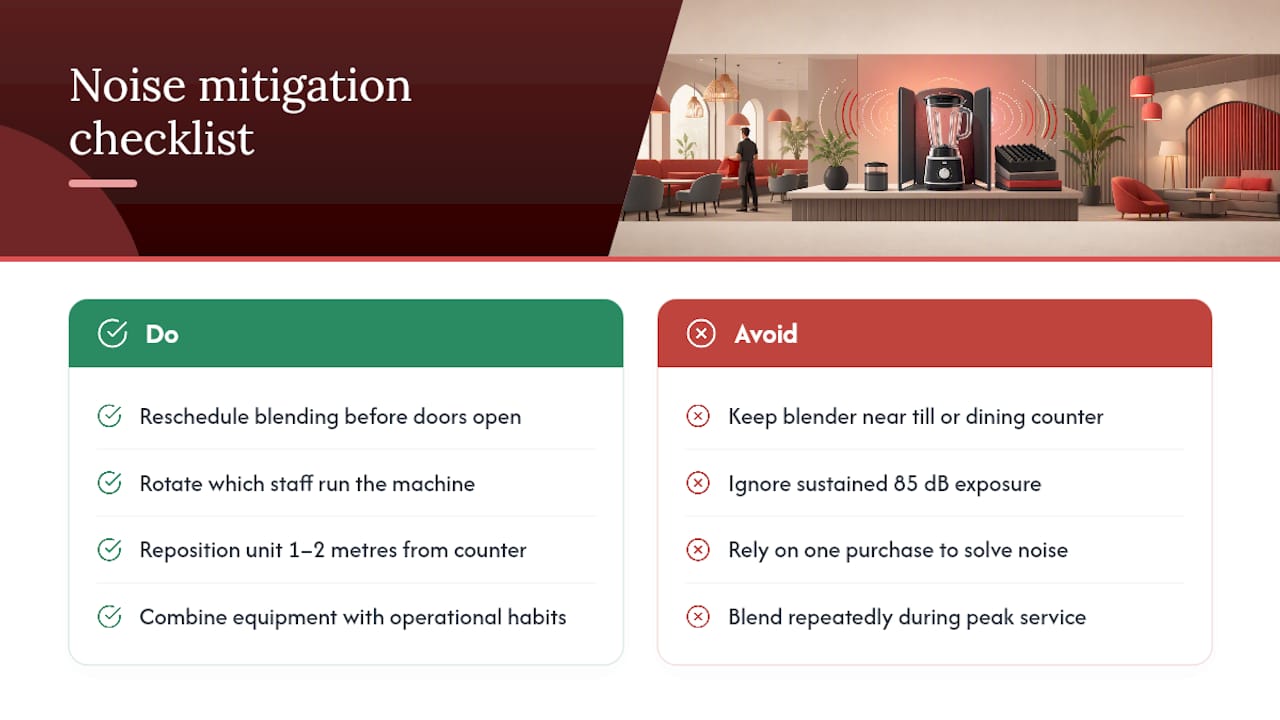
The fix isn’t always more expensive equipment. Sometimes it’s rescheduling when blending happens (prepping smoothie bases before doors open rather than during service), rotating which staff member runs the machine during peak hours, or simply repositioning the unit a metre or two further from both the counter and the dining area. Addressing both sides, staff wellbeing and customer perception, usually means combining an equipment choice with an operational habit, rather than expecting one purchase to solve everything.
Regulatory limits and workplace noise standards that apply to your kitchen
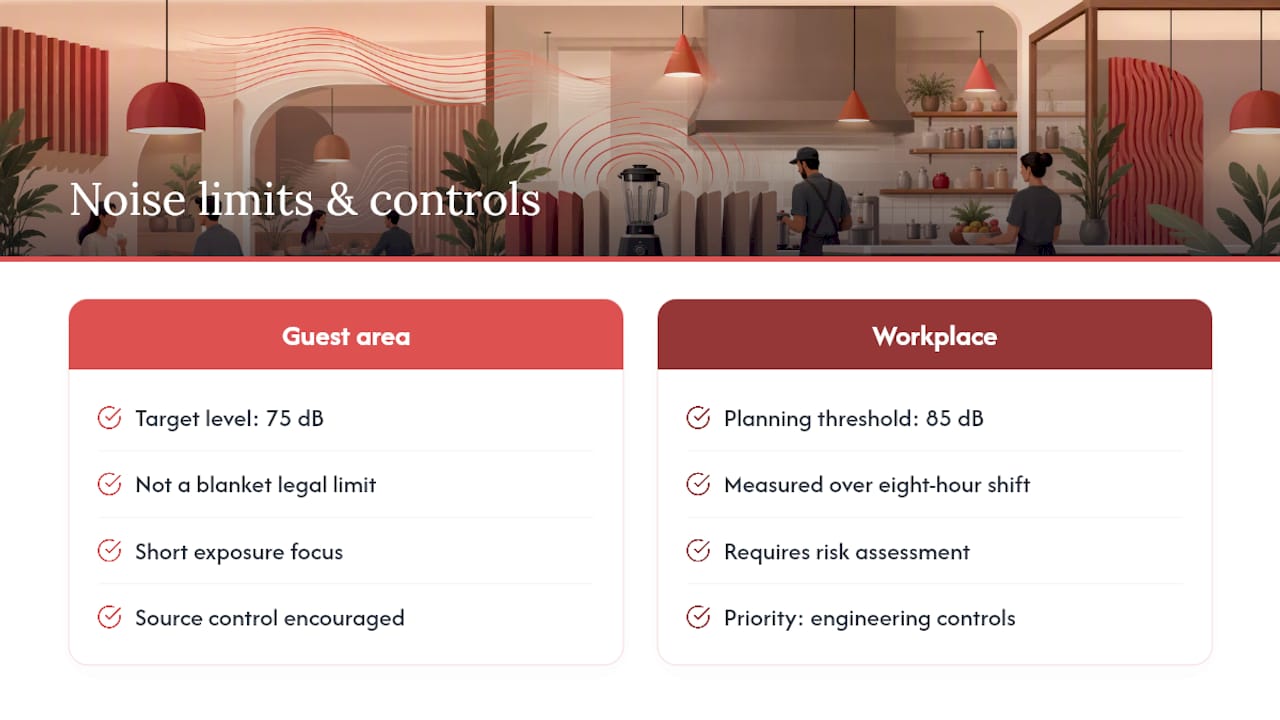
Workplace noise standards generally set an action threshold around 85 dB averaged over an eight-hour shift, the point at which employers are expected to introduce controls such as hearing protection, rotation, or engineering fixes. Singapore’s workplace safety guidance emphasises engineering controls and decoupling noise sources from building structures as the preferred first response, ahead of relying solely on personal protective equipment.
Practically, that means anti-vibration mats and sensible equipment placement aren’t just noise-comfort measures. They align with the kind of source control that workplace safety guidance treats as the priority intervention, ahead of asking staff to simply wear earmuffs and carry on. Commercial kitchens should treat an 85 dB blender running continuously through a lunch rush the same way they’d treat any other sustained occupational hazard: with a plan, not an assumption that staff will adapt.
There’s no single blanket decibel limit that applies to every commercial kitchen in every circumstance, since obligations depend on exposure duration, existing controls, and the specific risk assessment for that workspace. Operators should treat the 85 dB, eight-hour benchmark as a practical planning threshold rather than a strict legal ceiling, and consult current workplace safety guidance for their specific situation.
What the noise numbers actually tell you
The conventional advice on blender noise treats it as a spec-sheet detail, a single dB figure you compare across brochures and move on. That’s the wrong frame. A decibel rating tells you almost nothing about what a kitchen will actually sound like once you factor in room acoustics, ice ratio, batch frequency, and how close the machine sits to a customer’s table.
What the evidence actually supports is a layered response: choose equipment with genuine engineering behind its quiet operation (ventilated enclosures, not sealed boxes), then treat placement and maintenance as equally important levers you control for free. Too many operators buy the quietest-rated blender they can afford and stop there, ignoring that a worn bearing or a reflective countertop can undo most of that advantage within a year.
If you take one thing from this, prioritise the measurement conversation with your supplier before the purchase conversation. Demand a real dB figure at one metre, under conditions that match your kitchen, not a marketing percentage with no baseline attached.
— David
Ready to see noise levels for yourself
There’s a real gap between a spec sheet claim and what a blender sounds like running your actual recipe in your actual kitchen, and the only way to close that gap is to hear it yourself. Some showrooms let you test units against your own ice ratios and batch sizes rather than trusting a manufacturer’s demo clip.
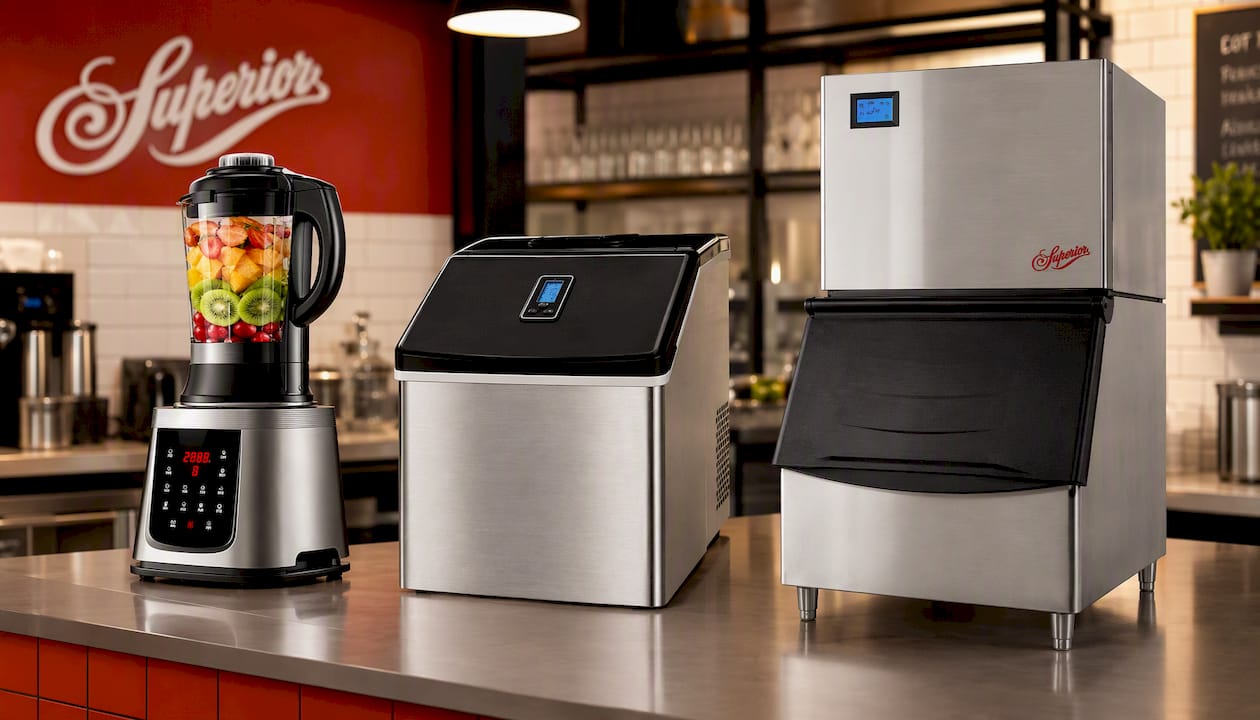
If soup service is part of your menu, the Cold / Hot Soup Glass Blender handles both blending and temperature control in one unit, worth seeing alongside your noise measurements during a visit. For beverage operations, a tabletop ice maker or, for higher-volume kitchens, the 500kg ice maker are worth factoring into the same conversation, since ice consistency affects both blend quality and noise spikes. Ask about anti-vibration mats and a service plan that keeps bearings and blades in good order, since that maintenance is what keeps a quiet unit quiet years down the line. Book a showroom demo or request certified dB measurements before your next equipment order.
Sources
- Commercial blender power & noise guide for juice bars
- Managing noise hazards — Tripartite Alliance for Fair & Progressive Employment Practices (TAFEP / WSH guidance page)