

Choose a blast chiller when your priority is rapid cook-to-chill food safety and same-day service. Choose a blast freezer when the job is rapid freezing for long-term quality preservation. Many kitchens need both, sized against HACCP benchmarks: +3°C within 90 minutes for chilling, and −18°C within 240 minutes for freezing.
TL;DR:
- Ensure the blast chiller can handle your largest batch in 90 minutes with probe-controlled cycles to meet HACCP standards and avoid over-processing.
- Choose a blast freezer if your goal is long-term preservation, as it rapidly cools to around −18°C within approximately 240 minutes.
- Match equipment capacity to your actual peak production volume to prevent cycle length issues and ensure food safety compliance.
- Prioritize probe control and request documented HACCP cycle logs when specifying units to satisfy audit and regulatory requirements.
- Proper placement and scheduling of chillers and freezers are crucial to integrating them effectively into your kitchen’s workflow and maintaining product quality.
Table of Contents
- Blast chiller vs freezer: what a blast chiller actually does
- Blast chiller vs blast freezer: how freezing differs technically
- Freezer vs blast chiller: matching the machine to the job
- How to choose and size a blast chiller or freezer for your kitchen
- Which Superiorkitchenequipment models fit which job
- Cleaning and maintenance: what actually differs between the two
- Where compliance actually bites: regulation and documentation
- Fitting blast equipment into your kitchen’s daily production cycle
- What the industry gets wrong about this comparison
- Get the right chiller or freezer specified for your kitchen
- Sources
Blast chiller vs freezer: what a blast chiller actually does
A blast chiller pulls cooked food down through the bacterial danger zone fast enough to stop bacteria multiplying, which is the entire point of the exercise. Standard commercial guidance defines that danger zone as roughly +5°C to +63°C, and every minute food spends inside it is a minute of risk. Blast chilling is built to shorten that window dramatically.
The HACCP benchmark most kitchens work to is +70/90°C down to +3°C within about 90 minutes. That figure isn’t arbitrary. It’s the standard auditors and export markets check against, so it shapes how you spec the machine, not just how you run it.
Most units offer two control approaches:
- Probe-controlled cycles, which end when a core-temperature probe reads the target, not when a timer runs out
- Time-based cycles, which run a fixed duration regardless of the load
- Soft chill mode for delicate items such as fish or mousse, where a slower ramp protects texture
- Hard chill mode for dense, high-volume batches that need maximum airflow to hit the target on time
Pro Tip: Probe-controlled cycles are the recommended industry practice for HACCP compliance because they stop the cycle exactly when the food is safe, rather than over-processing it on a fixed timer.
Capacity is usually rated in kilograms per cycle or trays per load, and ambient kitchen temperature affects how hard the compressor has to work to hit that 90-minute target.
Blast chiller vs blast freezer: how freezing differs technically
A blast freezer, sometimes called a shock freezer, has a different job entirely: driving core temperature down to around −18°C, typically within about 240 minutes. That speed matters for one specific reason.
Fast freezing forms small ice crystals inside the food’s cell structure. Slow freezing, the kind you get in a standard commercial freezer, forms large crystals that rupture cell walls and leave you with mushy texture and weeping liquid on thaw. This is why industry guidance is blunt about never using a standard fridge or freezer to cool hot product: it’s too slow, and it leaves food in the danger zone far longer than it should.
Two approaches dominate the category:
- IQF (individually quick frozen) for loose items like berries, dumplings or portioned fillets that need to stay separate
- Batch blast freezing for trayed or plated items going into long-term storage as a single unit
Blast freezers demand more compressor capacity than chillers, which shows up directly in footprint and running costs. A unit rated for 40kg of chilling might only manage 28 to 30kg of freezing on the same cabinet, because freezing simply asks more of the refrigeration system.
Freezer vs blast chiller: matching the machine to the job
The two machines solve different problems, and confusing them is the single most common specification mistake in commercial kitchens. Here’s the practical breakdown:
| Factor | Blast chiller | Blast freezer |
|---|---|---|
| Target temperature | +3°C core | −18°C core |
| Standard cycle time | ~90 minutes | ~240 minutes |
| Main purpose | Cook-to-chill food safety | Long-term preservation |
| Typical use case | Banquet prep, cook-chill service | Par-bake stock, IQF, central kitchen freezing |
A central production kitchen making sauces for multiple sites will lean on the chiller daily and the freezer for batching ahead. A bakery running par-bake programmes needs the freezer to lock product before final bake, while the chiller handles same-day fillings and creams. A banquet kitchen plating hundreds of covers in advance depends almost entirely on chiller capacity to hold quality until service.
The mistake operators make most often is buying a single dual-function cabinet and sizing it to the chill rating, then wondering why freeze cycles run long or fail to hit −18°C. Freeze capacity is always the smaller number on a combination unit, so size to that figure if you need both functions from one box.
Pro Tip: If your kitchen genuinely needs both, treat freeze capacity as the real ceiling on a dual-function unit, not the chill capacity printed larger on the spec sheet.
How to choose and size a blast chiller or freezer for your kitchen
Specification comes down to five decisions, in this order:
- Define the job. Are you chilling cooked food for same-day service, freezing for stock, or both? This decides whether you need a dedicated chiller, a dedicated freezer, or a combination unit sized to its freeze rating.
- Size to your largest single batch. The rule of thumb is straightforward: the machine should handle your biggest production run in one 90-minute cycle. Undersizing forces a second cycle, which breaks your prep schedule and risks food sitting out waiting its turn.
- Insist on probe control. Ask suppliers whether cycles terminate on measured core temperature or on a fixed timer. Request sample HACCP probe logs and cycle reports as evidence, not just a spec sheet claim.
- Check ambient and installation limits. Confirm required clearance, drainage provision, electrical supply, and the compressor’s rated operating range for your kitchen’s ambient temperature. A machine rated for a temperate back-of-house won’t perform the same in a hot, humid line kitchen.
- Weigh refrigerant and energy efficiency. Ask what refrigerant the unit runs and whether it’s an inverter compressor, since this affects both running cost and long-term compliance as refrigerant rules tighten.
Pro Tip: Always ask for a written HACCP validation report showing actual probe-logged cycle times on the specific model, not a generic manufacturer claim, before you sign off on a purchase.
Which Superiorkitchenequipment models fit which job
Mapping the checklist above to real hardware makes the decision concrete rather than theoretical.
- The Superior Inverter 2 Door Upright Chiller / Freezer suits back-of-house prep areas and small central kitchens that need flexible chill or freeze capacity in one footprint.
- The 1.8m Superior Inverter Counter Chiller / Freezer fits café and counter-service operations running mise en place at working height, where counter space doubles as prep surface.
- The 1.5m Superior Inverter Counter Chiller / Freezer works for compact kitchens and lower-throughput counters that still need reliable, probe-monitored temperature control.
| Kitchen type | Recommended model | Why it fits |
|---|---|---|
| Small central kitchen or back-of-house prep | Superior Inverter 2 Door Upright Chiller/Freezer | Dual-function capacity in a compact upright footprint |
| Café or counter service | 1.8m Superior Inverter Counter Chiller/Freezer | Counter-height access for high-frequency mise en place |
| Compact kitchen, lower volume | 1.5m Superior Inverter Counter Chiller/Freezer | Smaller footprint without sacrificing inverter efficiency |
This energy-efficient inverter range is designed around matching capacity to genuine kitchen throughput rather than over-specifying.
Cleaning and maintenance: what actually differs between the two
Blast chillers and freezers share a maintenance backbone, but the demands on each differ in ways that catch operators out.
Chillers cycle through a wider temperature swing more frequently, since they run multiple 90-minute cycles a day. That means condenser coils collect grease and airborne fat faster in a busy kitchen, and they need weekly coil cleaning rather than monthly. Door seals on chillers also see heavier daily use, so check gaskets for cracking or compression loss every few weeks, since a failing seal extends cycle times and pushes food closer to the danger zone before it hits target temperature.
Freezers run colder for longer stretches, which brings a different problem: ice build-up on evaporator coils and door tracks. Scheduled defrost cycles need checking to confirm they’re actually clearing frost rather than just running on a timer that no longer matches the load. Door tracks on chest or upright freezers benefit from monthly lubrication checks, since ice accumulation there is what causes doors to stop sealing properly.
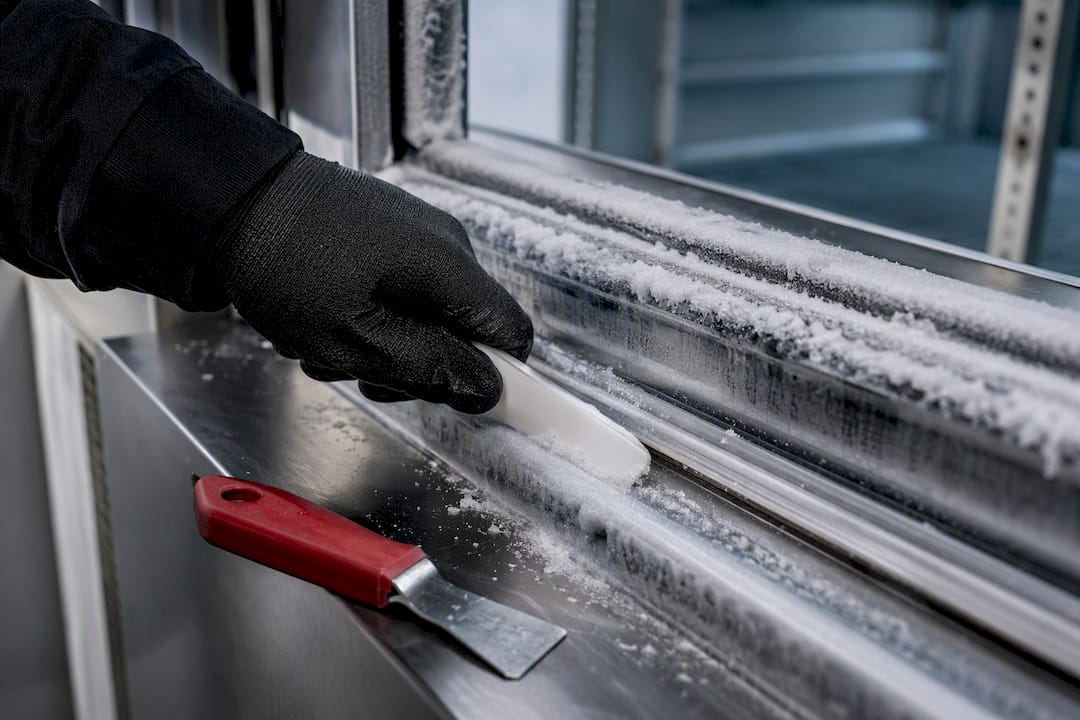
Both machines need their probes calibrated on a fixed schedule, typically quarterly, since a drifting probe undermines the entire HACCP record even if the compressor is working perfectly. Keep a log of every calibration and coil clean alongside your cycle records. When environmental health officers audit a kitchen, that paperwork is often what separates a pass from a follow-up visit.
Where compliance actually bites: regulation and documentation
Food-safety regulators don’t inspect the machine, they inspect the record it produces. That distinction matters more than most kitchens realise when they’re buying equipment.
HACCP frameworks require documented evidence that cooked food passed through the danger zone quickly enough to control bacterial growth, and rapid cooling through that zone is treated as a core control point in food-safety guidance rather than a nice-to-have. In practice, that means your chiller or freezer needs to produce a probe-logged cycle report for every batch, showing start temperature, end temperature and elapsed time. A machine that only shows a countdown timer, with no probe log, gives you nothing to show an inspector.
Local food authority guidance generally expects kitchens to retain these cycle records for a set period and to demonstrate that staff know how to read and act on them, not just that the equipment exists. This is also where using a standard fridge or freezer for hot food creates genuine legal exposure. Regulators treat that substitution as a control failure, since it leaves food in the danger zone longer and cannot generate the compliance evidence probe-controlled blast equipment produces automatically.
Whatever equipment you run, build your compliance file around three things: cycle reports, probe calibration records, and a written cleaning schedule. Missing any one of them is usually the actual finding in an audit, not the equipment itself.
Fitting blast equipment into your kitchen’s daily production cycle
The best-specified chiller or freezer still fails if it sits outside the kitchen’s actual workflow rather than inside it.
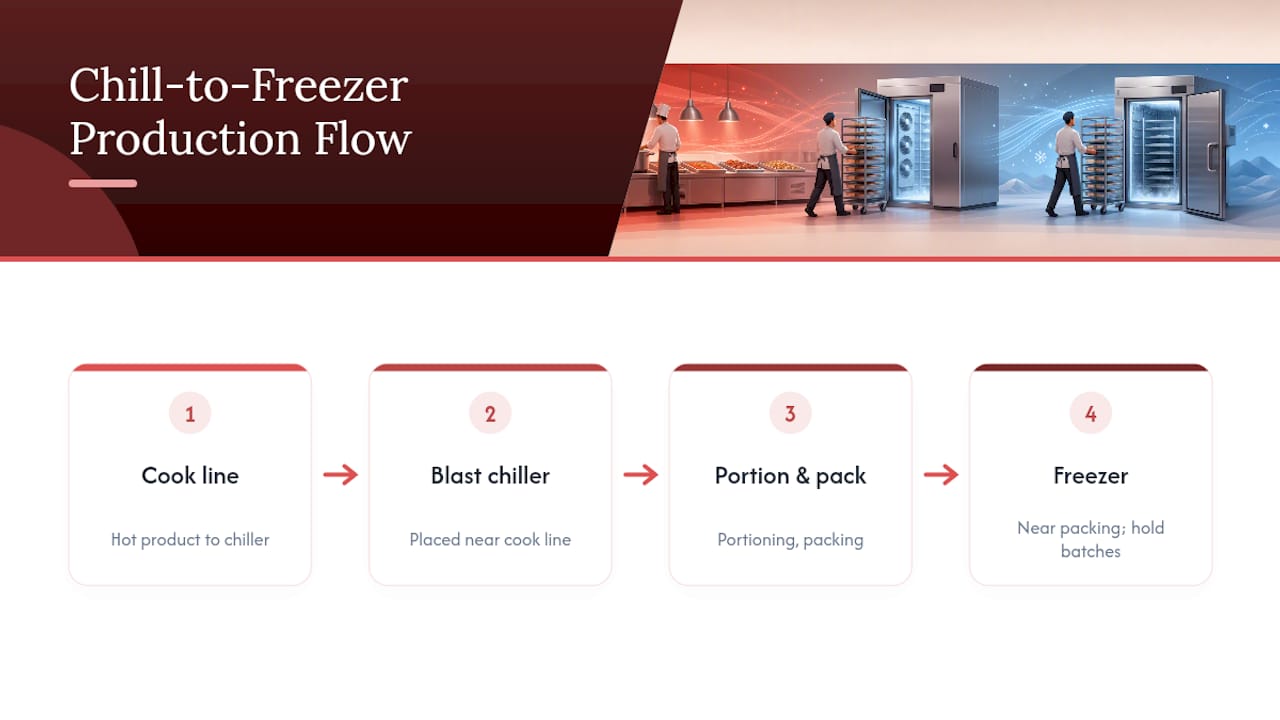
Production kitchens that get this right treat the blast chiller as the handoff point between cooking and storage, not an afterthought at the end of the line. Hot product comes straight off the stove, oven or combi and goes directly into the chiller within minutes, before it has a chance to sit and cool on a bench. That means physical placement matters as much as specification: the unit needs to sit close to the cook line, not tucked away near the walk-in.
Freezers, by contrast, usually sit further downstream, closer to packing and dispatch, because their role is holding finished batches rather than processing hot output. A central kitchen producing sauces or par-baked goods for multiple sites will typically chill first, portion or pack, then freeze for distribution, so the freezer’s position in the layout should reflect that second-stage role.
Scheduling matters just as much as layout. If your kitchen’s peak production window is the same two hours every day, the chiller needs enough throughput to handle that peak in a single cycle, not two. Staggering production earlier, even by 30 minutes, often solves a bottleneck that looks like an equipment problem but is actually a scheduling one. Build your prep timeline backwards from service, and slot the chill or freeze step in as a fixed stage, not a variable one that gets skipped when the kitchen is slammed.
What the industry gets wrong about this comparison
Most buying guides treat blast chillers and freezers as a single category with two settings. That framing undersells how differently the two machines are engineered, and it’s why so many kitchens end up with equipment that technically works but never quite fits how they actually cook.
The bigger issue is that specification conversations tend to start with budget rather than batch size. A kitchen will ask “what’s the cheapest unit that does both?” instead of “what’s my largest single production run, and does this machine clear it in one cycle?” That’s backwards. Undersizing against your peak batch doesn’t just slow you down, it quietly erodes the food-safety margin every single day, because a second cycle means the second half of your batch spent longer in the danger zone than it should have.
Probe control gets treated as a premium feature rather than the baseline it should be. A timer-based cycle might hit the target temperature most days, but “most days” is not what HACCP documentation is asking for. If there’s one change worth making before any other spec decision, it’s insisting on probe-terminated cycles and the paperwork to prove it, because that single feature is what turns a fast machine into a compliant one.
— David
Get the right chiller or freezer specified for your kitchen
Working out whether your kitchen needs a chiller, a freezer, or both is only useful once it turns into the right equipment on your floor. Superiorkitchenequipment stocks the inverter range built around exactly this decision, from the Superior Inverter 2 Door Upright Chiller / Freezer for back-of-house prep to the 1.8m and 1.5m Superior Inverter Counter Chiller / Freezer models for counter-service kitchens.
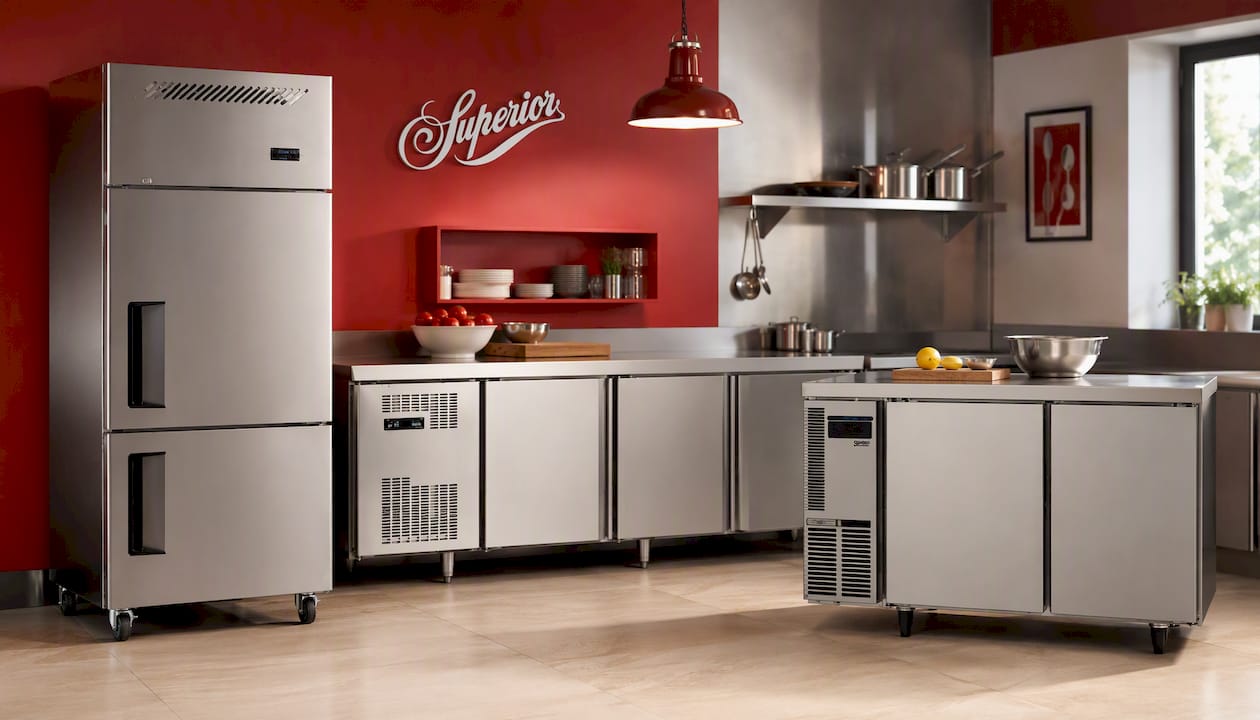
If you’re unsure which capacity matches your production peak, request a HACCP probe report and a site survey before you buy, not after. Visit the showroom to see the full range in person, or get in touch to request a quote for the model that matches your kitchen’s actual throughput.
Sources
- Blast Chiller vs Blast Freezer 2026: What’s the Difference? Complete Buyer’s Guide - Grace Kitchen Equipment
- PMCID PMC8620417 — peer‑reviewed discussion relevant to rapid cooling and food safety
- The in‑depth blast chiller and freezer buying guide — FridgeFreezerDirect