
Cast iron, enamelled cast iron, carbon steel, and magnetic stainless or multi-clad pans work on induction cooktops; pure aluminium, copper, glass, and ceramic generally don’t unless a manufacturer has bonded a magnetic base plate onto them. The fastest way to check any pan you already own is the magnet test: if a fridge magnet grips the base firmly, the cooktop will heat it. A small number of high-nickel stainless steels break this rule entirely, since they aren’t magnetic despite looking identical to grades that are.
TL;DR:
- Not all stainless steel pans are magnetic; high-nickel grades may look compatible but will not heat on induction without testing.
- A magnet test ensures compatibility, but base thickness and flatness are crucial for even heating and minimizing buzzing or uneven performance.
- Domestic induction hobs handle most household needs, but high-wattage, commercial-grade units are necessary for continuous, high-heat cooking demands.
- Hard-to-spot issues like warped or dirty bases significantly impact heating efficiency and can cause noise or uneven temperature distribution.
- Testing cookware with a magnet before purchase and checking for the induction symbol can prevent costly returns and improve cooking results.
Table of Contents
- What is induction cookware compatibility, exactly?
- How do you test whether a pan works on induction?
- Which material suits your cooking style best?
- Why does my induction pan buzz or heat unevenly?
- When does heavy-duty induction make sense?
- Do brands and regions differ on induction compatibility?
- How do power settings affect which pans perform best?
- How do you keep induction cookware performing well?
- The compatibility question everyone gets half right
- Ready to move up to commercial-grade induction?
- Sources
What is induction cookware compatibility, exactly?
Induction cookware compatibility comes down to one physical requirement: the pan’s base has to be ferromagnetic. An induction hob generates a magnetic field under the cooking zone, and that field only creates heat in metals that respond to a magnet. This is why the standard advice from testing bodies like Consumer Reports always starts with the same three words: try a magnet.
- Cast iron and enamelled cast iron. Solid ferromagnetic construction and excellent heat retention make these near-universal performers, enamel coating included.
- Carbon steel. A favourite among chefs for searing, carbon steel heats faster than cast iron and weighs noticeably less.
- Magnetic stainless steel and multi-clad pans. These heat up quickly and respond fast to temperature changes, but the base or core needs checking, since not all stainless is magnetic.
- Non-stick pans with a magnetic base. Convenient for eggs and delicate food, though the non-stick coating limits how high you can push the heat.
- Pure aluminium, copper, glass, and porcelain. None of these work on their own. CHOICE confirms they need a bonded magnetic layer before an induction hob will recognise them at all.
How do you test whether a pan works on induction?
You don’t need to guess, and you don’t need to trust a label blindly either. A few simple checks, done in the kitchen or right there in the shop, will tell you everything.
- Run the magnet test properly. Hold a fridge magnet against the centre of the base first, then move it towards the edges. Strong, immediate grip means good compatibility; a weak wobble suggests marginal or partial performance.
- Check the whole base, not just one spot. Some multi-clad pans use a magnetic ring around the edge with a non-magnetic centre, which can trip the hob’s sensors.
- Look for the induction symbol. Most manufacturers print a coiled-spring style mark on the base or packaging to confirm induction readiness.
- Match pan size to hob zone. A pan that’s too small won’t trigger the sensor at all, and one that’s too large can heat unevenly across the base, according to AEG’s cookware guidance.
- Confirm the minimum base diameter. Check the hob’s manual, since some models include flex zones that tolerate unusually large or rectangular pans, per KitchenAid’s product guidance.
Pro Tip: Carry a small fridge magnet when shopping for cookware. It takes ten seconds to test a pan in-store and saves you from a return trip once you discover it doesn’t heat at home.
Which material suits your cooking style best?
Compatibility answers the “will it work” question. Choosing the right one for how you actually cook is a separate decision, and it’s where most buying guides fall short.
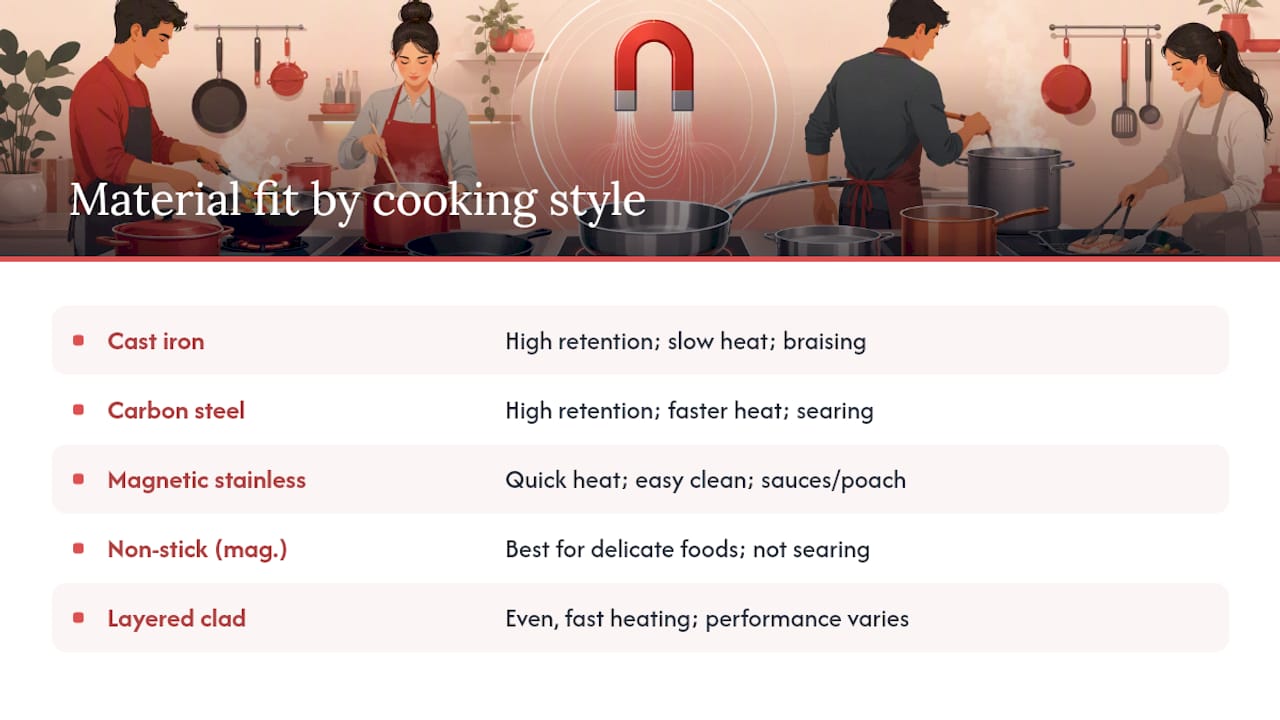
Cast iron rewards patience. It holds steady, even heat for braising, slow simmering, and searing that needs a long, hot surface. The trade-off is weight and upkeep: bare cast iron needs seasoning, and enamelled versions need gentler care to avoid chipping.
Carbon steel gives you most of cast iron’s heat retention in a lighter, faster-heating pan. It’s the choice serious home cooks reach for when searing steak or stir-frying at pace, though it also needs seasoning and isn’t dishwasher-friendly.
Magnetic stainless steel and multi-clad cookware heats up quickly and cleans easily, which makes it the natural pick for sauces, poaching, and anything that needs fast temperature control. The catch is thin bases: cheaper stainless pans can develop hot spots and sticking that better-built ones avoid, an issue KitchenAid’s cookware guide flags directly.
Non-stick pans with a magnetic base are ideal for eggs, fish, and anything delicate, but they’re the wrong tool for aggressive searing. High heat degrades non-stick coatings faster than any other material on this list.
Layered or clad bases, where a magnetic steel plate is bonded to an aluminium core, give you aluminium’s quick, even heating with induction compatibility bolted on. Performance varies by build quality, so a mid-range clad pan and a premium one can behave very differently on the same hob.
Why does my induction pan buzz or heat unevenly?
Most complaints about induction cookware trace back to one of two causes, and both are fixable once you know what to look for.
- The pan is stainless steel that isn’t actually magnetic. High-nickel grades are non-magnetic despite looking identical to compatible stainless, a trap Jindal Stainless explains clearly. The magnet test catches this every time.
- Poor contact between pan and hob. A warped, thin, or dirty base causes the buzzing or humming sound many users report, usually resolved by switching to a heavier, flatter pan.
- Induction interface discs (diffusers) let non-compatible pans work by placing a magnetic disc between pan and hob, though you lose some heating speed and evenness in the process.
- Rough or gritty pan bases can scratch a glass-ceramic hob surface over time, so keep bases clean and smooth.
Roughly a third of induction complaints Consumer Reports has documented trace back to buying pans without checking compatibility first, which is exactly why testing a single pan before committing to a full set makes financial sense.
When does heavy-duty induction make sense?
Domestic hobs suit most households, but frequent high-heat searing, large-batch cooking, or small-scale catering push past what a standard cooktop is built for. That’s the gap commercial-grade induction fills. Superiorkitchenequipment supplies energy-efficient commercial models at 3,500W, 4,200W, and 5,000W, built for sustained wok-level heat rather than occasional home use.
- Wok cooking that needs continuous high heat without power drop-off between batches.
- Caterers or small food businesses running multiple pans through service hours.
- Anyone replacing gas equipment who wants the running-cost benefits induction offers over gas or resistive electric.
If any of those describe your kitchen, browsing the Standing Induction Wok Range or Wok Style Induction Cooker 5000W is a reasonable next step before committing to domestic-grade equipment that won’t keep up.
Do brands and regions differ on induction compatibility?
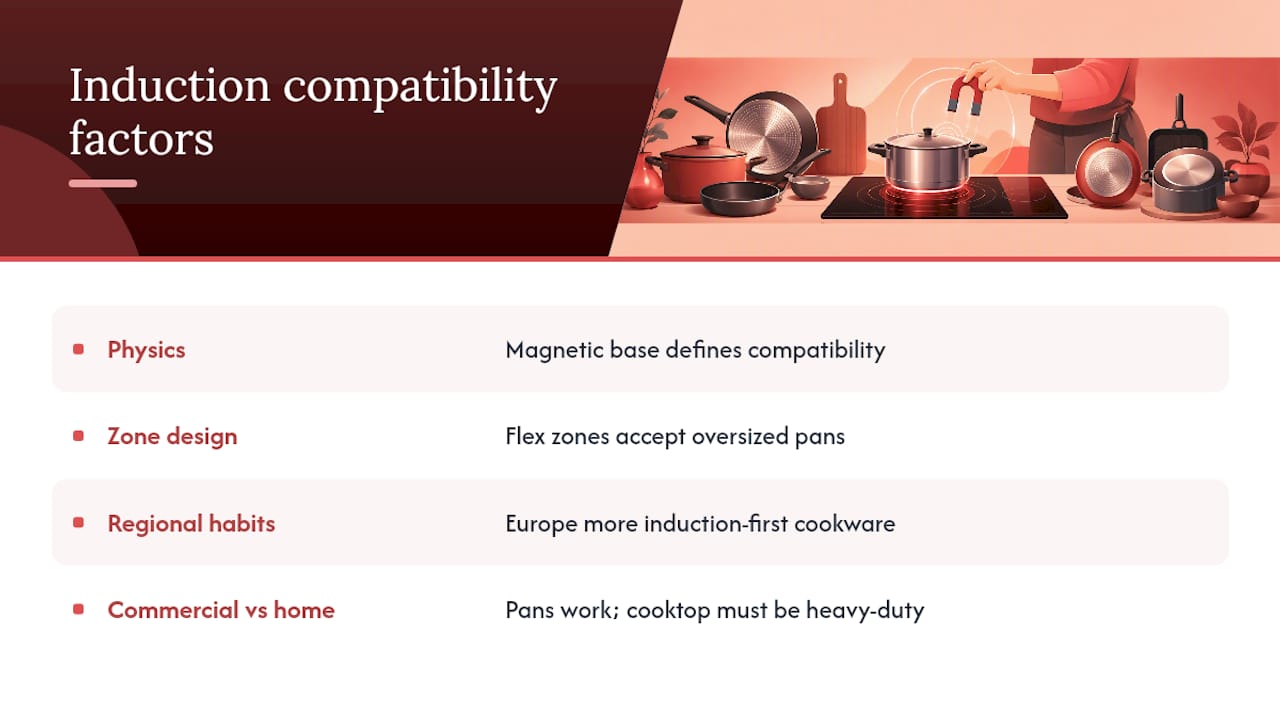
Compatibility itself isn’t brand-specific. It’s governed by physics: a magnetic base works regardless of who made the hob. Where brands genuinely differ is in zone design and tolerance. Some manufacturers, KitchenAid among them, build flex zones that bridge two burners into one long area, letting you use rectangular griddles or oversized stockpots that a fixed round zone would reject.
Regional habits matter more than most people expect. European kitchens, where induction has been mainstream for longer, tend to stock more induction-first cookware ranges as standard, while markets where gas has dominated often carry more gas-first pans that need the interface disc workaround. Commercial kitchens add another layer entirely: wok ranges and heavy-duty induction units are engineered for continuous, high-wattage operation that a household hob’s electronics were never designed to sustain. This is less a compatibility question than a durability one; the pan works, but the cooktop underneath it needs to be rated for the job.
The practical takeaway is that no major cooktop brand quietly redefines what “magnetic” means. If a pan passes the magnet test on one induction hob, it will pass on virtually any other, household or commercial.
How do power settings affect which pans perform best?
Induction hobs typically offer a range of power settings from low to high, including a rapid boost function that maximizes cooking power on domestic models. Thin-based pans struggle at the top end: they heat so fast that food scorches before it distributes evenly, which is why cheaper stainless cookware often performs worse at boost settings than mid-range settings.
Thicker, multi-layered bases handle the full power range more predictably, since the extra mass spreads heat across the surface instead of concentrating it under the coil. This is also where pan size interacts with power. A small pan on a high setting concentrates enormous energy into a tiny contact area, risking scorched spots, while the same pan on a low or medium setting behaves far more evenly. Cast iron and carbon steel, with their inherent heat retention, tend to smooth out these power jumps better than thin stainless ever will, which is part of why they remain the benchmark recommendation across buying guides.
How do you keep induction cookware performing well?
Compatibility isn’t a one-time checkbox. A pan that works perfectly on day one can develop problems if it’s not looked after.
- Keep the base clean and completely flat; even a light coating of grease or a warped edge can degrade contact and trigger buzzing.
- Avoid dragging cast iron or carbon steel across the hob surface, since rough bottoms can scratch glass-ceramic tops over time.
- Store enamelled cast iron carefully; chipped enamel exposes the metal beneath and accelerates rust.
- Re-season carbon steel and bare cast iron periodically to protect the surface and maintain even heating.
- Check stainless and multi-clad bases occasionally for warping, which thin, budget pans are more prone to develop after repeated high-heat use.
The compatibility question everyone gets half right
Most advice on this topic stops at “check for the induction symbol,” which is fine as far as it goes, but it undersells how often that symbol is missing, faded, or absent from older cookware you already own. The magnet test matters more than any logo, because it works on every pan regardless of age, origin, or whether the box survived long enough to read.
What conventional guides also underplay is that compatibility and performance are two different conversations. A pan can pass the magnet test and still heat unevenly if its base is thin or warped. I’d tell any reader to prioritise base thickness and flatness over material dogma. A well-built magnetic stainless pan will often outperform a cheap, thin cast iron one, even though cast iron has the better reputation.
If you’re buying new, test one pan before building a full set. If you’re pushing into serious heat, whether that’s a home cook who sears constantly or someone running a small catering operation, domestic hobs and domestic pans both start to show their limits, and that’s a genuinely different equipment category.
— David
Ready to move up to commercial-grade induction?
If you’ve worked through the checks above and realised your cooking demands more consistent, higher-wattage heat than a domestic hob can deliver, Superiorkitchenequipment builds specifically for that gap, without the compromises of adapting home equipment for commercial-style use.
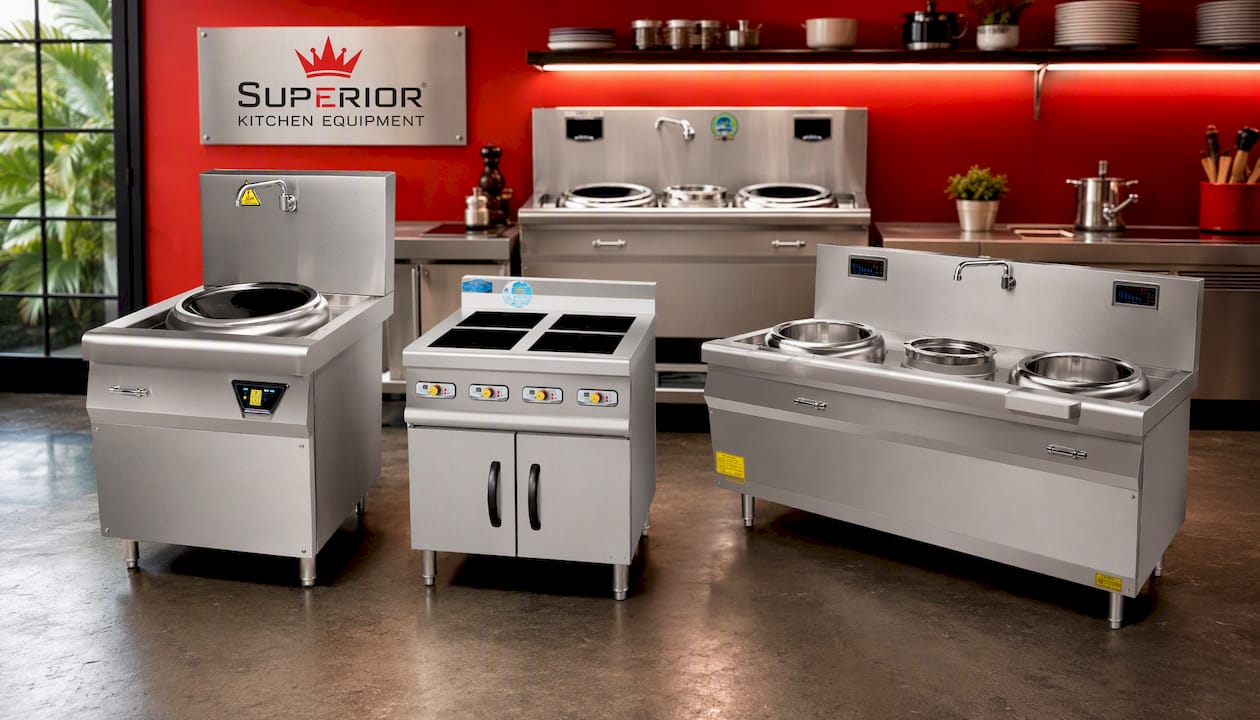
The Standing Induction Wok Range suits kitchens running continuous wok work, delivering the sustained high heat that stir-frying and flash-searing demand without power drop-off mid-service. The Standing Induction Cooker is built for kitchens that need one robust, reliable unit running for hours at a stretch, ideal for restaurants moving away from gas. The Heavy Duty Kwali Induction is designed around large traditional pans and wide-bottomed cookware that most domestic hobs simply can’t accommodate.
Visit the showroom to see how each unit performs with your own cookware, or browse the product pages for full specifications before you buy.
Sources
- Best cookware for induction cooktops | Consumer Reports
- How to buy the right pots and pans for induction cooking | CHOICE
- Is stainless steel induction compatible? | Jindal Stainless blog
- What cookware is suitable for cooking zones with induction heating | AEG support
- 5 types of induction compatible cookware | KitchenAid