

Buy a correctly sized, closed-door commercial refrigerator with a verified annual kWh rating and a documented maintenance plan. This delivers the lowest running cost, the fastest payback, and qualifies for energy efficiency grants. Superior Kitchen Equipment’s inverter counter chiller range meets these criteria and is a sound starting point for most Singapore kitchens.
TL;DR:
- Choosing a fridge with a verified annual energy consumption in kWh and an inverter compressor can significantly reduce operating costs over its lifetime.
- Solid door refrigerators are more efficient than glass doors, especially if product visibility is not essential, due to lower heat transfer and reduced anti-sweat heater use.
- Oversized units and poor siting, such as blocking airflow or insufficient clearance, cause unnecessary energy waste and should be avoided.
- Upfront costs for a high-efficiency refrigerator are usually recovered within two to three years through lower electricity bills, especially if the unit runs more than twelve hours daily.
- Compliance with Singapore’s MEPS standards ensures minimum efficiency, but selecting models that exceed these standards and align with site conditions offers better long-term savings.
Table of Contents
- What specifications actually determine energy efficiency?
- How do you size and type a unit to avoid wasting energy?
- Which energy standards and labels should you check before buying?
- What daily habits and maintenance keep a fridge efficient?
- Is the higher upfront cost of an efficient fridge worth it?
- What actually separates a good spec sheet from a good fridge in daily use?
- Ready to specify the right inverter chiller for your kitchen?
- Sources
What specifications actually determine energy efficiency?
The datasheet tells you more than the sales brochure does. Every commercial refrigerator sold in Singapore should list an annual energy consumption figure in kWh, usually tested under a standard climate class. That single number, not the compressor horsepower or the brand name, is what determines your electricity bill over the unit’s lifetime.
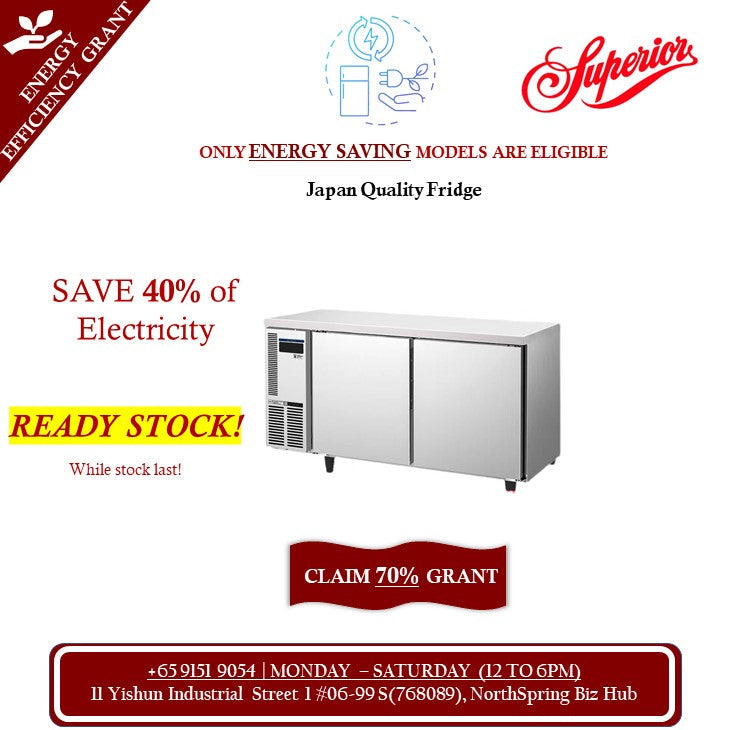
Closed solid doors beat glass every time on efficiency, because glass allows more heat transfer and demands anti-sweat heaters to stop condensation forming. If you need product visibility for a display counter, expect a measurable energy penalty and factor it into the running cost, not just the purchase price.
A handful of technical features separate an average fridge from a genuinely efficient one:
- Inverter compressors that modulate speed to match load, rather than cycling fully on and off, which cuts wasted energy during low-demand periods
- Natural refrigerants like R290, which tend to run more efficiently than older HFC blends and carry a lower environmental impact, an approach flagged by Worldchefs’ guidance on commercial refrigeration
- Digital controllers with connected monitoring, letting you track compressor runtime and temperature stability remotely
- Removable gaskets and wire-frame condensers, which make cleaning fast enough that staff actually do it
- Rear or bottom-mounted compressor placement suited to your kitchen layout, since poor airflow around the compressor forces it to work harder
Ask suppliers for the annual kWh figure in writing before you compare prices. A cheaper unit with a higher annual consumption figure often costs more over five years.
How do you size and type a unit to avoid wasting energy?
Oversizing is the most common and most expensive mistake in commercial kitchen procurement. A fridge running at half capacity still uses close to full energy to maintain temperature across that empty space, so bigger is not safer, it is just costlier.
Match the unit type to its job:
- Prep counters need compact chillers positioned directly at the workstation, sized to hold only a shift’s worth of ingredients rather than a week’s stock.
- Back-of-house storage units should be sized against measured throughput, not projected growth several years out, since usable capacity beats headline litres every time.
- Display merchandisers trade some efficiency for visibility, so keep their footprint as tight as the display need actually requires.
- High-volume combination units, such as a four-door chiller/freezer, suit central kitchens serving multiple outlets where consolidating storage reduces the number of compressors running.
Leave the service clearances the manufacturer specifies, typically 10 to 15 centimetres around vents. A unit squeezed against a wall or a hot line will run its compressor far longer than its rated cycle suggests.
Which energy standards and labels should you check before buying?
Singapore’s Mandatory Energy Performance Standards for commercial storage refrigerators, enforced by the National Environment Agency, took effect on 1 April 2024. Any unit sold in the local market now has to meet a minimum efficiency threshold before it can enter the market at all, which raises the floor but does not mean every compliant model is equally efficient above that floor.
Commercial refrigeration can account for a large share of a professional kitchen’s total energy use, according to Worldchefs, which makes this single equipment category one of the biggest levers you have over your utility bill.
When checking a label or datasheet, look for:
- The annual energy consumption figure in kWh, tested against a stated climate class (a higher climate class rating means the unit is tested and rated to perform in hotter ambient conditions, relevant in un-air-conditioned kitchen back-of-house areas)
- The refrigerant type and its environmental rating
- Whether the model exceeds the MEPS minimum by a meaningful margin, not just scrapes past it
International references such as ENERGY STAR and the US Federal Energy Management Program are useful cross-checks even outside their home market, because they publish comparative efficiency data that helps you judge whether a “high efficiency” claim on a Singapore product sheet is actually competitive. In a kitchen running two or three units continuously, specifying the best available model rather than the minimum compliant one is usually the better economic call, since the efficiency gap compounds every single day the compressor runs.
What daily habits and maintenance keep a fridge efficient?
The purchase decision sets your ceiling for efficiency. Maintenance and staff habits decide whether you actually get near it.
- Close doors immediately after use and train staff not to prop them open during service rushes
- Avoid overstocking beyond the rated usable capacity, since blocked airflow inside the cabinet forces the compressor to overcompensate
- Clean condenser coils monthly in a busy kitchen; dust and grease build up faster than most operators expect
- Inspect door gaskets every three months and replace them the moment they lose their seal, since a poor gasket lets in warm, humid air constantly
- Check defrost heaters and anti-sweat controls each quarter to confirm they are not running longer than needed
- Site the unit away from ovens, fryers, and direct sun, since a compressor working against ambient heat draws considerably more power
Pro Tip: Log compressor runtime weekly if your unit has connected monitoring. A sudden jump in runtime with no change in stock levels almost always means a failing gasket or a dirty condenser, and catching it early is cheaper than the electricity you’d otherwise waste for months.
Gasket condition and condenser cleanliness are widely considered the single biggest determinant of sustained efficiency, well ahead of which brand you bought.
Is the higher upfront cost of an efficient fridge worth it?
Work out payback with a simple formula: divide the price premium of the efficient model by the annual electricity cost saved (its annual kWh saving multiplied by your tariff rate). Most operators find the sum settles well within the unit’s working life, often inside two to three years for continuously run units.
The FEMP purchasing guidance from the US Department of Energy shows that specifying the best available model rather than a merely compliant one typically produces the strongest lifetime savings once you account for the full service life of the unit, not just the first year.
Before you finalise a purchase, check what support is available to offset the premium:
- Enterprise Singapore’s Energy Efficiency Grant helps fund eligible energy-saving equipment purchases and related consultancy costs
- Confirm your shortlisted model appears on the pre-approved equipment list before you order, since grant eligibility is tied to specific listed models
- Rule of thumb: if a unit runs more than twelve hours a day, the “best available” tier is almost always worth the premium; for occasional-use units, the calculation is closer and worth running the numbers on
What actually separates a good spec sheet from a good fridge in daily use?
Most procurement guides treat the energy label as the finish line. It’s the starting point. A unit can carry an excellent annual kWh rating on paper and still run poorly in a kitchen where the compressor sits against a wall with no clearance, or where nobody has touched the condenser in a year.
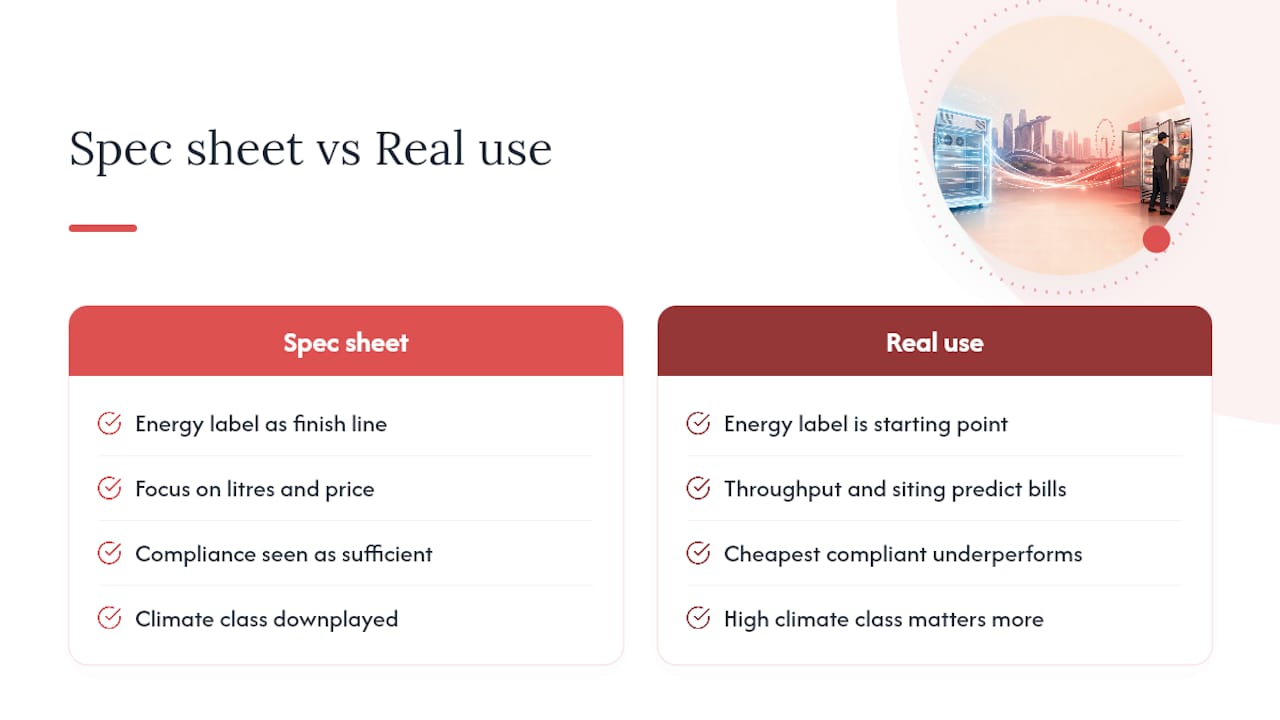
What gets underestimated constantly is the gap between rated performance and installed performance. A high climate class rating matters far more in an un-air-conditioned back kitchen than most spec sheets make obvious, and that single detail can swing real electricity use more than the difference between two mid-range compressor types. Operators comparing quotes tend to fixate on litres and price, when throughput and siting conditions are the better predictors of what the bill will actually look like in month six.
The other pattern worth naming: businesses often default to the cheapest compliant model to satisfy MEPS, then wonder why savings never materialise. Compliance is a floor, not a target. In a kitchen running units continuously, the incremental cost of the better-specified model is usually recovered fast enough that treating it as a discretionary upgrade, rather than the default choice, is the actual expensive mistake.
— David
Ready to specify the right inverter chiller for your kitchen?
If you’ve read this far, you already know the checklist: closed doors, verified annual kWh, inverter compressor, correct sizing, and a maintenance plan that actually gets followed. Superior Kitchen Equipment’s inverter counter chiller range is built around exactly that brief, so you’re not stitching together features from three different suppliers to get a compliant, grant-eligible unit.
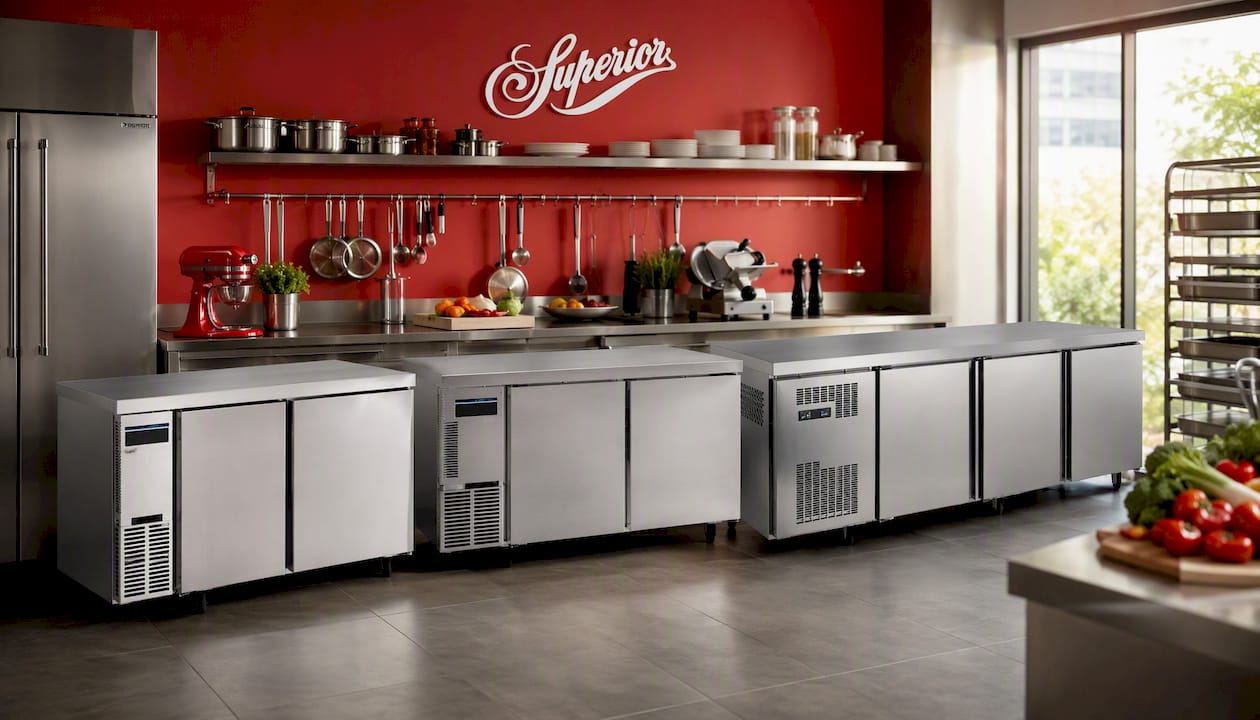
The 1.5m Superior Inverter Counter Chiller/Freezer suits prep stations needing tight footprint and steady runtime, with inverter technology that scales power to load rather than cycling on and off. For lines with a heavier throughput, the 1.8m inverter counter chiller adds capacity without sacrificing that same compressor efficiency. Both are the kind of model you’d want checked against the grant pre-approval list before you commit, and our team can walk you through that alongside the technical spec sheet.
Visit the showroom to see the full counter chiller range in person, or request a quote and we’ll confirm grant eligibility and sizing for your kitchen before you order.
Sources
- Energy saving with commercial refrigerators — Worldchefs
- Purchasing energy-efficient commercial refrigerators and freezers — U.S. Department of Energy (FEMP)
- Energy Efficiency Grant — Enterprise Singapore