
Energy-efficient commercial kitchen equipment usually cuts electricity costs and often qualifies for grant co-funding under Singapore’s Energy Efficiency Grant. It typically pays back its added cost within the equipment’s lifetime through lower utility bills and faster service. Your first move: identify the exact model and category on the EEG pre-approved list, then collect vendor quotations before you commit to purchase.
TL;DR:
- Most energy-efficient kitchen equipment qualifies for substantial co-funding under Singapore’s EEG, which can significantly reduce upfront costs.
- Proper modeling of payback relies on using actual tariffs and duty cycles, with longer operating hours leading to faster returns on investment.
- Successful application depends on timing, correct sub-sector selection, and detailed vendor quotations matching EEG specifications; missteps can delay or disqualify claims.
- Equipment choices should prioritize inverter refrigeration and induction technology, with build quality and lifecycle also influencing long-term savings.
- Complementary habits like demand-based ventilation, regular cleaning, and proper layout maintenance amplify energy savings beyond initial equipment efficiency.
Table of Contents
- Why eco friendly kitchen equipment pays for itself
- How does the Energy Efficiency Grant work for kitchens?
- What should your procurement checklist cover?
- Which operating habits protect your energy savings?
- What else matters beyond grant eligibility?
- Are there other grants besides the EEG?
- How do you compare suppliers and get competitive quotes?
- What commonly goes wrong with grant applications?
- How Superior Kitchen Equipment supports your upgrade
- A procurement tip from David at Superior Kitchen Equipment
- Sources
Why eco friendly kitchen equipment pays for itself
Buying eco friendly kitchen equipment is a life-cycle decision, not a purchase-price decision. A cheaper fryer or chiller with poor insulation or an outdated compressor costs more over five years once you add electricity and repair bills to the sticker price. The right comparison sets capital cost against energy use, maintenance frequency, and expected service life together.
ENERGY STAR guidance on commercial food-service equipment shows that certified models can deliver meaningful annual savings against standard equipment, alongside secondary benefits that rarely make it into a spec sheet.
- Faster recovery times after a fryer basket drop or oven door opening, meaning less standby energy wasted
- Longer service life on well-built compressors and induction elements, reducing replacement frequency
- More consistent output, which supports throughput during service peaks
Fact: ENERGY STAR’s own benchmarking data frames certified commercial food-service equipment as a category where efficiency gains and operational upside tend to move together, not as a trade-off between the two.
When you model payback, use your actual tariff and duty cycle rather than a generic industry average. A caterer running double shifts recovers efficiency investment faster than a café open six hours a day, simply because the appliance runs longer and the savings compound faster.
How does the Energy Efficiency Grant work for kitchens?
The Energy Efficiency Grant (EEG) Base tier co-funds pre-approved energy-efficient equipment, with support that can be substantial for SMEs and non-SMEs, capped at a government specified amount per company. The scheme has been extended to run for a limited period starting 1 April 2026.
Eligibility rests on a few checks worth confirming before you shop: your business needs the appropriate SSIC classification for food services, a valid SFA licence where applicable, minimum local shareholding, and a group turnover below a specified ceiling, alongside proof the equipment eligibility criteria are met and used in Singapore.
For food services, GoBusiness lists pre-approved equipment categories that commonly include:
- Commercial refrigerators using inverter technology
- Cooking hobs using induction technology
- LED lighting retrofits for kitchen and service areas
- Selected ventilation and cooling equipment meeting programme criteria
Applying runs through the Business Grants Portal (BGP). Enterprise Singapore’s step-by-step guide sets out the sequence: do not commence the project before submitting your application, select the correct sector and sub-sector so the claim routes to the right agency, attach vendor quotations with brand and model details, and confirm the deployment address matches your business premises.
Pro Tip: Selecting the wrong sub-sector is the single most common reason applications stall. If you run a mixed operation, such as a central kitchen supplying a retail outlet, apply under the sub-sector that matches where the equipment will actually sit.
What should your procurement checklist cover?
A grant-ready purchase order looks different from a normal one. Before you sign anything, match the model’s technical claims to the EEG’s own language: inverter technology for refrigeration, induction technology for cooking hobs. A supplier who cannot confirm this in writing is a supplier who will cost you a rejected application later.
- Ask for quantified kWh figures and the duty-cycle assumptions behind them, not just a marketing claim of “energy saving”
- Confirm installation needs including electrical load, ventilation clearance, and drainage before ordering
- Check the supplier’s maintenance and servicing terms, since a warranty gap on compressors or induction coils erodes projected savings fast
- Require quotations that state brand, model number, the deployment address, and an itemised fee breakdown ready for BGP upload
- Keep a dated procurement file showing quotations were collected before you applied, not after
Stainless steel workstations and shelving do not carry energy ratings, but they sit inside the same procurement conversation. A well-planned customised stainless steel table layout reduces staff movement around energy-hungry equipment, which shortens door-open time on refrigeration and improves how consistently your induction stations get used.
Pro Tip: Photograph your existing kitchen layout and electrical panel before ordering. Suppliers use this to confirm whether new induction or refrigeration loads need panel upgrades, and Enterprise Singapore’s own procurement guidance treats this documentation as part of a clean application.
Which operating habits protect your energy savings?
Efficient equipment only saves what you let it save. ENERGY STAR’s restaurant operations checklist sets out habits that turn a rated efficiency figure into a real utility bill reduction.
- Preheat ovens and griddles only when service is imminent, not at the start of every shift regardless of demand.
- Run exhaust hoods on demand rather than continuously; a hood running through a quiet afternoon burns power for no cooking gain.
- Clean condenser and evaporator coils on a fixed schedule, since dust buildup forces compressors to work harder for the same cooling output.
- Check door gaskets on walk-ins and reach-ins regularly; a worn seal lets warm air in and can quietly double a fridge’s run time.
- Verify thermostat accuracy periodically rather than trusting the display, since drift of even a few degrees increases compressor cycling.
Beyond daily habits, a few retrofits multiply the return on a single appliance swap. Demand-based ventilation controls and variable frequency drives (VFDs) on extraction fans adjust airflow to actual cooking activity instead of running at one fixed speed all day. Anti-sweat heater controls and timed defrost cycles on walk-in coolers cut standby losses that most kitchens never think to measure. ENERGY STAR notes that pairing controls with equipment often produces larger incremental savings than a single appliance upgrade on its own.
What else matters beyond grant eligibility?
Grant eligibility gets equipment through the door, but it is not the full efficiency picture. Rated energy consumption figures, expressed as kWh per day or per cycle, let you compare two grant-eligible models against each other rather than treating “EEG approved” as a single quality bar. A refrigerator drawing 15% less energy than another at the same purchase price is the better buy even before any grant is applied.
Certification matters too. Look for inverter-driven compressors on refrigeration and induction coil ratings on cooking hobs, since these technical standards are what the EEG’s own equipment lists are built around in the first place. Beyond the spec sheet, ask about build quality: stainless steel gauge, insulation thickness on refrigeration cabinets, and the availability of local parts and servicing all affect how long the appliance keeps performing at its rated efficiency.
Lifecycle impact is the piece most buyers skip. An appliance rated efficiently on day one that needs a full compressor replacement within three years has a worse lifetime footprint than a slightly less efficient unit built to run for a decade with routine servicing. Ask suppliers for expected service life and typical failure points, not just the energy label. A refrigerator meeting inverter or MEPS criteria recognised by local regulators gives you a technical baseline that protects both your grant claim and your on-floor performance.
Finally, weigh how the equipment fits your existing layout. A unit that is efficient in isolation but forces awkward workflow, extra walking distance, or poor ventilation clearance rarely performs to its rated figures in daily use.
Are there other grants besides the EEG?
The EEG is the main scheme aimed specifically at energy-efficient equipment, but it sits within a wider set of support available to Singapore food businesses. The Productivity Solutions Grant (PSG) supports digital and productivity-focused purchases such as point-of-sale systems, which often accompany a kitchen upgrade even though it does not fund appliances directly.
Some sector-specific schemes and enterprise development support exist for food manufacturers scaling production capacity, and these can sometimes be combined with an EEG claim on the equipment side of the same project, provided each grant’s own conditions on co-funding overlap are respected. Because scheme names, caps, and windows shift from year to year, always check the current terms directly with Enterprise Singapore or GoBusiness rather than relying on a supplier’s summary. A supplier can tell you what equipment qualifies; only the granting agency can confirm what funding stacks together for your specific business structure.
Treat grant-hunting as a secondary exercise to the equipment decision itself. Chasing a smaller, unfamiliar grant for a marginal saving is rarely worth delaying a well-planned EEG application on your main refrigeration or cooking equipment.
How do you compare suppliers and get competitive quotes?
Start with three quotations minimum, not because it is a formality, but because energy specifications vary more between suppliers than most buyers expect for what looks like the same category of appliance.
Ask every supplier the same set of questions so the quotations are actually comparable: rated kWh consumption, warranty length on compressors or induction elements, whether the model appears on the current EEG pre-approved list, and expected lead time for delivery and installation. A supplier who cannot answer the energy question directly, and instead points to a general efficiency claim, is a weaker candidate for a grant-linked purchase.
Site visits matter more than brochures for kitchen equipment. Seeing a commercial chiller or freezer running, hearing the compressor noise, and checking build quality in person tells you think a spec sheet cannot. The same goes for induction cooking, where coil response and control panel layout affect how your line cooks actually use the equipment day to day.
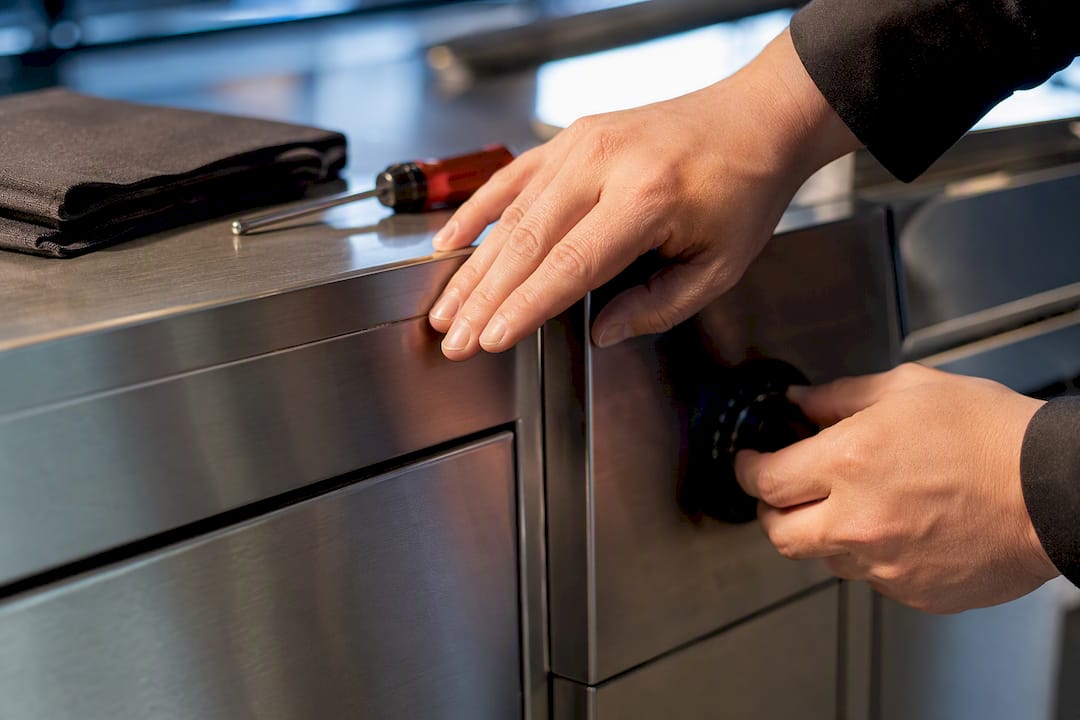
Once you shortlist a supplier, request the final quotation in the exact format BGP needs: brand, model, unit price, deployment address, and an itemised breakdown separating equipment cost from installation or delivery fees. Suppliers experienced with EEG applications will provide this without extra prompting, which is itself a useful signal of how smoothly the rest of the process will go.
What commonly goes wrong with grant applications?
The most frequent pitfall is starting the project before the application is submitted. Enterprise Singapore’s own guidance is explicit that this can disqualify an otherwise eligible purchase, yet it happens often when a fridge breaks down and a business owner orders a replacement out of urgency.
Sector and sub-sector selection errors are the second common failure. Choosing a sub-sector that does not match your actual SSIC classification routes the application to the wrong reviewing team and typically forces a resubmission, losing weeks in the process.
Incomplete or mismatched quotations also cause delays. If the deployment address on the quotation does not match your registered business premises, or the model number on the invoice differs even slightly from what was approved, expect a request for clarification at best and a rejection at worst.
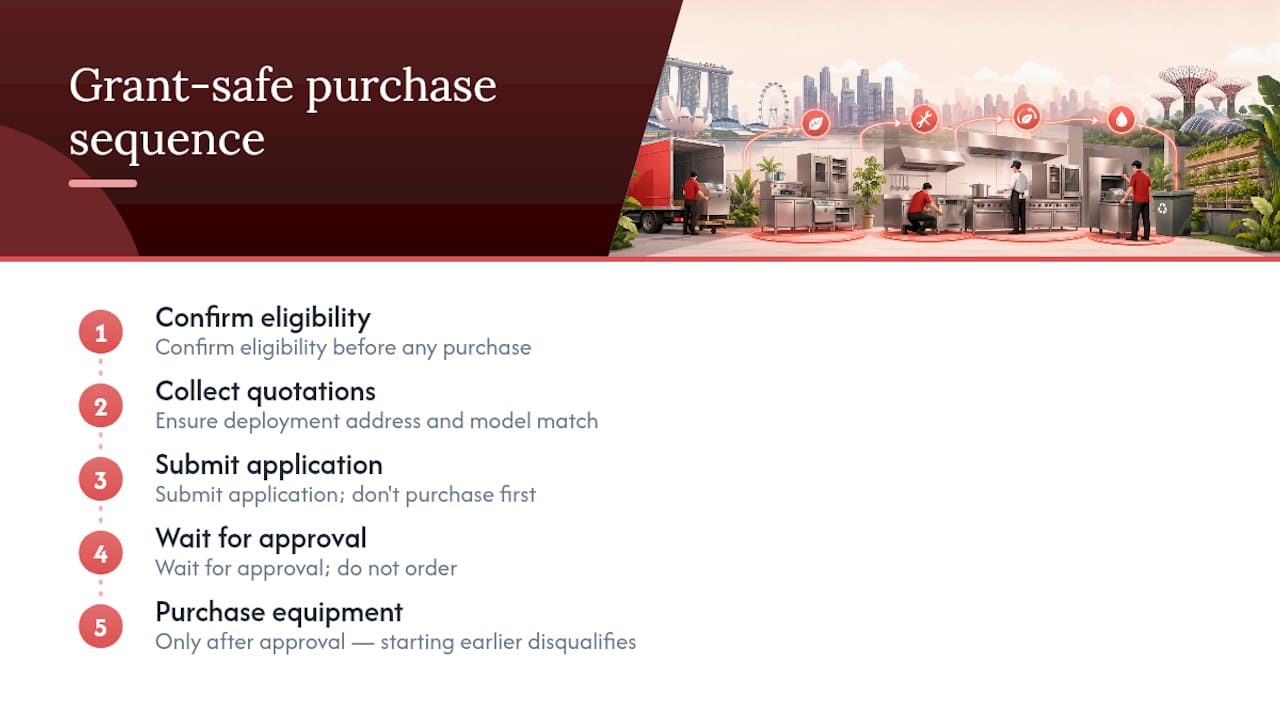
Avoiding these pitfalls comes down to sequencing discipline: confirm eligibility, collect quotations, apply, wait for approval, then purchase. It reads as bureaucratic, but it is the order that protects your co-funding.
How Superior Kitchen Equipment supports your upgrade
A supplier can provide energy-efficient commercial chillers, freezers, and induction cooking equipment that match EEG pre-approved categories, alongside procurement support to help you prepare grant-ready quotations.
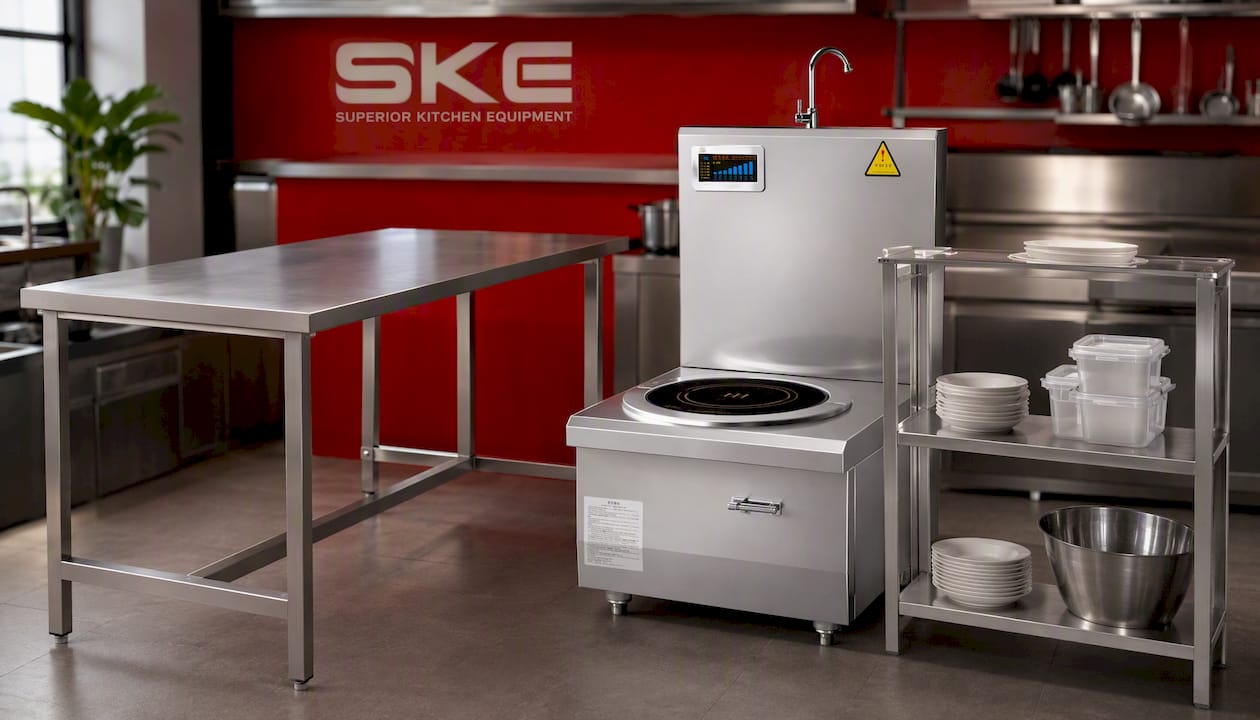
Three products fit naturally into an efficiency upgrade project. The Customized Stainless Steel Table supports better kitchen workflow, keeping staff closer to induction stations and refrigeration to reduce wasted movement and door-open time. The Induction Soup Boiler replaces gas-fired stockpot burners with induction heating, cutting ambient heat load in the kitchen and removing a gas connection from your energy mix entirely. Stainless Steel Tabletop Shelves keep prep surfaces organised and hygienic, supporting the kind of tight, efficient layout that helps refrigeration and cooking equipment run at their rated performance rather than working harder to compensate for clutter.
Read the Energy Efficiency Grant overview on our blog, then request a quotation that includes energy specifications and your deployment address ready for BGP submission. Visiting a showroom lets you inspect induction and refrigeration equipment firsthand before you commit.
A procurement tip from David at Superior Kitchen Equipment
A procurement tip: collect and label every quotation and BGP document before you buy anything, not after. Applications that stall almost always trace back to sequencing, not equipment choice. Contact suppliers for a grant-aware quotation or arrange a site visit.
— David