

For bulk solid prep, buy a commercial food processor; for liquid-heavy menus and front-of-house drinks, buy a commercial blender. The two machines are not interchangeable, and the decision comes down to your menu mix and batch size. The market offers product ranges including Cold / Hot Soup Glass Blenders and food processors from 1.8L to 6L, so operators can compare the right specification against their own service numbers.
TL;DR:
- Choose a food processor for bulk solid prep tasks that require high torque, such as chopping and kneading, rather than relying on high RPM blenders.
- Match your equipment’s capacity to peak-hour volume estimates rather than average demand, as actual throughput often falls short of rated capacity.
- Prioritize torque ratings and duty cycle data from suppliers to ensure machines can handle continuous, high-volume use without overheating or failure.
- Conduct hands-on showroom testing to assess noise, ergonomics, and real cycle times, ensuring the equipment suits your workflow and environment.
- Map each menu item to either solid or liquid prep and size equipment according to peak-hour needs to avoid inefficiencies and premature wear.
Table of Contents
- Commercial blender vs food processor: comparing the capabilities
- When should you use a food processor or a blender?
- How do you choose the right commercial equipment specification?
- How do you keep a commercial blender or processor running safely?
- How Superior Kitchen Equipment supports your buying decision
- Why menu-mapping beats brand loyalty every time
- Ready to compare machines against your own menu?
- Sources
Commercial blender vs food processor: comparing the capabilities
The core difference between these two machines is what they do to an ingredient’s cell structure, not just how fast they spin. A food processor bowl and its S-blade or discs are built to cut, shred, and knead with control, producing a consistent particle size in solid or semi-solid ingredients. A blender jar narrows toward the blade to force liquid into a vortex, pulling ingredients back down through the blade repeatedly until the mixture is smooth. Commercial food processors are optimised for solid-ingredient batch prep such as slicing, shredding, kneading, and bulk chopping, while blenders handle high-speed liquid work like soups, smoothies, and frozen beverages.
Motor behaviour tells the same story from a different angle. Blenders run at very high RPM to shear liquids and ice, and commercial models typically create a vortex effect at those speeds for an ultra-smooth finish. Food processors, by contrast, rely more on torque than raw speed. Kneading dough or shredding a dense root vegetable needs sustained turning force rather than blistering RPM, which is why processor motors are geared differently even when their wattage looks similar on a spec sheet.
Capacity translates into throughput differently for each machine too. A blender’s jar volume roughly equals one batch of finished liquid, so a jar gives you close to that volume of soup or purée per run. A food processor’s bowl capacity is less generous in practical terms, because solid ingredients don’t compress the way liquids do. A 6L bowl might only yield 4L of shredded cabbage once you account for airspace, so buyers should size up rather than trust the litre rating literally.
Versatility and cleaning burden move in opposite directions. Processors win on versatility, since interchangeable discs and S-blade systems let one unit slice, grate, mince, and knead, replacing several manual tools and knife stations. That same modularity means more parts to strip down, wash, and reassemble at the end of a shift. Blenders have fewer parts, usually just a jar, lid, and blade assembly, and many commercial units now include a rinse or self-clean cycle that cuts turnaround between drink orders.
Noise is the deciding factor for front-of-house placement. A blender running at full speed on ice is loud enough to disrupt conversation in a small café, which is why sound-enclosure options and pre-programmed cycles have become standard on bar-facing models. Processors are mostly used out of customer earshot, so noise rarely factors into that purchase.
- Texture control: processors for consistent chop/shred, blenders for smooth purée or emulsion
- Motor priority: torque and duty cycle for processors, RPM and heat handling for blenders
- Capacity reading: blender litres are near-literal, processor litres need a real-world discount
- Cleaning load: processors need more disassembly time; blenders are faster to turn around
- Noise exposure: blenders need sound management near guests; processors generally don’t
When should you use a food processor or a blender?
Match the appliance to the job at hand rather than trying to make one machine cover both roles. Many well-run kitchens run dedicated stations for each, processors for bulk prep and blenders for sauces and drinks, instead of forcing a single unit to switch tasks all shift.
- Back-of-house bulk prep — vegetable dicing, cheese grating, dough mixing, and coleslaw shredding all belong on a processor, similar to preparations seen in seitan döner production. Any task producing more than roughly five servings’ worth of solid ingredient favours the processor’s disc system over hand-cutting.
- Sauce and soup finishing — purées, veloutés, and emulsified dressings need the blender’s vortex action to hit a genuinely smooth consistency, something a processor blade struggles to match on thin liquids.
- Bar and beverage service — smoothies, frozen cocktails, and milkshakes are blender territory exclusively, and a front-of-house unit should sit close to the ice supply and glassware, not tucked away in the prep kitchen.
- Batch dough and pastry work — bakeries and pizzerias lean on processor torque for kneading, since blender blades aren’t built to handle stiff dough without stalling the motor.
- High-volume catering prep — when a menu specifies large-format dishes for events, a bigger-bowl processor cuts labour time dramatically on tasks like shredding cabbage or dicing onions for hundreds of covers.
Kitchen layout should follow the same logic. Put the processor near the prep bench and cold storage, since it’s feeding mise en place rather than plated dishes. Put the blender near the pass or the bar, close to where the finished soup, sauce, or drink actually leaves the kitchen. Separating the two stations avoids a bottleneck where staff queue for one machine to do two unrelated jobs, and it also means a broken blender doesn’t stop your vegetable prep for the day.
How do you choose the right commercial equipment specification?
Start with the menu, not the brochure. List every dish or drink that needs mechanical prep, tag each one as solid or liquid work, then estimate peak-hour volume rather than an average day. Matching capacity to peak throughput matters more than covering typical demand, since a machine that copes on a quiet Tuesday can still choke during Saturday dinner service.
Convert that peak volume into servings per hour, then check it against the manufacturer’s rated capacity per cycle and realistic cycle time, including load and unload. A blender rated for a 2L jar and a 45-second cycle can theoretically produce well over 100 servings an hour of an 8oz drink, but real-world throughput drops once you factor in ice loading and cup filling.
On motor specification, look for wattage in the 1,500 to 3,500W range for a genuinely commercial blender, and confirm the duty cycle, meaning how long the motor can run continuously before needing a rest, rather than relying on peak-power marketing figures alone. For processors, ask about torque rating and whether the motor is rated for continuous dough work, since a unit built for occasional chopping will overheat quickly under sustained kneading.
- Ask suppliers for duty-cycle figures in writing, not just peak wattage
- Confirm which discs, blades, or jars are included versus sold separately
- Check whether jars and bowls are dishwasher-safe or need manual stripping
- Request the machine’s decibel rating if it will sit near guests
- Ask about spare parts lead time and local warranty support before signing
Attachments deserve a hard line between essential and optional. A shredding disc and a slicing disc cover most vegetable prep and should be considered standard, while a julienne disc or a citrus attachment are nice extras that rarely justify a price premium unless your menu specifically calls for them. For blenders, a tamper or plunger for thick mixtures is worth requiring, while a second jar is a convenience rather than a necessity.
Sanitation design should carry as much weight as raw power in the buying decision. Smooth internal surfaces, minimal crevices around the blade seal, and tool-free disassembly all reduce allergen cross-contamination risk and cut cleaning time between services. Energy efficiency is worth raising with any supplier too, since lower running costs and grant eligibility can meaningfully change the total cost of ownership over the appliance’s working life.
Pro Tip: Ask for the machine’s warranty terms and average spare-parts delivery time before you compare price. A cheaper blender that takes three weeks to source a replacement jar during a busy season will cost you far more in lost service than the saving on the invoice.
How do you keep a commercial blender or processor running safely?
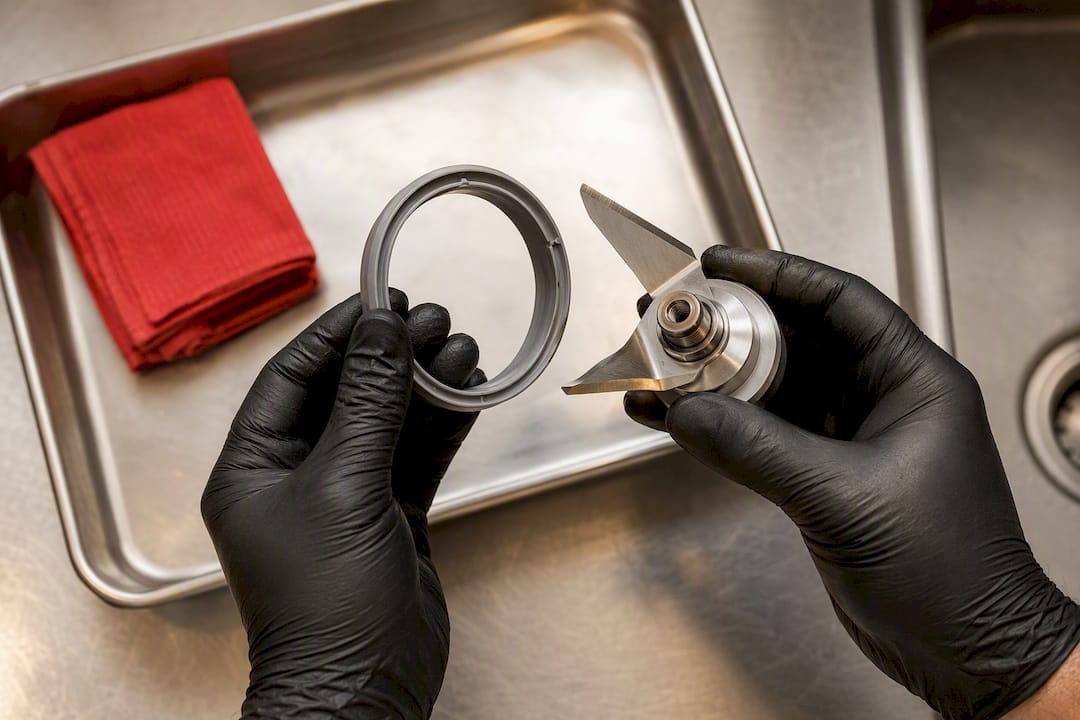
Daily strip-down and sanitation should be non-negotiable, not optional depending on how busy service was. Rinse jars and bowls immediately after each use to stop food residue drying onto blades, and confirm which parts are genuinely dishwasher-safe versus which need a manual soak, since sending a heat-sensitive seal through a commercial dishwasher repeatedly will shorten its life.
Cleaning design matters as much as motor power for reducing allergen cross-contamination between dishes, particularly on processors where multiple discs and blades pass through the same bowl during a shift. A processor genuinely reduces manual knife time on bulk vegetable prep, but it typically adds noticeable extra cleaning time per shift compared with a standalone blender, so factor that labour cost into staffing rather than treating the machine purchase as the only saving.
- Strip blades and seals daily and inspect for nicks or wear that could harbour bacteria
- Check motor coupling and drive shafts weekly for looseness or unusual heat
- Keep a small stock of spare blades and gaskets rather than waiting for a failure
- Train staff to always use the tamper or pusher, never fingers, near a feed chute
- Log any unusual vibration or smell immediately rather than running the machine “one more shift”
Noise mitigation deserves its own line item where a blender sits near guests. A sound-enclosure fitted blender can cut perceived noise dramatically compared with an open unit, which matters more in a small café than in a cavernous banquet kitchen. Operator training on feed-chute safety and blade handling remains one of the simplest, cheapest ways to prevent the most common commercial kitchen injuries linked to these machines.
How Superior Kitchen Equipment supports your buying decision
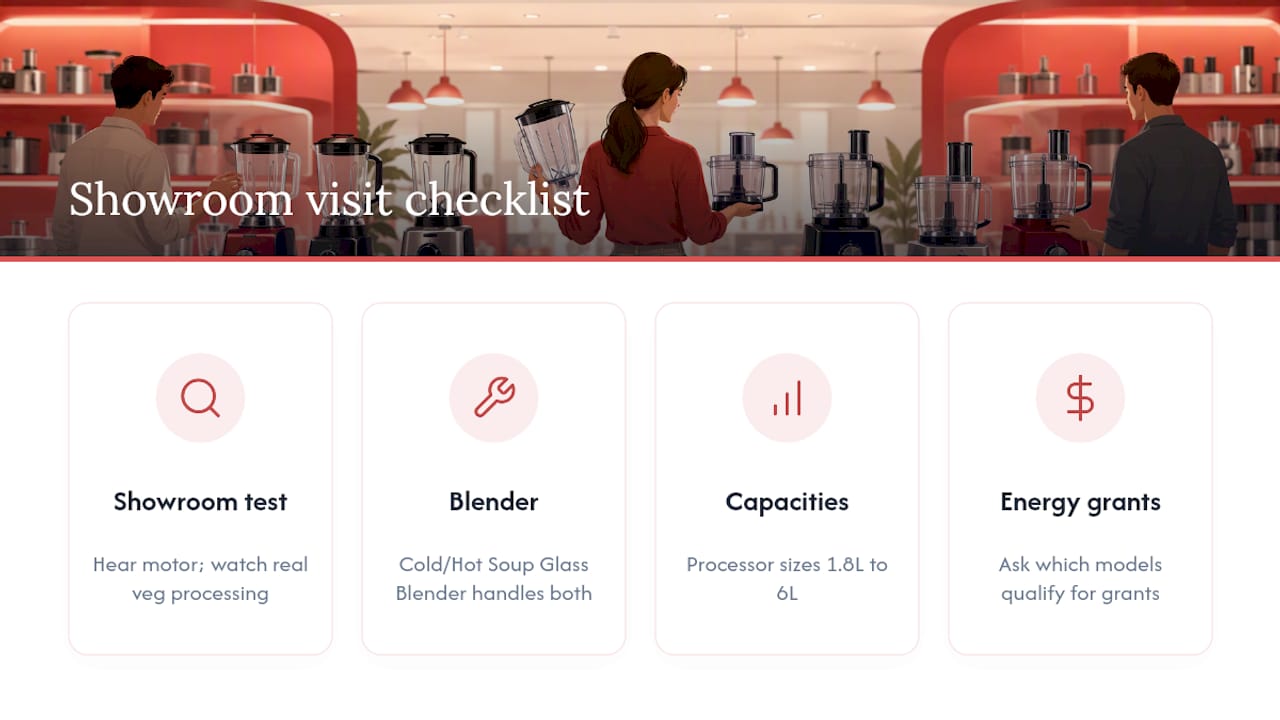
Reading a spec sheet only tells you so much. A showroom visit lets you hear a blender at full speed, watch a processor handle a genuinely tough root vegetable, and check whether the noise level or the bowl capacity actually suits your kitchen before you commit budget to it. That hands-on comparison catches problems a data sheet never will, particularly around ergonomics and real cycle time.
Superiorkitchenequipment’s range covers both sides of this decision directly. The Cold / Hot Soup Glass Blender suits operators running hot soups or sauces through the same machine used for cold smoothies, while the food processor line spans 1.8L capacity for smaller kitchens up to 6L for higher-volume prep. Bringing your actual menu and peak service figures to a showroom visit turns a general spec comparison into a decision based on your own numbers.
Energy efficiency is worth raising during that visit too. Grant schemes tied to energy-efficient kitchen equipment can materially lower the total cost of a purchase over its lifetime, and it’s worth asking which models in the range qualify before finalising a specification.
Why menu-mapping beats brand loyalty every time
The mistake most operators make is picking a brand they trust and then working backwards to justify it for every task in the kitchen. That gets expensive fast, because a blender pushed into shredding duty or a processor forced into soup work will underperform and wear out faster than a machine matched to its actual job.
What the evidence in this comparison actually supports is narrower and more useful: map every dish and drink on your menu to solid or liquid prep, size the machine to your peak hour rather than your average day, and buy for duty cycle over headline wattage. Conventional advice tends to stop at “get a good blender and a good processor” without pushing further into batch-size arithmetic or cleaning-time trade-offs, and that’s where kitchens quietly lose money on labour they never budgeted for.
If you take one thing from this comparison, prioritise the peak-hour throughput calculation before anything else. Everything downstream, capacity, motor spec, attachments, follows from getting that number right first.
— David
Ready to compare machines against your own menu?
Buying kitchen equipment from a spec sheet alone leaves too much to guesswork, and that’s exactly what a showroom visit to a kitchen equipment supplier is built to solve. Bring your menu list, your busiest hour’s order count, and any dishes you’re unsure about, and you can run them past an actual machine rather than a product description.
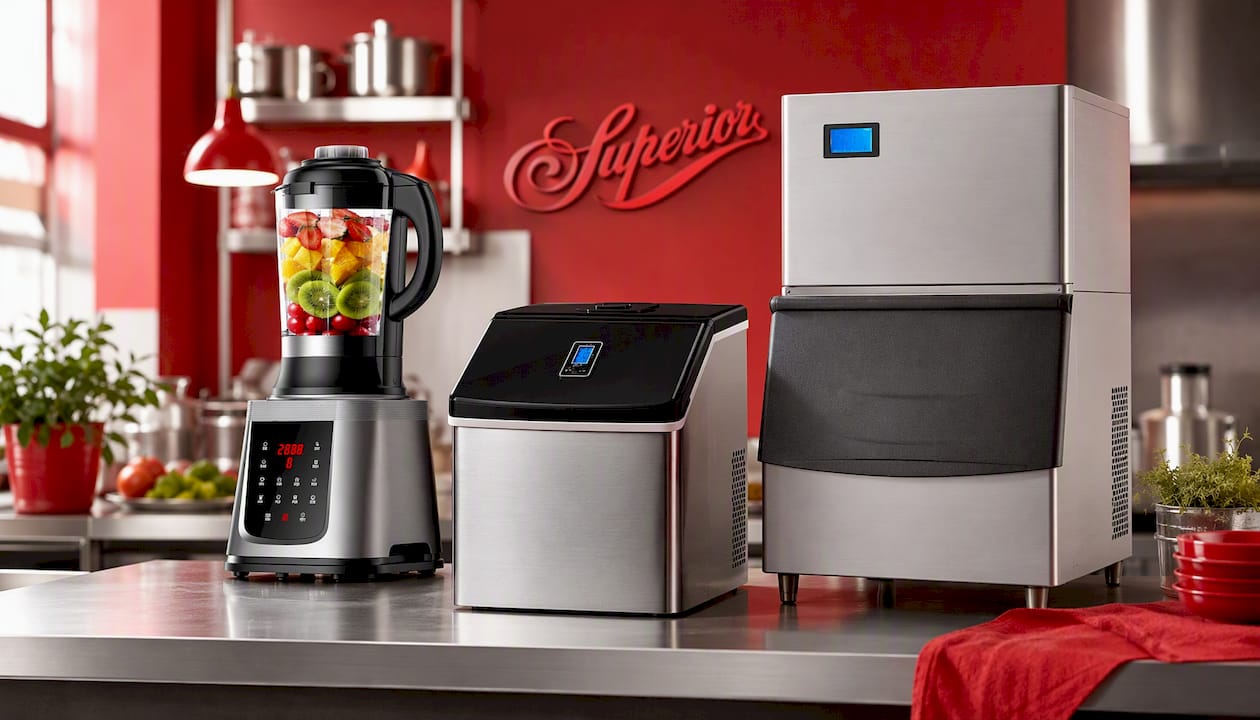
Beyond blenders and processors, the same visit is worth it for beverage-heavy menus that depend on a steady ice supply. The Tabletop Ice Maker suits smaller bars and cafés, while operations running high-volume catering or a busy drinks programme should look at the Ice Maker Machine 500KG for continuous supply during peak trading. Every product on the site is paired with guidance on energy-efficiency grants where applicable, which can bring the real cost of an upgrade down well below the sticker price.
Get in touch to book a showroom slot or request a quote against your menu and peak-service numbers, and see the Cold / Hot Soup Glass Blender and the full processor range side by side before you decide.