

Most commercial kitchen equipment typically pays back its cost within a few years, and the single biggest variable is utilisation, how many hours a day the machine actually earns its keep. A soft-serve machine used through three daily rush periods can pay back in under a year; the same machine sitting idle half the week takes three times as long. Financing terms and grant support can shift that timeline further, sometimes cutting the effective wait by half.
TL;DR:
- Equipment utilization greatly impacts payback speed, with machines used during peak hours paying back in under a year, while idle periods extend that timeline.
- The typical payback period ranges from one to five years, but high-margin items like coffee machines can recover costs in just a few weeks, depending on sales volume.
- Financing options like leasing or loans usually delay the formal payback period, but monthly net benefits often cover lease payments immediately, maintaining cash flow.
- Grants and tax incentives in Singapore, such as the Energy Efficiency Grant and capital allowances, can significantly shorten payback, especially when equipment is pre-approved and well-documented.
- Building a conservative, scenario-based payback forecast and verifying specifications through showroom visits improve accuracy and help secure funding approvals.
Table of Contents
- What does restaurant equipment payback actually mean?
- How do you calculate payback and ROI, step by step?
- Which factors change the payback period most?
- How does financing change your actual payback timeline?
- What grants and tax rules shorten payback in Singapore?
- How do you build a defensible payback estimate in a spreadsheet?
- How does showroom testing and grant paperwork shorten real-world payback?
- Should you always choose the equipment with the shortest payback?
- How can Superior Kitchen Equipment help you shorten payback?
- Where can you verify grant and tax details yourself?
- Sources
- FAQ
What does restaurant equipment payback actually mean?
Restaurant equipment payback is the time it takes for a piece of kitchen equipment to generate enough net financial benefit to cover its full installed cost. It’s the practical cousin of the more formal metric, kitchen equipment return on investment, and operators tend to reach for payback first because it answers the question that matters at 11pm when the invoice is due: when do we get this money back?
Industry benchmarks put typical commercial kitchen equipment payback somewhere between one and five years, with high-margin categories like bean-to-cup coffee or soft-serve programmes often paying back relatively quickly. Multi-purpose combi ovens, which replace several older units at once, usually take twenty-four to thirty-six months because the savings arrive gradually across many functions rather than in one obvious spike.
How do you calculate payback and ROI, step by step?
The formula is simpler than most operators expect, and you can run it on the back of a supplier quote.
- Simple payback period = total installed cost ÷ annual net benefit.
- ROI = (net benefit ÷ cost) × 100, expressed as a percentage.
- Total installed cost is not just the sticker price. Add delivery, installation labour, any electrical or plumbing upgrades, ventilation work, and staff training.
- Annual net benefit = incremental gross profit from extra sales, plus labour savings, plus energy savings, minus any added maintenance cost.
Two worked examples show how differently this plays out depending on the category.
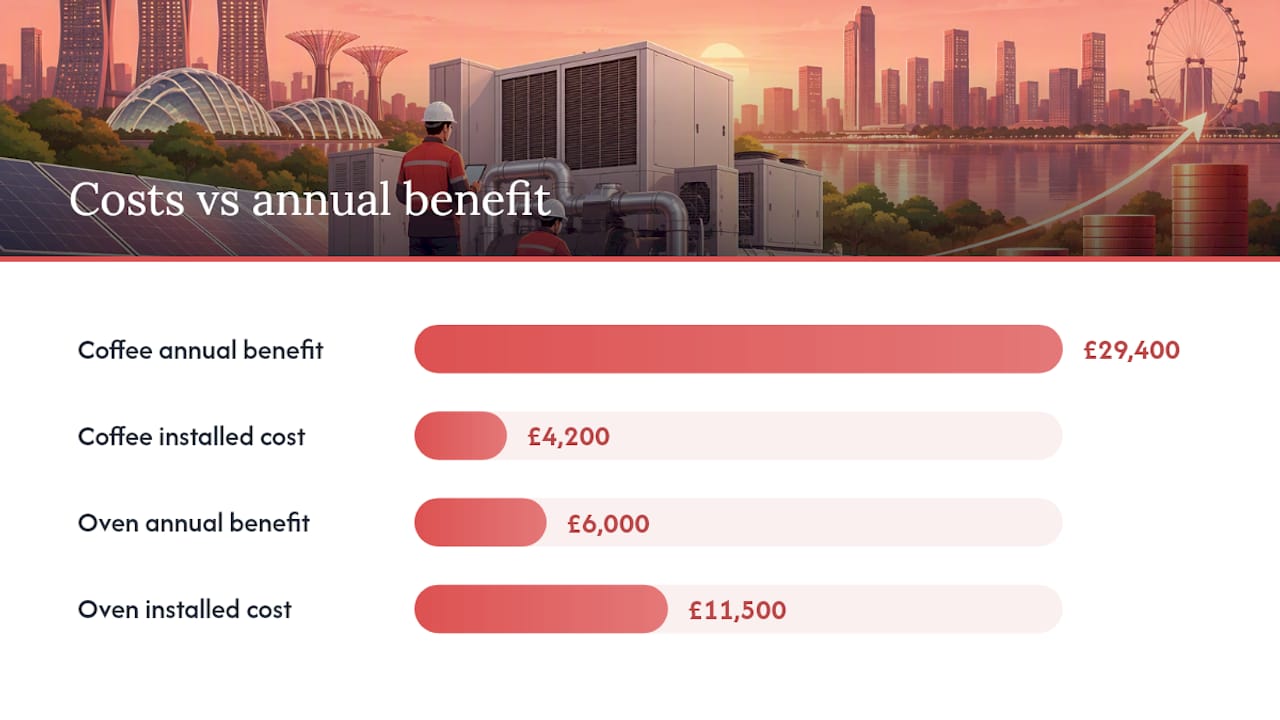
Example A: bean-to-cup coffee machine. Total installed cost, including a small electrical upgrade, comes to £4,200. It adds forty extra coffee sales a day at a 70% gross margin on a £3.50 cup, roughly £98 a day in gross profit, or about £29,400 a year assuming a 300-day trading calendar. Payback lands at roughly seven weeks, an example of why high-margin, high-frequency items dominate the fast end of the payback range.
Example B: combi oven. Total installed cost, including ventilation adjustments, comes to £11,500. It replaces two older ovens, cutting energy use and freeing up 90 minutes of staff time daily, worth around £14 in labour plus £6 in energy savings per operating day. Over 300 days, that is £6,000 a year, giving a payback of just under two years. The oven’s broader lifecycle value, consistency, capacity, and reduced staff strain, doesn’t show up in the maths but matters just as much in practice.
Which factors change the payback period most?
Payback is a moving target, and testing your assumptions against reality separates a defensible forecast from wishful thinking.
- Utilisation drives everything: a machine running twelve hours a day, six days a week, earns back its cost far faster than one running half that schedule, and seasonal dips (a quiet January after a busy December) need to be built in, not ignored.
- Energy use matters more than most quotes reveal; two fryers with identical prices can have meaningfully different measured kWh draw, and certified energy-efficient models typically close that gap.
- Labour savings come from consolidation, one combi oven doing the work of a grill, a steamer, and a convection oven, cuts prep time and reduces the headcount needed at peak service.
- Maintenance and downtime risk eat into projected savings fast; a unit with a thin local service network can sit broken for a week, wiping out a month’s worth of projected benefit.
- Menu fit decides whether the equipment’s output matches what customers actually order; a machine that produces something your regulars don’t want has no payback story at all.
Pro Tip: *Ask any supplier for the measured annual kWh rating, not the nameplate wattage.
How does financing change your actual payback timeline?
Simple payback assumes you paid cash. Most operators don’t, and financing changes the break-even date in ways worth mapping out before you sign anything.
- Bank loan: interest adds to the total cost recovered, so the “financed payback” date is always later than the cash payback date, though the gap is often smaller than owners expect if the annual net benefit is strong.
- Operating lease: monthly payments replace the need for a capital outlay, so cash-flow payback (when the equipment starts contributing net positive cash each month) can arrive on day one, even though the accounting payback period stretches over the lease term.
- Lease-to-own: sits between the two, usually with higher monthly costs than an operating lease but ownership at the end.
A quick illustration: buying the £11,500 combi oven outright means waiting roughly two years for the cash to return. Leasing the same oven at, say, £350 a month means the monthly net benefit (roughly £500 from labour and energy savings) exceeds the payment from month one, so cash-flow payback is immediate, even though the economic payback period barely changes. As a rule of thumb, leasing preserves cash without lengthening true economic payback whenever the monthly net benefit already covers the lease payment with room to spare.
What grants and tax rules shorten payback in Singapore?
Two government levers do more to shorten payback than almost any equipment feature: the Enterprise Singapore Energy Efficiency Grant, and IRAS capital allowances.
- The Energy Efficiency Grant (EEG) covers up to 70% of qualifying costs for pre-approved energy-efficient equipment, including refrigerators, cooking hobs, and water heaters, capped at S$30,000 per company per year at base tier.
- A separate advanced tier exists for larger projects, with different eligibility and a project-level assessment rather than a flat cap.
- IRAS capital allowances let businesses write off qualifying equipment over one, two, or three years depending on the method elected, which brings forward the tax benefit and improves cash flow in the early years.
Applying the EEG to Example B changes the picture considerably.
Base-tier EEG support has an annual cap on the support amount per company, so operators buying several eligible items should sequence applications across categories or years to make the most of it.
A few administrative details matter more than they should: quotations must be addressed to your exact registered company name, payment cannot be made before the application is approved, and you’ll need product brochures, technical specifications, and deployment photos ready before you submit.
How do you build a defensible payback estimate in a spreadsheet?
A clean payback forecast has one column for costs and one for benefits, run through three scenarios rather than one hopeful number.
- List every cost line: quoted price, delivery, installation, electrical or plumbing upgrades, and staff training.
- List every benefit line: incremental gross profit, energy savings (measured kWh, not nameplate), labour savings, minus any added maintenance.
- Apply grant support and capital allowance timing to adjust the net cost and the effective first-year cash position.
- Run the numbers three times, best case, expected case, worst case, each with different utilisation assumptions, and report months to payback alongside a simple ROI percentage for each.
| Scenario | Utilisation assumption | Months to payback |
|---|---|---|
| Best case | Peak hours, 6 days/week | Fastest |
| Expected case | Realistic average, seasonal dip included | Middle |
| Worst case | Reduced hours, slower ramp-up | Slowest |
Present all three figures to management or a lender rather than a single number. A range built on honest utilisation assumptions holds up far better under scrutiny than a single optimistic estimate that falls apart the first time footfall dips.
How does showroom testing and grant paperwork shorten real-world payback?
Payback estimates only hold up when the underlying assumptions come from equipment you’ve actually seen run, not a spec sheet. Superiorkitchenequipment specialises in energy-efficient kitchen equipment for Singapore’s food service sector, and offers products that let businesses claim grants of up to 70% of the original cost while cutting electricity bills by as much as 40%.
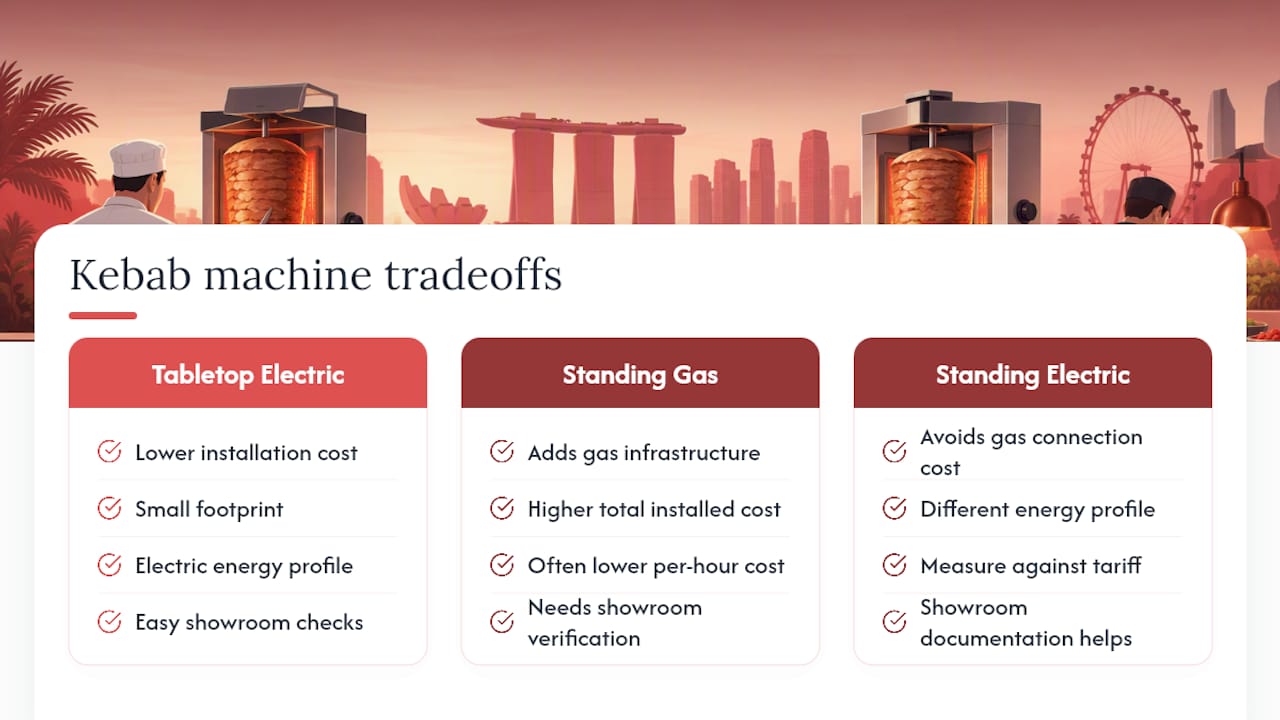
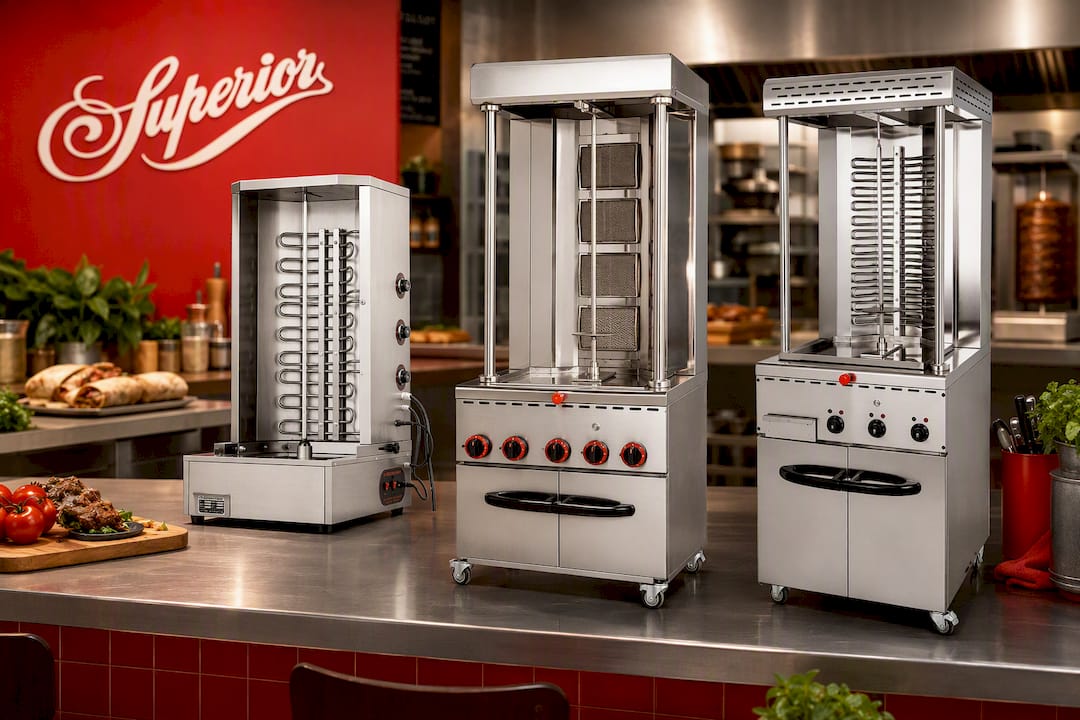
Three examples from the catalogue show how equipment choice alone shifts the payback conversation. A Tabletop Large Electric Kebab Machine suits a tight kitchen footprint with lower installation costs than a standing unit. A Standing Gas Kebab Machine needs gas supply infrastructure, which adds to total installed cost but often runs cheaper per hour at high volume. A Standing Electric Kebab Machine avoids that gas connection cost but carries a different energy profile worth measuring against your actual electricity tariff.
Showroom visits let you check serial numbers, collect brochures, and confirm technical specs, exactly the documentation an EEG application needs.
Should you always choose the equipment with the shortest payback?
Not always. Payback is a ranking tool, not a verdict, and the fastest number on the page sometimes hides a shorter lifespan or a thinner service network. I’d weigh payback against expected lifespan, downtime risk, and warranty support before signing anything, and I’d always ask a vendor how long parts stay in stock. A machine with a slightly longer payback but a decade of reliable service usually beats a quick win that fails in year three.
— David
How can Superior Kitchen Equipment help you shorten payback?
If you’ve worked through the maths above and landed on a category worth upgrading, the next question is practical: which supplier gets you EEG-ready paperwork without the back-and-forth. Superiorkitchenequipment provides quotations addressed correctly for grant applications, along with the technical specs and serial numbers assessors ask for, so you’re not chasing documents after the fact.
A sensible next step is to request an EEG-ready quotation for the equipment category you’re evaluating, ask for the measured energy specs so your payback maths holds up, and book a showroom visit to see the units running before you commit. Browse the full product collection to compare categories side by side, or start with a specific line if you already know what you need.
Where can you verify grant and tax details yourself?
- Energy Efficiency Grant (EEG) - Enterprise Singapore: full eligibility criteria and tier structure.
- EEG application checklist (PDF): required documents and quotation rules.
- Capital allowances - IRAS: write-off options affecting cash flow.
- Sustainability in food services: operator guide: utilisation and energy-efficiency context for operators.
Sources
- Quick tips for Energy Efficiency Grant (EEG) applications (checklist) - EnterpriseSG
- Energy Efficiency Grant (EEG) - EnterpriseSG (detailed page)
- Capital allowances - IRAS
FAQ
What is the 30/30/30/10 rule in restaurants?
Equipment payback calculations feed directly into the overheads and profit lines, since faster payback frees up margin sooner.
How many years do you depreciate restaurant equipment?
Depreciation schedules vary by jurisdiction and equipment type, but Singapore businesses can use IRAS capital allowances to write off qualifying kitchen equipment over one, two, or three years depending on the method elected. Choosing an accelerated write-off brings the tax benefit forward, improving early cash flow.
Who finances restaurant equipment?
Options include bank term loans, equipment leasing companies, and lease-to-own arrangements offered through some equipment suppliers. Superiorkitchenequipment can supply the vendor quotations and technical documentation needed whichever financing route you choose, particularly where grant support is involved.
How do I sell used restaurant equipment?
Used commercial kitchen equipment is typically sold through equipment resellers, trade classifieds, or auction platforms specialising in food service assets. Getting a fair price usually depends on documented service history and remaining lifespan, factors worth tracking from the day you first calculate payback.
What is a realistic restaurant equipment payback range?
Most equipment falls between one and five years, with high-margin categories like coffee or soft-serve programmes often paying back in six to eighteen months. Grants such as the EEG and accelerated tax write-offs can shorten that range considerably for qualifying purchases.