

A saladette is a compact, counter-height chiller with a row of cold pans on top, built for assembling cold ingredients at the point of service. A prep table is the larger refrigerated work station: pan rail, cutting board and refrigerated storage underneath. Choose a saladette when the task is portioning and topping, and a prep table when staff also prepare, cut and assemble on the unit and need stock within reach. At Superior Kitchen Equipment, we supply table-top salad bar chillers and guide Singapore food businesses on energy-efficient refrigeration and the Energy Efficiency Grant (EEG).
This guide explains how the two differ, how a worktop fridge and the sandwich and pizza versions fit in, and how to check energy use and grant eligibility before you buy.
TL;DR
- A saladette is a pan-rail chiller for holding and portioning cold toppings. A prep table adds a cutting board and refrigerated storage below, so it works as a full assembly station.
- A worktop fridge has a flat stainless steel top and no pan rail. It stores stock and gives work surface, but does not hold ingredients ready for assembly.
- Sandwich prep tables are shallower. Pizza prep tables have a deeper board and are built for wide, flat toppings.
- Energy use depends on the exact model, door habits and kitchen heat. Check the model’s declared energy data and the EEG criteria rather than assuming eligibility.
- Under the EEG, support of up to 70% applies to SMEs for eligible equipment, so confirm the model before you order.
Table of Contents
- What a saladette is
- What a prep table is
- Saladette vs prep table: side by side
- Prep table vs worktop fridge
- Sandwich prep table vs pizza prep table
- How to decide: five questions
- Running costs and energy use in Singapore
- Energy labels and EEG grant eligibility
- Which one for which business
- Our perspective
- See the range in person
- FAQ
- Sources
What a saladette is
In commercial kitchens, “saladette” usually describes a counter-top refrigerated unit with a recessed rail that holds food pans of cut vegetables, cheese, sauces, cold proteins or garnishes. The unit sits on a bench or a stand. Staff pick from the pans and assemble on a separate work surface nearby.
Typical users are salad counters, bubble tea and dessert shops, sushi and poke bars, sandwich counters and cafés with a short cold menu. The unit’s job is to keep ingredients cold and visible while service moves quickly.
Our range includes table-top salad bar chillers in three lengths: 1.2m, 1.5m and 1.8m. Length decides how many pans you can hold, and that follows from how many ingredients your menu calls for.
What a prep table is
A refrigerated prep table combines three things in one footprint:
- A refrigerated pan rail on top for ready-to-use ingredients.
- A cutting board or work surface in front of the rail.
- Refrigerated storage below, behind doors or drawers, for back-up stock.
Because storage sits under the work surface, a cook can refill pans without leaving the station. That is the main workflow gain. The unit is bigger, heavier and has a larger cooled volume than a saladette, so it suits kitchens that assemble many orders per hour from the same spot.
Saladette vs prep table: side by side
| Feature | Saladette | Refrigerated prep table |
|---|---|---|
| Main job | Holds and portions cold toppings | Holds toppings, gives a work surface and stores stock |
| Layout | Pan rail on a compact counter-top body | Pan rail, cutting board and cooled cabinet in one unit |
| Storage below | None, or the unit sits on a separate stand or fridge | Doors or drawers with refrigerated storage |
| Footprint | Small, fits a counter | Larger, needs floor space |
| Best for | Salad, dessert, bubble tea and topping counters, short menus | Sandwich, burrito, pizza and assembly-line kitchens |
| Refilling | Fetch stock from a separate chiller | Refill from the cabinet beneath |
| Cooled volume | Smaller | Larger |
The practical question is where your stock lives. If you already have a reach-in chiller or an undercounter fridge close to the counter, a saladette adds the pan rail you are missing. If you have no cold storage near the assembly point, a prep table avoids repeated walks to the back.
Prep table vs worktop fridge
A worktop fridge, also called an undercounter chiller, is a refrigerator with a flat stainless steel top. It stores ingredients and gives you a surface to work on, but it has no pan rail, so ingredients stay inside until staff fetch them.
Use this rule of thumb:
- Worktop fridge: your team preps in batches, stores finished prep, and plates or assembles elsewhere. The top is for light work, such as holding trays or tools.
- Prep table: your team assembles to order and needs open, cold, labelled pans at hand.
A worktop fridge is the simpler choice for a back-of-house prep corner. A prep table belongs on the line, facing the order flow. Many kitchens use both: a worktop fridge for bulk storage and a saladette or prep table for service.
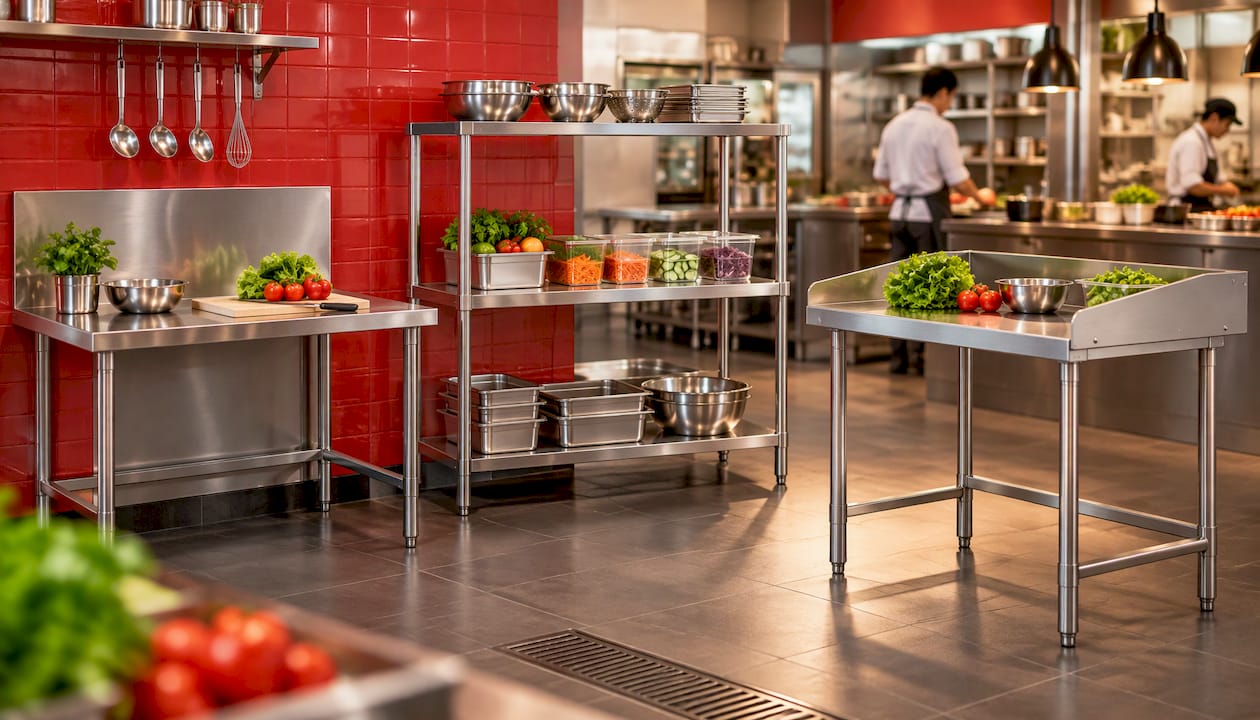
Stainless steel work surfaces without refrigeration also have a place when you need bench space beside a chiller. We stock a stainless steel table with backsplash, a table with sides covered and tabletop shelves to build the station around the chiller.
Sandwich prep table vs pizza prep table
The two prep table types differ mainly in the depth of the work surface and the way the rail is arranged.
Sandwich (or sandwich and salad) prep table
- Shallower body and a shallower cutting board, sized for bread rolls, wraps and bowls.
- Pan rail holds a dozen or so small pans of fillings in a compact reach.
- Suits cafés, sandwich shops, rice bowl counters and salad stations.
Pizza prep table
- Deeper body and a deeper cutting board, sized for dough bases and flatbreads.
- A pan rail set along the back or side for toppings, with storage for dough trays, sauces and cheese underneath.
- Suits pizzerias, flatbread kitchens and any menu where the base is wide and flat.
If your menu is varied, choose by the widest item you assemble. A board that is too shallow for the base slows every order. A board that is too deep wastes counter space and cooled volume you pay to run.
How to decide: five questions
Answer these in order, and the choice usually becomes clear.
- How many ingredients does one order use? Four or fewer cold toppings point to a saladette. Eight or more, or several proteins, point to a prep table.
- Where is your stock? Stock near the counter favours a saladette. Stock in a separate room favours a prep table.
- How wide is the largest item you assemble? A pizza base or large wrap needs a deeper board.
- How much floor and counter space can you spare? Measure the bench and the walkway. Staff need room to open doors and drawers.
- How hot is the kitchen? A unit beside fryers or ovens works harder, so plan the position as carefully as the model.
Entrepreneurs fitting out a first outlet often gain most from the fifth question, because layout mistakes are costly to fix after installation.
Running costs and energy use in Singapore
Refrigeration runs all day, so the model you buy affects your electricity bill for years. Three factors matter most.
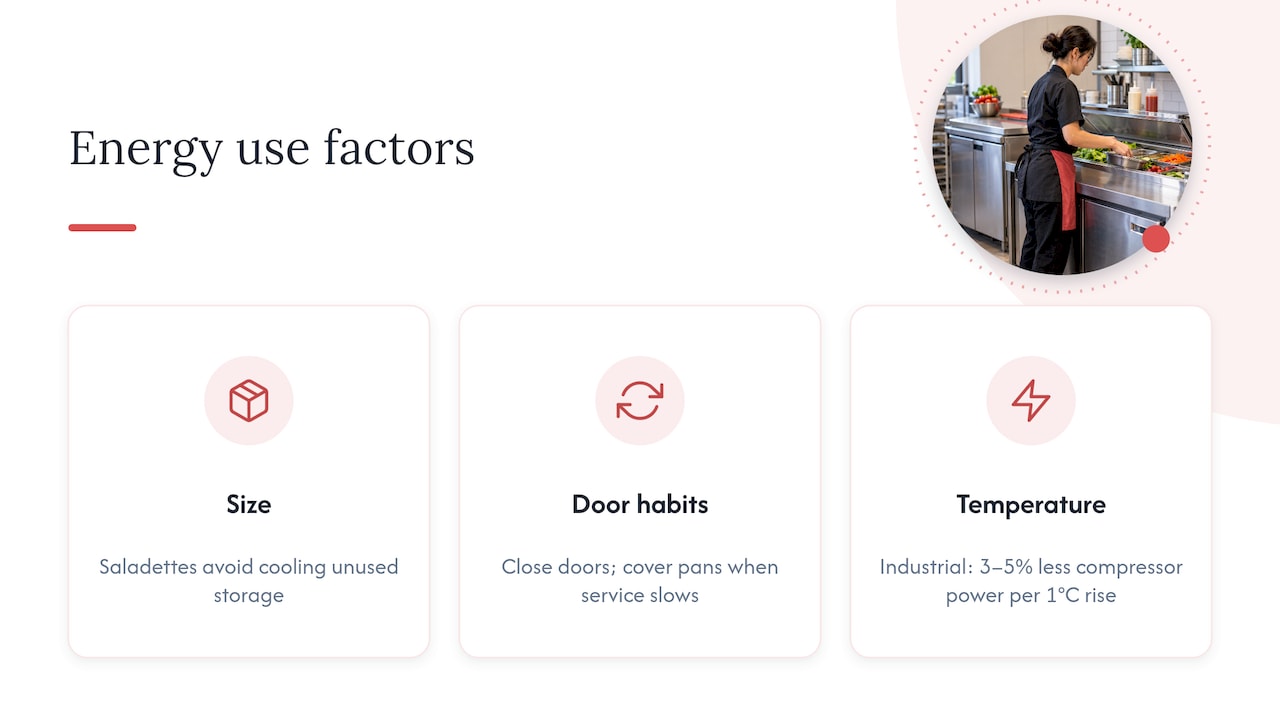
Size and cooled volume. A larger prep table cools more air and holds more stock than a saladette. If you only need a pan rail, a saladette avoids cooling storage you do not use.
Door and lid habits. The National Environment Agency’s best practice guide for food and beverage establishments explains that refrigeration energy depends on system settings and load, and that keeping doors closed limits warm air entering. On a prep table, this means closing doors and drawers after refilling and covering pans when service slows.
Temperature settings. The same NEA guide gives an illustrative figure for industrial systems of 3 to 5% less compressor power for each 1°C rise in suction temperature. That is not a guaranteed saving for a small saladette, but it shows why a setting that is colder than your food needs costs money. Set the unit to the temperature your food safety plan requires, and no lower.
The hospitality efficiency guide on running a leaner restaurant kitchen covers how workflow and equipment placement affect daily operating costs, which applies directly to where you site a chiller.
We publish further detail on this topic in our article on prep table refrigerator energy use in Singapore kitchens.
Energy labels and EEG grant eligibility
Singapore regulates commercial storage refrigerators. Under National Environment Agency requirements effective 1 April 2025, these refrigerators are rated from 1 tick (low efficiency) to 5 ticks (excellent efficiency) based on an Energy Efficiency Index. Registration of models is needed before supply from 1 April 2026.
For grants, the GoBusiness refrigerator support page states that from 1 April 2025 regulated commercial storage refrigerators must meet a minimum four-tick rating for the EEG criteria, and other commercial refrigerators must use inverter technology. The same page gives EEG support of up to 70% for SMEs and 30% for non-SMEs.
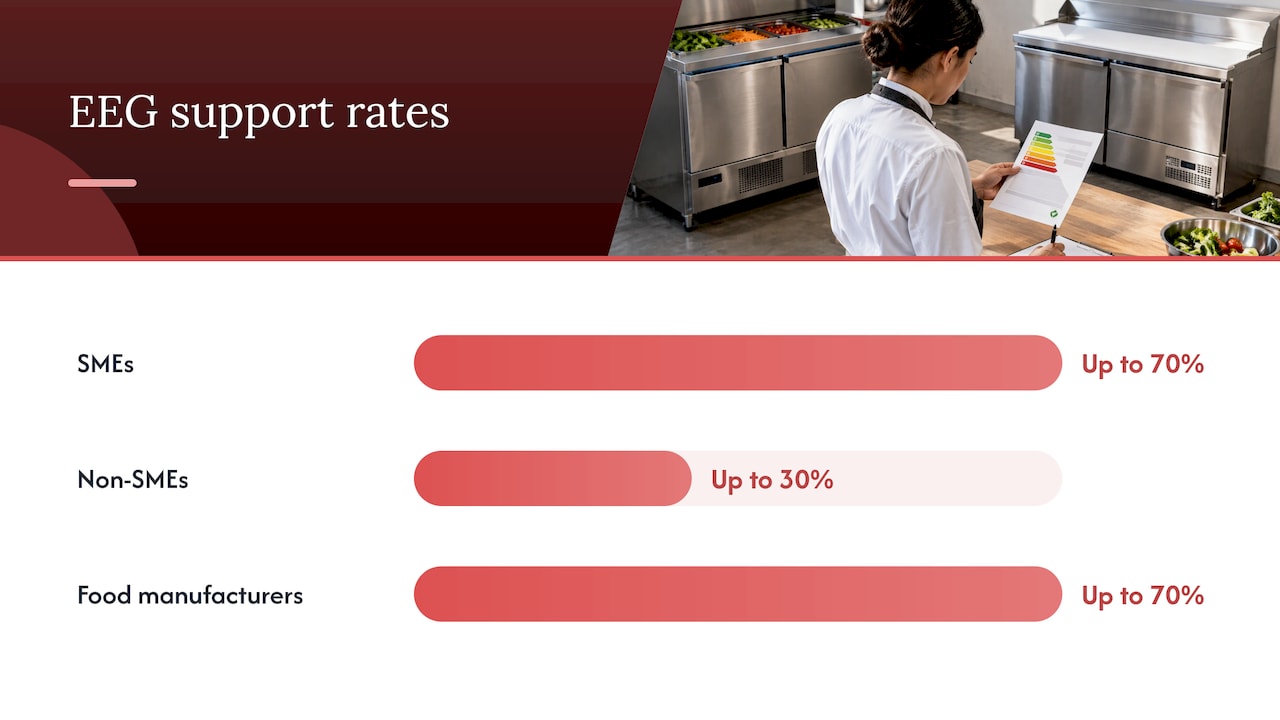
Food manufacturers have a separate route. NEA states that manufacturing companies in SSIC 10 to 32, which includes food manufacturing, may receive up to 70% support for pre-approved energy-efficient equipment under the EEG Base Tier until 31 March 2028.
What this means when you compare a saladette with a prep table:
- Eligibility depends on the specific model, not on the product type. Do not assume every saladette or prep table qualifies.
- Check the tick rating or inverter specification before you place the order, because the criteria apply to the equipment you buy.
- Confirm whether your business counts as an SME, since the support level differs.
We list models in our Energy Efficiency Grant eligible equipment collection, and our guides on EEG-ready procurement and restaurant energy savings in Singapore explain the process in steps. If you are weighing refrigerants as well, read our R290 commercial refrigerator buyer’s guide and R290 safety guidelines.
Which one for which business
- Salad, poke, dessert or bubble tea counter: a saladette. The menu is short and stock is held in a nearby chiller.
- Sandwich or wrap shop: a sandwich prep table, for the board depth and the storage below.
- Pizzeria or flatbread kitchen: a pizza prep table, for the deeper board.
- Caterer with a central kitchen: a worktop fridge for batch prep and storage, plus a saladette for plating lines.
- Food manufacturer: check the EEG Base Tier and match the unit to the line layout, with the model’s rating confirmed before purchase.
- First-time operator: start from the menu and the layout, then choose the smallest unit that holds your pans and your stock.
Our perspective
Most buying mistakes we see in this category come from choosing by name instead of by task. A saladette and a prep table look alike from across the room, but they do different jobs, and they cost different amounts to run.
Our approach is to start from the menu: how many pans, how wide the base, where the stock sits. Then we look at the energy rating, because for Singapore food businesses the model’s efficiency can decide whether a grant applies. We focus on energy-efficient equipment that lets businesses claim government grants of up to 70% of the original cost, and we aim to help commercial kitchens reduce operating costs, with savings on electricity of up to 40%.
A well-matched unit, closed doors and a sensible temperature setting do more for your bill than any single feature. We would rather you leave with the right size of chiller than the biggest one.
David
See the range in person
We sell commercial refrigerators, chillers, freezers, stainless steel tables and other kitchen equipment online and in our showroom in Singapore, with guidance on claiming government energy efficiency grants. You can compare salad bar chillers and worktop units side by side and match them to your menu and bench space.
Browse the full refrigerator and kitchen equipment collections to start, or go straight to the grant-eligible equipment list.
FAQ
Is a saladette the same as a prep table?
No. A saladette is a compact unit with a refrigerated pan rail for holding toppings. A prep table adds a cutting board and refrigerated storage below, so staff can assemble and restock at one station. Many kitchens use a saladette where space is tight and a prep table where assembly volume is high.
Can I use a worktop fridge instead of a prep table?
Yes, if your team preps in batches and assembles elsewhere. A worktop fridge stores stock and gives a flat surface but has no pan rail. If staff assemble to order and need open, cold pans within reach, a prep table or a saladette on top of a chiller suits the task better.
What is the difference between a sandwich and a pizza prep table?
The sandwich version has a shallower body and cutting board, sized for bread and wraps. The pizza version has a deeper board for dough bases, with storage for dough, sauce and cheese. Choose by the widest item you assemble.
Do saladettes and prep tables qualify for the Energy Efficiency Grant?
Eligibility depends on the model. For commercial refrigerators, GoBusiness states a four-tick minimum for regulated storage refrigerators and inverter technology for other commercial refrigerators, with support of up to 70% for SMEs. Confirm the exact model against the criteria before ordering.
How can I lower the running cost of a prep table?
Keep doors and drawers closed, cover pans when service is quiet, set the temperature to what your food safety plan requires, and site the unit away from fryers and ovens. NEA guidance notes that limiting warm air entering reduces refrigeration load.
Sources
- Best Practice Guide for Improving Energy Efficiency of Food and Beverage Establishments, NEA
- Requirements for regulated goods under the Energy Conservation Act, effective 1 April 2025, NEA
- Energy Efficiency Grant, NEA
- Refrigerator support, GoBusiness
- Kitchen Efficiency: How to Run a Faster, Leaner Restaurant Kitchen