
Water quality decides how long a commercial combi oven performs well. Steam leaves dissolved minerals behind inside the oven, so scale builds up on the parts that make steam. Singapore’s tap water is moderately soft, which is a good starting point, but the right check is a reading of your own water against the specification of the model you plan to buy. Boiler and boilerless combi ovens also differ in how much water they use and how sensitive they are to it, so the choice of oven and the water question should be settled together.
This guide is for restaurant owners, caterers, food manufacturers and kitchen managers who are choosing or running a combi oven in Singapore. It covers what water does inside the oven, what Singapore’s supply looks like, what to measure, how boiler and boilerless designs compare, and how to keep the oven clean.
TL;DR
- Steam is nearly pure water, so every mineral in the inlet water stays inside the oven as scale. One filtration manufacturer’s guide says the steam is essentially 100% pure water and that impurities are left in pipes, tanks and steam generators.
- Singapore tap water is soft to moderately soft. PUB’s 2025 report gives an average of 116 mg/L total dissolved solids and an average pH of 8.0, but your building’s pipework can change what reaches the oven.
- Boiler-based combi ovens use far more water per steam cycle than boilerless ones, and they need treated make-up water and regular descaling.
- Read the water specification in the datasheet of the model you buy, test your own tap water, and follow the cleaning and descaling routine from the first day.
Table of Contents
- What water does inside a combi oven
- What Singapore’s water looks like
- What to test and which limits to follow
- Boiler or boilerless combi oven: how water use differs
- Keeping the oven clean and scale-free
- Questions to settle before buying
- Our view: choose the oven and the water plan together
- Combi ovens available through Superior Kitchen Equipment
- FAQ
- Sources
What water does inside a combi oven
A combi oven cooks with hot air, steam or both. To make steam, it heats water in a boiler or on a hot surface. The water evaporates, and everything dissolved in it stays behind. Over weeks of daily service, those deposits form scale on heating elements, in pipes, valves and nozzles.
The effects are practical:
- Higher energy use. A 3M foodservice brochure states that 1/8 inch of scale in steam equipment can lead to a 25% energy loss, based on an example of US$900 in annual energy costs. A Pentair Everpure brochure says limescale can raise the energy an appliance consumes by up to 40%. These are manufacturers’ figures, not Singapore measurements, but they show the direction: scale makes the oven work harder for the same steam.
- Blocked parts. A Kinetico guide on steamers and combi ovens says particulates can clog nozzles and valves, and that water contaminants may lead to service calls and affect the long-term life of the equipment.
- Corrosion. The same 3M brochure lists chlorine, chloramines and chlorides as substances that increase corrosion, service calls and reduced service life.
For a kitchen that runs the oven every day, these are not abstract risks. Downtime during lunch service and a rising electricity bill are the visible costs. If you are buying a combi oven partly to cut energy use, water quality is part of that goal. Our guide on combi oven energy use covers what operators should check on the energy side.
What Singapore’s water looks like
Singapore starts from a favourable position. PUB, the national water agency, states that tap water is moderately soft and safe to drink directly from the tap, within the Food Safety and Security (Non-Packaged Drinking Water) Regulations 2025 and WHO guidelines.
PUB’s drinking water quality report for 2025 gives these figures for January to December 2025:
| Parameter | Average | Range |
|---|---|---|
| Total dissolved solids (TDS) | 116 mg/L | 63 to 542 mg/L |
| pH | 8.0 | 7.5 to 8.9 |
| Conductivity | 232 µS/cm | 98 to 625 µS/cm |
TDS is the total amount of dissolved minerals and salts in the water. pH shows how acidic or alkaline it is. Conductivity is a quick electrical measure that tracks dissolved solids. These are annual figures that PUB updates in its published reports, so use them as a picture of the supply, not as a reading of your own tap.
For hardness, a Singapore water-testing supplier reports a typical range of 16 to 106 mg/L as calcium carbonate, with calcium averaging 17.1 mg/L. It notes that most supply is soft to moderately soft, so severe scaling is uncommon, although ageing internal plumbing can still show mineral build-up. The same page points out that scale on heating elements acts as insulation and shortens equipment life, and that testing is the only way to know the hardness at a particular site.
Two conclusions follow. First, Singapore kitchens generally begin with water that is easier on steam equipment than water in hard-water regions. Second, a combi oven runs every day and concentrates minerals each time it makes steam, so even soft water leaves deposits over months. A kitchen in an older building, or one with long internal pipe runs, can see a different result from the PUB average.
What to test and which limits to follow
The limits that matter are set by the oven manufacturer, not by drinking-water rules. Water that is perfectly safe to drink can still fall outside a combi oven’s specification. A filtration manufacturer’s selection guide lists one combi oven maker’s water guidelines as an example of what a specification looks like:
| Characteristic | Example guideline |
|---|---|
| Total dissolved solids | 50 to 125 ppm |
| Hardness | 30 to 70 ppm |
| Chlorides | below 30 ppm |
| Silica | below 12 ppm |
| Free chlorine | below 0.1 ppm |
| pH | 7.0 to 8.5 |
PPM (parts per million) is roughly the same as mg/L for water. Compare that table with PUB’s 2025 figures: average TDS and pH fall inside the example range, but the TDS range at the top end (542 mg/L) and the pH ceiling (8.9) do not. That is why a reading at your own tap matters more than a national average. Other manufacturers publish their own limits, and they differ, so the datasheet of the exact model you are buying is the reference.
A practical testing routine:
- Request the water specification for the oven model before you order. It is normally in the installation or technical documentation.
- Test the water at the connection point that will feed the oven, not at a tap elsewhere in the building. Measure TDS, hardness, chlorides, free chlorine and pH.
- Compare each reading with the model’s limits, line by line.
- Repeat the test after plumbing works, a change of premises or any sign of scale, such as slow steam or error messages about the steam generator.
If the readings sit inside the limits, the oven’s standard connection and routine descaling are the plan. If they do not, the filtration manufacturer’s guide advises using filtration when the water is within guidelines and reverse osmosis when it is not. Reverse osmosis is a membrane process that removes most dissolved minerals. A typical commercial unit aimed at combi ovens, the EZ-RO 200/18L, accepts feed water up to 1000 ppm TDS, delivers up to 757 L a day and calls for replacement of its filters and mineral cartridges every six months or when capacity is reached. Any treatment system needs a maintenance date in the kitchen calendar, because an exhausted cartridge protects nothing.
Boiler or boilerless combi oven: how water use differs
A boiler combi oven makes steam in a separate boiler tank. A boilerless (also called self-contained or direct-injection) oven sprays water from a small reservoir onto a hot surface inside the cooking cabinet. The two designs handle water differently, and that affects both running cost and sensitivity to water quality.
US EPA WaterSense reports that:
- boiler-based combination ovens can use more than 20 gallons (76 L) of water per steam-mode cooking cycle, partly because water is used to cool condensed steam before it goes to drain;
- boilerless ovens use a self-contained reservoir, are typically drained and refilled daily, and need neither a condensate drain nor cooling water;
- ENERGY STAR certified boilerless models use 10 gallons (38 L) or less per steam-mode cycle, and 0.5 gallons (1.9 L) or less per pan;
- operators should track water quality and prevent scale to extend equipment life.
The water utility EBMUD adds that boilerless steamers and combi ovens need no tempering water or water and sewer connections, that combi ovens can save up to 75% of energy in steam mode, and that boiler types need treated make-up water and regular descaling.
| Point | Boiler combi oven | Boilerless combi oven |
|---|---|---|
| Steam source | Separate boiler tank | Water sprayed onto a hot surface |
| Water per steam cycle (EPA) | Can exceed 76 L | 38 L or less for ENERGY STAR models |
| Condensate cooling water | Used | Not required |
| Water treatment | Treated make-up water and regular descaling | Water spec still applies; daily drain and refill |
| Installation | Water and drain connections | Fewer connections |
The water bill is only part of the difference. A boiler holds a large volume of water at temperature for long periods, so it is the component where scale collects fastest if the water is outside the specification. A boilerless oven has less standing water, but its spray surface and nozzles still receive every mineral in the supply, which is why the manufacturer’s limits apply to both designs.
Matching the design to the kitchen
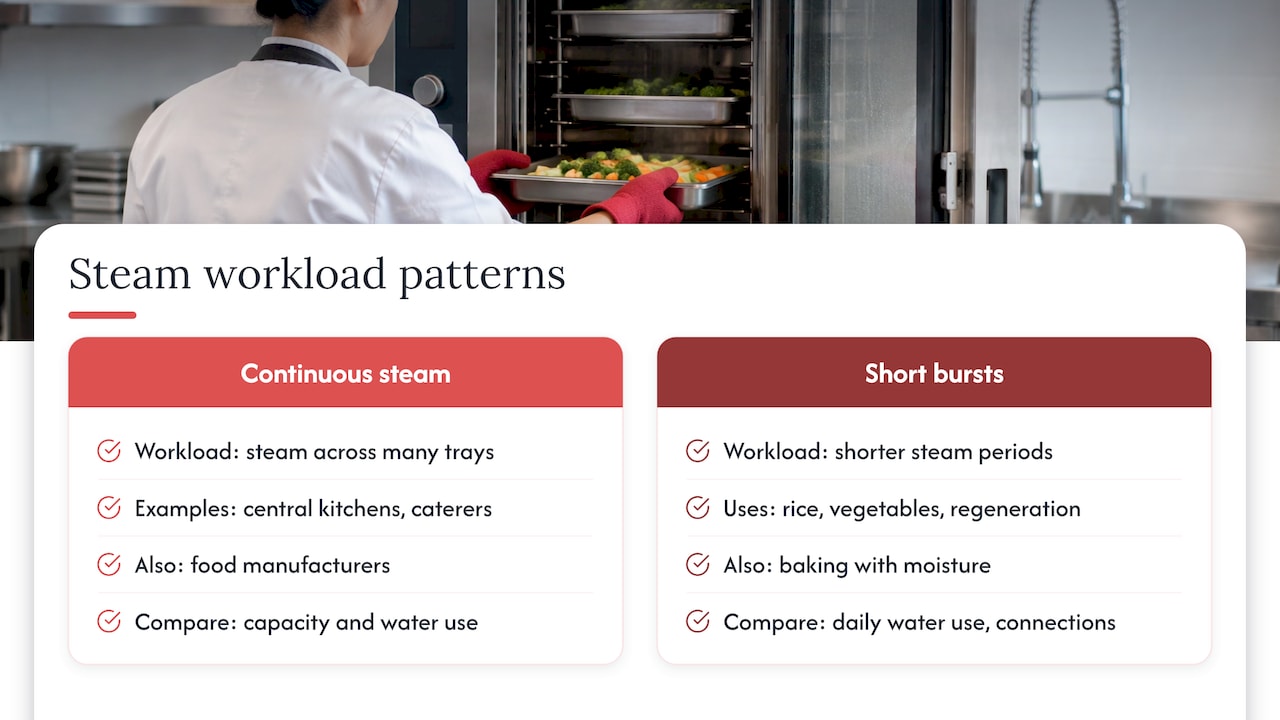
The workload decides. A kitchen that uses steam constantly across many trays, such as a central kitchen, a caterer batch-cooking for events or a food manufacturer, should compare the steam capacity and water use of the specific models at its tray size. A restaurant that uses steam in shorter bursts, for rice, vegetables, regeneration and baking with moisture, should compare daily water use and the connections the premises already have. In both cases, ask for the water consumption per steam cycle and the water specification of each model on the shortlist, and compare them with your test results.
Keeping the oven clean and scale-free
Water treatment lowers the rate of scale, but cleaning remains part of the routine. For a worked example from a household-class steamer sold in Singapore, V-ZUG’s care guidance says to descale when the appliance prompts you according to the water-hardness setting, that a cycle takes about 45 minutes, and that with a salt-based softener you should descale at least every two years even without a reminder. Commercial ovens have their own cycles and intervals, so follow the manual of your model.
A workable commercial routine:
- Set the water hardness in the oven’s settings to match your test result, if the model has that option, so that descaling prompts appear at the right time.
- Run the automatic cleaning programme on the schedule in the manual, using the cleaning agents the manufacturer specifies.
- Drain and refill boilerless reservoirs daily, as EPA describes for this design.
- Record each descaling and filter change with the date and the technician’s name, so warranty questions can be answered from the log.
- Act on early signs: slower steam, scale flakes in the cabinet or repeated error codes.
We set out the full routine in our guide to four-tier combi oven cleaning and warranty protection. Following the cleaning schedule and the water specification is the way to keep a combi oven performing as the manufacturer intends.
Questions to settle before buying
Water quality is easier to manage when it is part of the purchase decision, not a repair topic. Bring these questions to the quotation stage:
- What are the water specifications (TDS, hardness, chlorides, chlorine, pH) for this model?
- Is it a boiler or boilerless design, and what are the water use per steam cycle and the connections required?
- What cleaning and descaling programme does it have, and at what interval?
- What do my test results say against those limits?
- Does the premises have the water inlet and drain positions the oven needs?
If you are still deciding between a combi oven and a convection oven, our comparison of combi oven vs convection explains which kitchens benefit from steam at all.
Our view: choose the oven and the water plan together
We work with restaurants, caterers and food manufacturers across Singapore who buy a combi oven to save energy and labour. The oven only delivers that if the water it receives matches its specification.
Our advice is to treat water as part of the equipment specification. Ask for the datasheet, test the water at the connection point, and decide on the boiler or boilerless design with the daily workload in front of you. The EPA’s figures on water use per steam cycle make a clear case for comparing designs on running cost, not only on purchase price.
Our range includes the Rational iCombi Pro and the Convotherm combi oven, and we also guide businesses on the government energy efficiency grants that can cover up to 70% of the original cost of qualifying equipment. Energy-efficient equipment and a clean water supply support each other: an oven that is free of scale uses its energy for cooking.
Bring your kitchen’s menu, tray volume and water test results to our showroom, and we can go through the models with you.
David
Combi ovens available through Superior Kitchen Equipment
We supply combi ovens for Singapore commercial kitchens through our online store and showroom. The range includes the Rational iCombi Pro 10 tray, the Rational iCombi Pro 20 tray and the Convotherm combi oven with 10 trays. Our combi oven page shows the full selection, and our guide to combi oven prices, grants and budgeting in Singapore explains how grant support fits into a purchase.
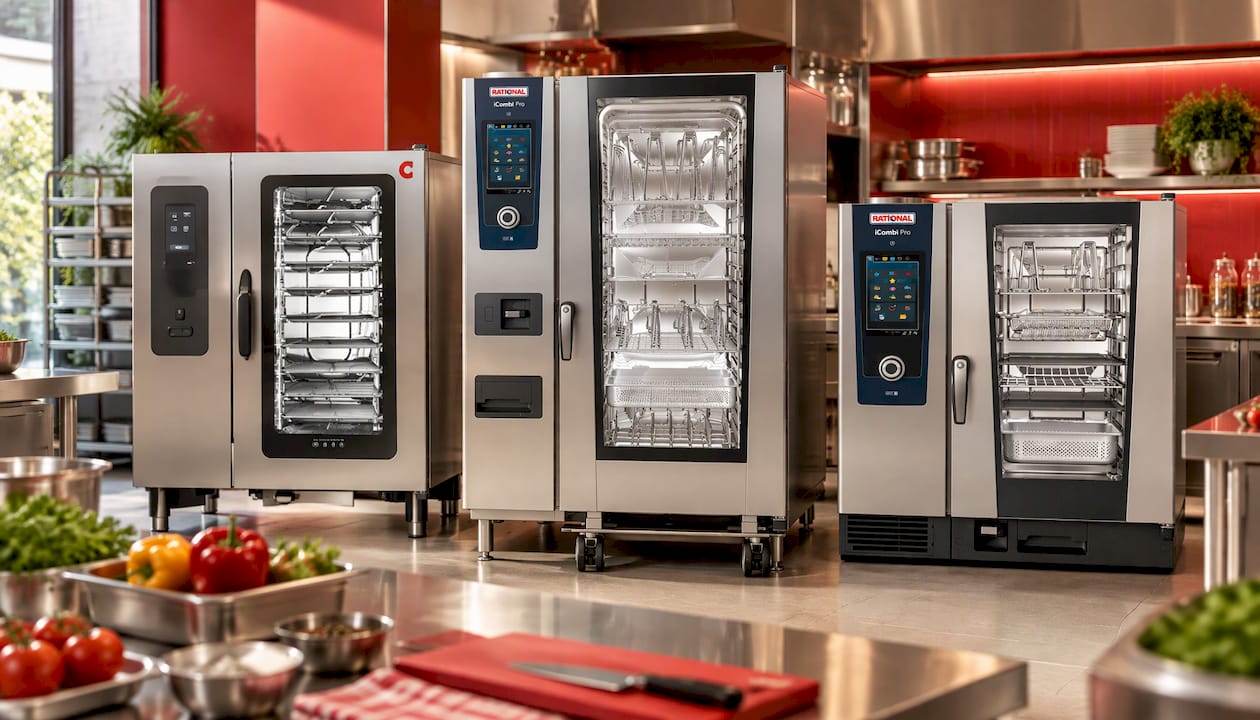
We help businesses pick a model by tray capacity, menu and water conditions. Visit the Superior Kitchen Equipment website to browse the range or to arrange a showroom visit.
FAQ
Can I use Singapore tap water in a commercial combi oven?
PUB states that Singapore tap water is safe to drink and moderately soft. Whether it suits a particular oven depends on that model’s water specification, so test the water at the oven’s connection point and compare it with the manufacturer’s limits for TDS, hardness, chlorides, chlorine and pH.
Do I need a water filter or reverse osmosis system?
It depends on your test results. A filtration manufacturer’s guide advises filtration when the water is within the oven’s guidelines and reverse osmosis when it is not. Treatment units carry their own replacement schedule, such as every six months for one commercial reverse osmosis system, so include that in your running costs.
Is a boilerless combi oven more water efficient than a boiler model?
According to US EPA WaterSense, boiler-based ovens can use more than 76 L per steam-mode cycle, while ENERGY STAR certified boilerless models use 38 L or less. Boilerless designs also avoid condensate cooling water and extra connections. Compare the figures for the specific models on your shortlist.
How often should a combi oven be descaled?
Follow the prompts and intervals in the manual of your model, which depend on the water hardness setting. As an example from a steamer sold in Singapore, one manufacturer says a descaling cycle takes about 45 minutes and that, with a salt-based softener, descaling should happen at least every two years even without a reminder.
Does scale really raise energy use?
Manufacturer literature says so. A 3M brochure puts the loss at 25% for 1/8 inch of scale, and a Pentair Everpure brochure says limescale can increase energy consumption by up to 40%. Those figures come from the manufacturers’ own material, so treat them as an indication of direction, not as a measurement for your kitchen.
Sources
- The impact of water on steamers and combi ovens (Kinetico)
- 3M Foodservice Water Filtration Products for Combi Ovens
- Everpure Claris and Conserv water treatment for steam applications
- Water treatment selection guide for ovens
- EZ-RO 200/18L reverse osmosis technical sheet
- Water Treatment, PUB Singapore’s National Water Agency
- Singapore Drinking Water Quality, January to December 2025 (PUB)
- Singapore water hardness: testing and measurement
- WaterSense at Work, Section 4.3: Combination Ovens (US EPA)
- Food Service Operations (EBMUD)
- Combi steamer and steamer care (V-ZUG Singapore)