

A fryer oil filter system removes food particles and residue from used oil so that it can be reused for longer, with less waste and less handling of hot oil. For a Singapore kitchen, the better choice is to decide on filtration when you buy the fryer, not after. The type of filtration, the fryer’s energy use and the eligibility for government energy grants are linked decisions, and Superior Kitchen Equipment supplies commercial fryers together with guidance on claiming those grants.
TL;DR
- A filter system strains particles from used frying oil. Built-in (automated) and portable (semi-automated) systems let staff filter without contact with hot oil.
- Filtering extends oil life but does not make oil last forever. Change oil when it changes colour or smell, smokes, or foams.
- Filter media should match what you fry: paper, fabric, mesh and carbon each do a different job.
- Singapore’s NEA Energy Efficiency Grant offers up to 70% support for SMEs on pre-approved energy-efficient equipment, subject to eligibility.
- Decide on the fryer and the filtration method together, so the equipment, the routine and any grant application fit.
Table of Contents
- What a fryer oil filter system does
- Passive and active filtration
- Choosing the right filter media
- How to filter fryer oil safely
- When filtering is no longer enough
- What filtration does to oil use and running costs
- Choosing the fryer and the filter system together
- Energy grants for fryer upgrades in Singapore
- Our offer for commercial kitchens
- Our perspective
- FAQ
- Sources
What a fryer oil filter system does
Every batch of fried food leaves crumbs, batter and burnt fragments in the oil. These particles keep cooking, darken the oil, add bitter flavours and speed up its breakdown. A filter system removes them while the oil is still in use.
The UK Health and Safety Executive (HSE) describes two common designs in its catering information sheet on emptying and filtering fryers:
- Automated (built-in) filtering. The oil drains into an enclosed reservoir. An electric pump then circulates it through a filter and internal pipework back into the fryer. The system is enclosed, so the operator never touches hot oil.
- Semi-automated (portable) filtering. A unit sits beside the fryer. Hot oil drains through an extension pipe into an enclosed container, is filtered and is returned to the fryer.
The HSE adds that most of these systems need the oil at 100 °C or above to work effectively. That is a useful detail for planning, because it means filtering is done at working temperature, not after a long cool-down.
Passive and active filtration
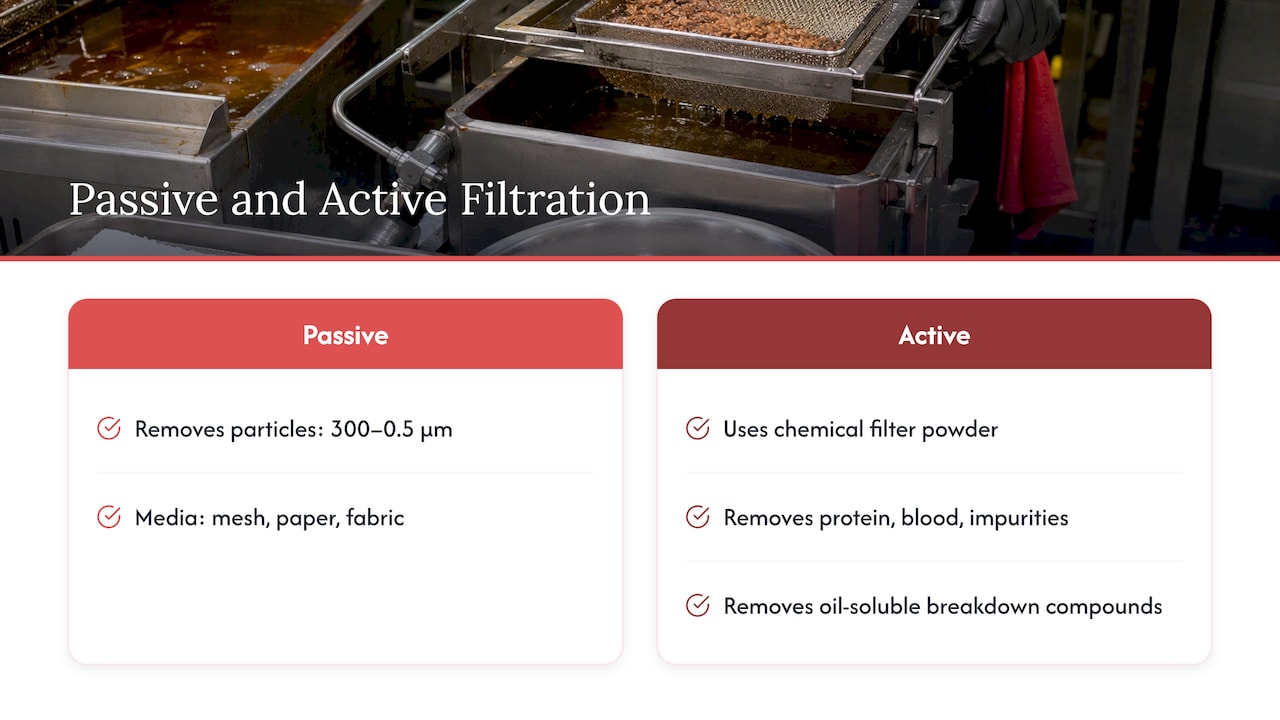
Food technology writing separates filtration into two kinds. Richard Stier, writing in the Institute of Food Technologists’ magazine in 2024, describes passive systems (screens, paper filters, cones, diatomaceous earth and leaf filters) as removers of particles. Active systems remove oil-soluble chemical breakdown compounds as well.
FER Magazine puts figures on this. Passive media such as stainless-steel mesh, paper and fabric remove particles from 300 down to 0.5 microns. Active filtering uses a chemical filter powder that removes protein, blood and other impurities. This extra polishing step is usually needed when you fry meat, seafood and poultry.
For most kitchens the practical question is simple. If you fry mostly potato, tempura vegetables or dough products, particle removal is the main job. If you fry chicken, fish or prawns all day, the oil picks up more dissolved impurities, and the filtration method needs to reflect it.
Choosing the right filter media
The same FER guidance compares the common media:
| Media | What it does well | What to watch |
|---|---|---|
| Paper | Inexpensive and widely used | Clogs quickly and absorbs a lot of oil, which costs money over time |
| Fabric | Reusable and removes the smallest particles | Needs regular cleaning |
| Stainless-steel mesh | Removes larger particles and can be rinsed and reused | Does not catch the finest particles |
| Carbon | Removes volatile compounds that cause off-flavours | Suited to products where flavour transfer is a concern |
Match the media to the food. A kitchen frying a single product, such as fish balls or fried chicken, can settle on one routine. A kitchen frying a mixed menu in one fryer needs a routine that keeps flavours from carrying over. Stier’s advice for restaurants is that a system must be easy to use and rugged enough for a working kitchen, and that its benefits should outweigh its cost. Both points matter more in a busy Singapore kitchen than any technical specification.
How to filter fryer oil safely
Safety is the first reason to have a proper system. Hot oil causes severe burns, and manual draining is where most accidents happen. The HSE’s guidance for UK catering kitchens sets out the following:
- Prefer automated or semi-automated filtering. These avoid operator contact with hot oil and can be done at normal cooking temperature.
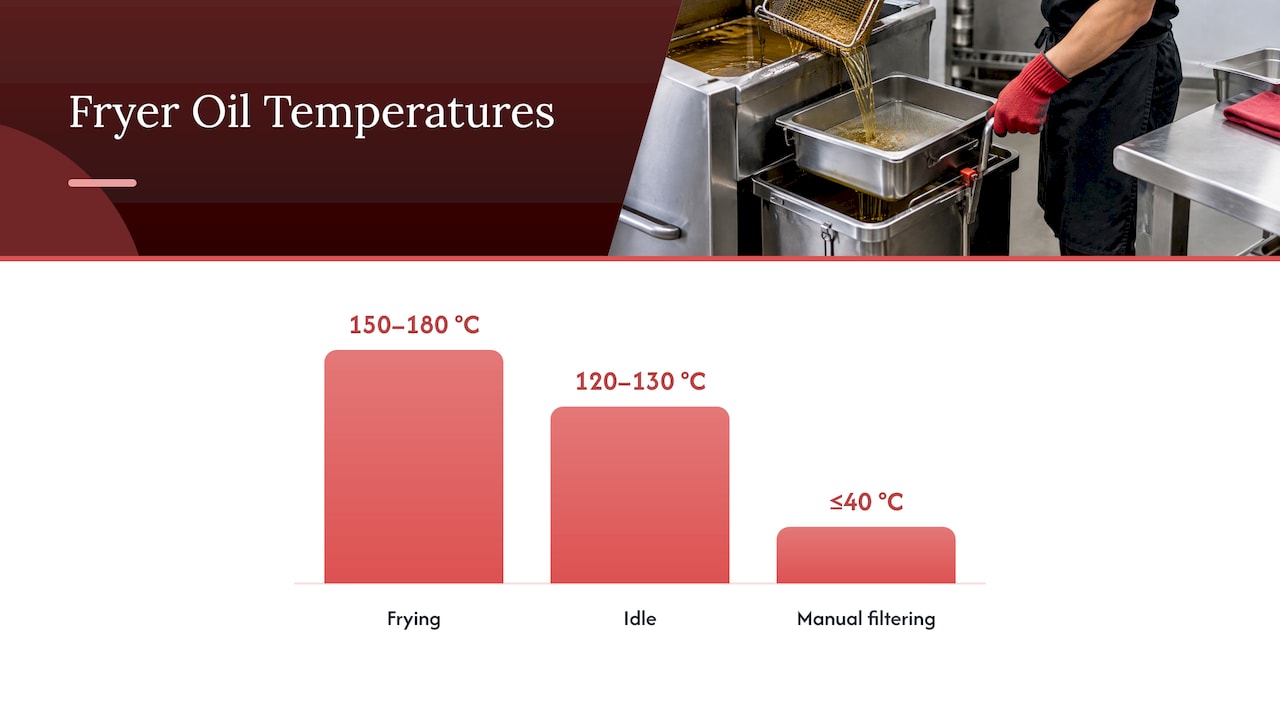
- If you must empty and filter by hand, wait. Manual emptying should only be done once the oil has cooled to 40 °C or below.
- Plan around the cooling time. Oil takes only 6 to 7 minutes to heat up but 6 to 7 hours to cool down, so a manual routine at closing time is slow. The HSE recommends doing filtering and cleaning as the first task of the day instead of at closing.
- Switch the fryer off when unattended. This is a fire safety measure and also saves energy.
To cut the amount of waste your filter has to deal with, follow the habits set out by Hong Kong’s Centre for Food Safety in its deep-frying oil tips. They suggest keeping the frying temperature between 150 °C and 180 °C and removing crumbs from the fryer frequently. They also suggest seasoning food after frying, lowering the idle temperature to 120 to 130 °C during breaks, and covering the fryer when it is off.
Our own guide on fryer filtration methods for Singapore commercial kitchens goes through the methods in more detail, and the page on deep fryer maintenance covers the wider routine.
When filtering is no longer enough
Filtration removes particles. It does not reverse the chemical ageing of oil. Singapore’s Food Agency (SFA) explains in its guidance on reusing cooking oils that deep-frying typically runs at 177 to 232 °C. Repeated heating at these temperatures breaks the oil down, lowers its smoke point and forms compounds such as polycyclic aromatic hydrocarbons and aldehydes, which are linked to cancer and cardiovascular disease risk.
The SFA advises food businesses to replace oil as often as possible. Replace it when it:
- changes colour,
- develops an unusual odour,
- begins to smoke, or
- starts to foam.
If you strain used oil for reuse, the SFA recommends straining through a cloth or sieve and storing it in a sealed, light-proof container.
The Hong Kong guidance makes a useful point about timing. It says fixed hours or use-counts are unreliable, because oil deteriorates according to the food, the quantity and the temperature. It recommends discarding oil when total polar compounds (TPC, a measure of the chemical breakdown products in the oil) exceed 27%, and it advises against topping up with fresh oil to dilute old oil. In practice, write down your own change triggers, keep a log of when oil was filtered and replaced, and train every shift to use the same signs.
For a wider view of running a food business well, including managing a routine like this across staff, see these best practices for food entrepreneurs.
What filtration does to oil use and running costs
The benefits are real and well documented, although the size of the saving depends on your menu and volume. Stier lists reduced oil usage, oil life extension, improved food quality, reduced cleanup time, reduced downtime, reduced energy usage and a safer workplace among the potential benefits of filtration.
Manufacturers publish figures for their own equipment. GEA states for its external oil filters that they remove sediment down to 1 µm, extend oil life by 3 to 5 times and produce a dry sediment cake with little or no oil, which reduces waste. Those figures are for industrial-scale filters, so treat them as a sign of what good filtration can do, not as a promise for a single restaurant fryer. The GEA documentation gives the details.
A worked example shows how to think about it. Suppose your kitchen discards the fryer oil on a fixed schedule, whatever its condition. If your filtering routine lets you keep the oil in good condition for longer, you buy fewer containers of oil and you pay for less disposal. If the fryer also heats efficiently, the same menu costs less in electricity. Both savings arrive through the fryer, which is why the fryer and the filtration method should be chosen together. Our article on saving fryer oil costs through operations routines works through the routine side of this.
Choosing the fryer and the filter system together
When you are specifying a new fryer, work through these questions in order:
- What do you fry, and how much? Mixed menus and protein-heavy menus need stricter filtration than single-product, vegetable or dough menus.
- How many fryer pots do you run? A single small unit suits a different routine from a double standing unit that runs through service.
- Who does the filtering, and when? If it is the first task of the day, as the HSE suggests, the routine must be short enough for the opening shift to do every day.
- Gas or electric? This choice affects installation, power supply and running costs. Our guide on gas versus electric fryers for Singapore kitchens sets out what to check before you commit.
- What is the total cost? Include the unit, filter media, oil, disposal, energy and staff time, and compare that over a year.
Our fryer range includes the 8L deep fryer, the standing double deep fryer, the automated standing double deep fryer and gas models such as the 14L gas deep fryer. Seeing the units in the showroom helps with sizing, since pot capacity and footprint are easier to judge in person.
Energy grants for fryer upgrades in Singapore
The National Environment Agency’s Energy Efficiency Grant (EEG) supports businesses that buy pre-approved energy-efficient equipment. The published terms are:
- Support of up to 70% for SMEs and up to 30% for non-SMEs.
- A cap of S$30,000 per company in the Base Tier.
- The Base Tier was extended to 31 March 2028, as announced in the Ministry of Finance’s Ministerial Statement of 7 April 2026.
- An Advanced Tier of up to S$350,000, for projects with at least 350 tonnes of lifetime carbon abatement, which runs until 31 March 2027.
Eligibility is defined by the NEA. It requires a Singapore-registered business with at least 30% local shareholding, group turnover of S$500 million or less, equipment used in Singapore and a partnership with an Energy Efficiency National Partnership (EENP) member. The sectors, equipment categories and approved models are set out on the NEA page, and they are updated, so confirm them there before you plan a purchase around the grant. Supported equipment listed includes cooking hobs, refrigerators, water heaters, boilers, motors and compressed air systems.
Because the grant applies to pre-approved equipment, the order of steps matters: confirm the eligibility of your business and the equipment first, then buy. We provide guidance on claiming government energy efficiency grants alongside our commercial kitchen equipment.
Our offer for commercial kitchens
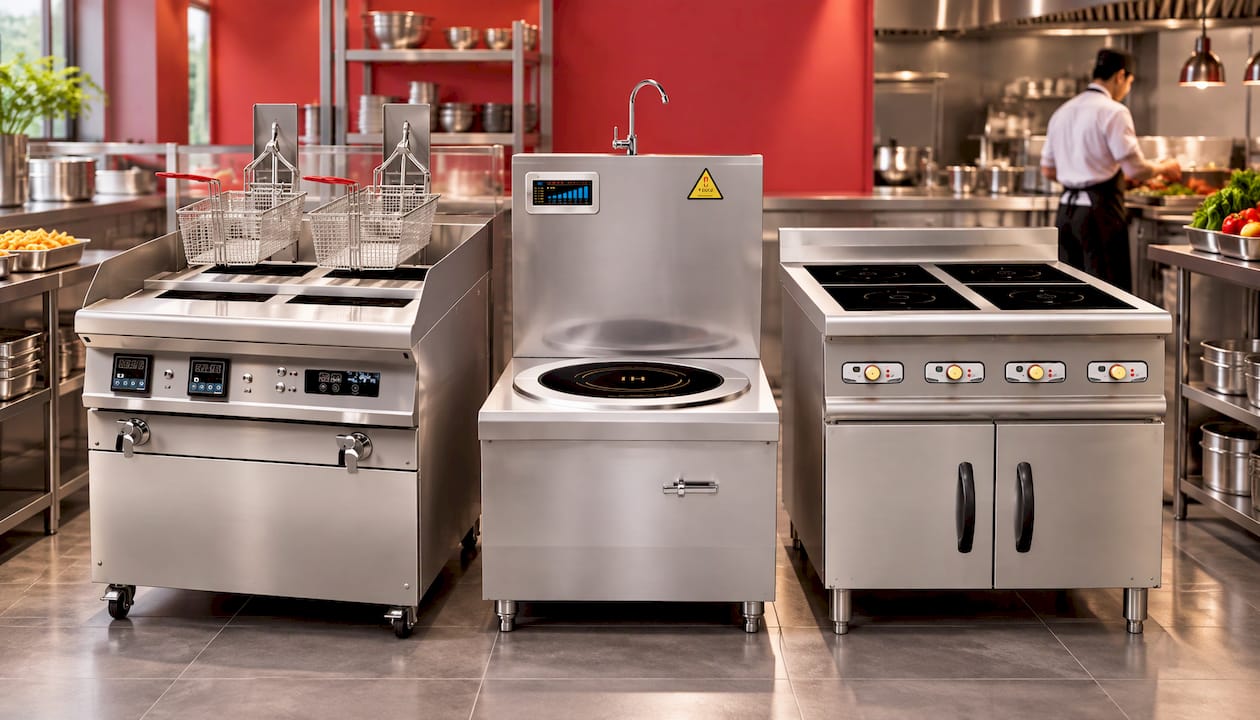
Superior Kitchen Equipment supplies commercial kitchen appliances to restaurants, caterers, food manufacturers and new food businesses in Singapore. The range covers fryers, induction cookers, refrigerators, ovens, food warmers, stainless steel tables and more, and our focus is on energy-efficient equipment that can qualify for government grants of up to 70% of the original cost.
If you are choosing a fryer, start with the automated standing double deep fryer or browse the full commercial kitchen equipment range. You can also visit our showroom to see the products in person.
Our perspective
Most kitchens treat filtering as a cleaning chore and the fryer as a separate purchase. We see them as one decision. The fryer sets how much energy you use and how hard the oil is worked, and the routine around it decides how long the oil lasts.
That is why we start a fryer conversation with the menu, the number of pots and the shift routine, and then with the grant. Our focus is energy-efficient equipment that businesses can claim grants on, with savings on electricity bills of up to 40% in our own claims.
Our advice to a new owner is to write the routine before the purchase order. Decide who filters, at what time of day, and what signs mean the oil is changed. A fryer that fits that routine will be used properly, and that is where the savings come from.
David
FAQ
How does a fryer oil filter system work?
Oil is drained from the fryer into an enclosed container or reservoir and passed through a filter medium that traps crumbs and residue. It is then returned to the fryer. According to the HSE, built-in systems use an electric pump and internal pipework, and portable units sit beside the fryer.
How often should a restaurant change fryer oil?
There is no fixed number of hours that suits every kitchen. The SFA advises replacing oil as frequently as possible, and certainly when it changes colour, smells unusual, smokes or foams. Do not top up old oil with fresh oil to extend its use.
What is the best filter media for a fryer?
It depends on the food. Paper is inexpensive but clogs quickly and absorbs oil. Fabric is reusable and catches the smallest particles. Carbon removes compounds that cause off-flavours, and a chemical filter powder is typically used for meat, seafood and poultry.
Can a Singapore food business get a grant for an energy-efficient fryer?
The NEA Energy Efficiency Grant offers up to 70% support for SMEs on pre-approved energy-efficient equipment, subject to sector, ownership and equipment eligibility. Check the NEA page for the approved list before you buy, and ask us for guidance on the claim.
Sources
- HSE Catering Information Sheet No 17: Safety during emptying and filtering fryers
- Ensuring Quality and Safety in Fried Foods, Food Technology Magazine
- Maintenance Tips: Best Practices To Extend Fryer Oil Life, FER Magazine
- Tips for Using Deep-frying Oil, Centre for Food Safety, Hong Kong
- Reusing Cooking Oils, Singapore Food Agency
- Frying oil filtration with GEA Oberlin Oil Filters
- Energy Efficiency Grant, National Environment Agency
- Best Practices for Food Entrepreneurs: 2026 Guide