
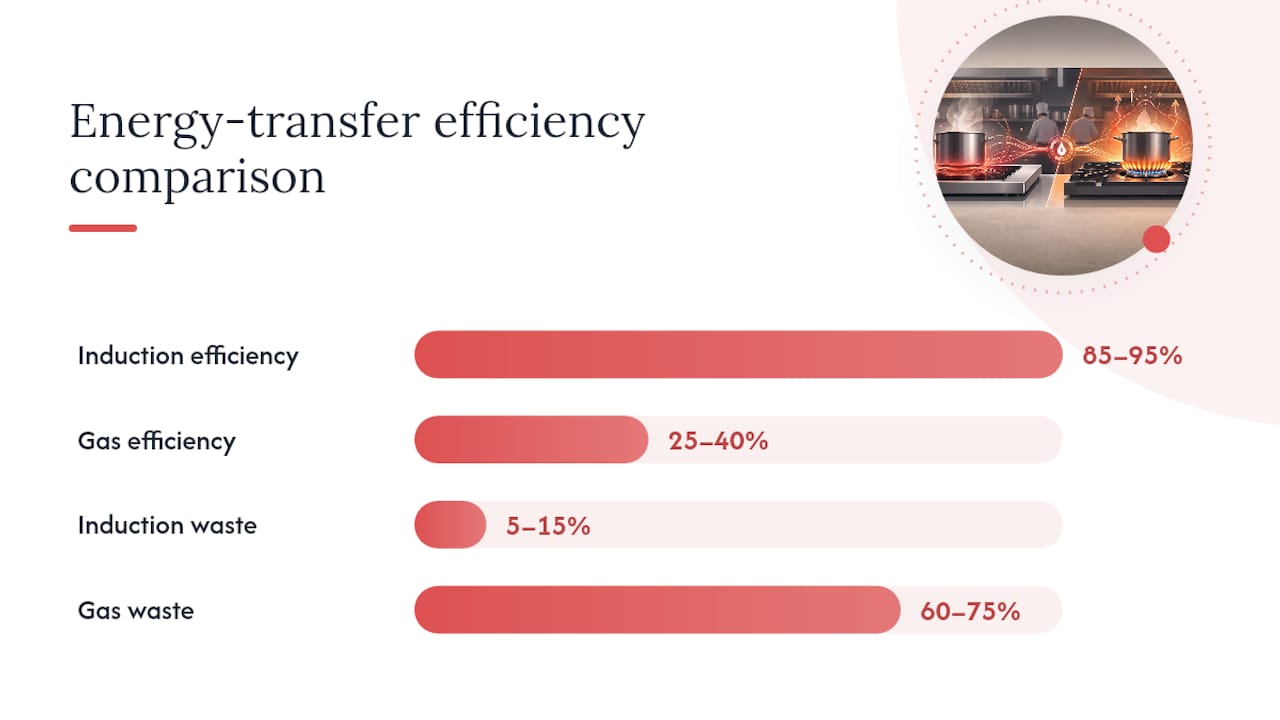
For most modern commercial kitchens, induction is the better default. It transfers energy more efficiently, cuts ventilation demand, and reduces burn and fire risk compared with gas. Gas still earns its place where wok-style flame control or unreliable power supply make electric cooking impractical.
- Induction ranges reach 85 to 95% energy efficiency compared with 25 to 40% for gas, and cut HVAC load by roughly 20 to 25%.
- Superior Kitchen Equipment customers can claim grant support of up to 70% of equipment cost, alongside electricity savings of up to 40%.
I’m David, and I’ve spent years helping food businesses work through exactly this decision. The rest of this guide sets out the evidence behind that recommendation, and where it doesn’t apply.
Key Takeaways
Induction outperforms gas on energy efficiency, ventilation load, and safety for most commercial kitchens, while gas retains an edge for flame-dependent techniques and lower upfront cost.
| Point | Details |
|---|---|
| Efficiency gap is substantial | Induction reaches 85 to 95% energy-transfer efficiency versus 25 to 40% for gas. |
| Gas still suits flame technique | Wok hei, charring, and flambé remain easier to execute with visible flame control. |
| Electrical capacity is the real cost variable | A distribution board upgrade can extend payback beyond the equipment price alone. |
| Ventilation demand drops with induction | HVAC and extraction loads can fall by roughly 20 to 25% after conversion. |
| Superior Kitchen Equipment supports the switch | Offers 3500W to 5000W induction models, grant support up to 70%, and electricity savings up to 40%. |
Table of Contents
- Induction vs gas cooker: cooking performance and control
- What does switching to induction cost, and how fast does it pay back?
- Electrical requirements: what a switch to induction actually demands
- Is induction safer than gas in a commercial kitchen?
- Maintenance, cleaning time and downtime planning
- Choosing between induction, gas, and a hybrid setup
- How Superior Kitchen Equipment fits your kitchen
- What training does kitchen staff need to switch to induction?
- Common misconceptions about induction and gas cookers
- Get induction equipment built for your kitchen
- Sources
Induction vs gas cooker: cooking performance and control
Induction heats the pan directly through a magnetic field, so energy moves into the food with almost none lost to the surrounding air. Gas burns fuel and directs a flame beneath the cookware, which means a portion of that heat always escapes around the pan’s edges. That single difference explains most of the performance gap chefs notice day to day.
For precision work, induction usually wins. Delicate sauces that split at the wrong temperature, consistent searing across dozens of steaks, or a rapid rolling boil for pasta service all benefit from the near-instant, exact response induction gives when you turn the dial. Gas keeps its edge where visible flame matters: wok tossing with a jumping flame, deliberate charring on a plancha, or flambéing at the table.
- Induction: precision sauces, repeatable searing, fast boil times, and no open flame near staff.
- Gas: flame-dependent wok technique, direct charring, tableside flambé.
Cookware matters more with induction than gas. Pans need a magnetic base, so cast iron and most stainless steel work fine, while aluminium, copper, and glass generally don’t unless they carry an induction-ready plate.
Pro Tip: Hold a fridge magnet to the base of any pan before buying it. If the magnet grips firmly, the pan will work on induction. If it slides off, leave it on the shelf.
What does switching to induction cost, and how fast does it pay back?
Gas ranges typically carry a lower sticker price than equivalent induction units, and that gap is real. But purchase price is only the opening line of the total cost picture, not the conclusion.
Running costs tell a different story. Because induction transfers heat so directly, kitchens converting multiple lines report meaningfully lower monthly energy spend, and the reduced ventilation load means extraction fans run less aggressively too, trimming HVAC costs on top of the cooking energy itself.
In numbers: Induction’s 85 to 95% energy-transfer efficiency against gas’s 25 to 40% means a large share of every dollar spent on gas never reaches the food at all. That gap compounds over a busy service, seven days a week.
A simple way to frame payback for your own kitchen:
- Total the induction equipment cost, including any electrical works needed.
- Subtract the value of grant support you qualify for, up to 70% of equipment cost.
- Divide the remaining net cost by your estimated monthly energy and labour savings.
That calculation tells you your payback period in months. Where a distribution board upgrade is required, add that cost into step one. It’s the single factor most likely to stretch payback beyond what an equipment quote alone suggests, so verify grant eligibility and electrical scope locally before committing.
Electrical requirements: what a switch to induction actually demands
Induction units draw far more current than a comparable gas burner needs for its igniter, and that changes what your kitchen’s electrical infrastructure has to support. A single heavy-duty induction cooker at 5000W is manageable on many existing circuits, but a full bank of induction ranges usually needs three-phase power and dedicated breakers sized for continuous commercial use.
Before ordering equipment, get clear on what’s already in place:
- Confirm your electrical supply type and available capacity for induction equipment.
- Ask an electrician whether a distribution board upgrade is needed, and get that quoted in writing before you buy.
- Budget separately for wiring runs, panel work, and the scheduled downtime an upgrade requires.
Gas remains the practical choice for kitchens without reliable grid power, temporary event catering, or sites where a full electrical upgrade isn’t feasible in the short term.
Pro Tip: Book an on-site power-mapping survey before you order any induction equipment. It’s the cheapest way to avoid discovering a six-figure electrical bottleneck after the units have already arrived.
Is induction safer than gas in a commercial kitchen?
Gas combustion produces pollutants requiring active extraction to maintain safe kitchen air for staff. Induction cooking avoids these combustion by-products entirely due to the absence of flame.
That absence of combustion also lowers ventilation and HVAC demand, which means lower ambient kitchen temperatures and more comfortable conditions for line staff during peak service.
- Gas carries open-flame fire risk and requires gas leak detection and shut-off protocols.
- Induction cooktops typically include auto shut-off and pan-detection sensors that stop heating when cookware is removed.
- Induction surfaces stay far cooler to the touch than a gas burner grate, reducing accidental burn risk.
Insurance premiums and fire code obligations vary by jurisdiction, so check with your local authority and insurer before finalising equipment choices, particularly if you’re removing gas supply entirely.
Maintenance, cleaning time and downtime planning
Daily cleaning is where induction saves the most staff hours. A smooth glass surface wipes clean in minutes, while gas burner grates, drip trays, and igniters need regular scrubbing and periodic disassembly to stay food-safe.
Long-term service patterns differ too. Induction repairs are usually modular electronic swaps, while gas ranges wear through valves, igniters, and burner components over years of use.
- Consult service providers about sourcing parts for induction compared to gas equipment.
- Confirm whether modular components can be swapped on-site to avoid multi-day downtime.
- Check warranty terms on induction coils separately from the control panel.
Choosing between induction, gas, and a hybrid setup
Match your equipment to your menu and site conditions rather than a general preference. Fine dining kitchens built around sauce work and plated precision tend to favour full induction lines. High-volume searing operations, like steakhouses, also lean induction for consistency across dozens of covers a night. Wok-led Asian concepts frequently keep at least one gas or specialised wok station for the flame technique the cuisine depends on, and mobile or temporary catering setups often stay on gas simply because reliable power isn’t guaranteed on-site.
Run these five checks before you buy:
- Does your menu depend on visible flame technique, or is it built around precise, repeatable heat?
- Does your electrical supply have the capacity for induction, or will it need upgrading?
- How much ventilation and HVAC capacity do you currently have, and could you reduce it?
- What’s your budget after applying available grant support?
- Are your kitchen staff trained on induction controls, or will they need onboarding?
A hybrid layout, pairing an induction-led line with one dedicated wok or flame station, is a common and pragmatic way to phase in the switch without disrupting a menu that genuinely needs both.
How Superior Kitchen Equipment fits your kitchen
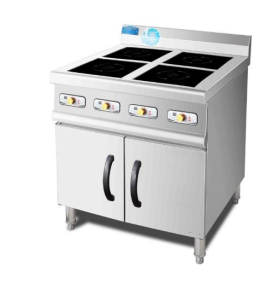
Superior Kitchen Equipment stocks three induction ranges built for exactly the profiles above. The Standing Induction Wok Range suits kitchens that want wok-style output without an open flame. The Standing Induction Cooker works as a direct replacement for legacy gas ranges in general prep and à la carte lines. The Heavy Duty Kwali Induction is built for high-output kitchens and manufacturers running specialised cookware at volume.
- Available in 3500W, 4200W, and 5000W wattage options to match line demand.
- Customers can claim grant support of up to 70% of equipment cost.
- Electricity savings of up to 40% are reported by businesses that have made the switch.
- Visit the showroom to test units on your own cookware before ordering.
Next steps are straightforward: request a site survey to confirm electrical capacity, check your grant eligibility, and book a showroom visit to see the 5000W induction cooker in person before you commit budget.
What training does kitchen staff need to switch to induction?
Moving a brigade from gas to induction is less about technical retraining and more about breaking habits built over years of flame cooking. Chefs used to judging heat by flame height and colour have to relearn that judgement using dial settings and pan feedback instead, and that adjustment usually takes a few shifts, not weeks.
The most common early mistake is cookware related, not technique related. Staff reach for a favourite copper or thin aluminium pan out of habit, find it doesn’t heat, and assume the unit is faulty. A short briefing on which pans work, reinforced with the magnet test, solves this in minutes rather than requiring a formal course.
Temperature vocabulary needs a small shift too. Induction dials often use numbered power levels rather than a visual flame, so kitchens benefit from agreeing house standards, for example “level 7 for a hard sear, level 3 for holding a sauce”, so every cook on the line uses the equipment the same way. Larger operations sometimes bring in a supplier-led demonstration during installation, which tends to shorten the adjustment period considerably compared with leaving staff to work it out through trial and error during live service.
Where a kitchen runs a hybrid setup with both gas and induction stations, cross-training matters more, not less. Staff rotating between a wok station and an induction line need to hold both sets of instincts at once, and that’s usually the trickiest transition to manage smoothly.
Common misconceptions about induction and gas cookers
The idea that induction “can’t get as hot” as gas is one of the most persistent myths in commercial kitchens, and it isn’t accurate. Induction units heat pans faster than gas in most controlled comparisons, because the energy goes directly into the cookware rather than into the surrounding air first. What induction can’t do is replicate the visual flame that some techniques, like wok hei, are built around, and that’s a technique limitation, not a heat limitation.
Another common assumption is that all existing pans will need replacing. In practice, most stainless steel and cast iron cookware already used in professional kitchens works fine on induction, since it’s the base material that matters, not the brand or age of the pan.
There’s also a belief that gas is inherently cheaper to run than induction. Purchase price often favours gas, but running costs regularly favour induction once you factor in energy-transfer efficiency and reduced ventilation demand. The two figures get conflated more often than they should be.
Finally, some operators assume a switch to induction means an all-or-nothing kitchen overhaul. Most transitions happen line by line, station by station, not as a single disruptive changeover on day one.
Author note from David: observed outcomes and common operator concerns
Kitchens that switch to induction usually see faster service and lower energy bills. The one caveat I raise with every operator: budget for electrical capacity honestly before you order equipment.
Get induction equipment built for your kitchen
Superior Kitchen Equipment is the practical route to that switch, not just the advice behind it. Where independent guides can only tell you induction saves energy, we put the actual units, wattage options, and grant paperwork in front of you, so the decision turns into an order rather than another open browser tab.
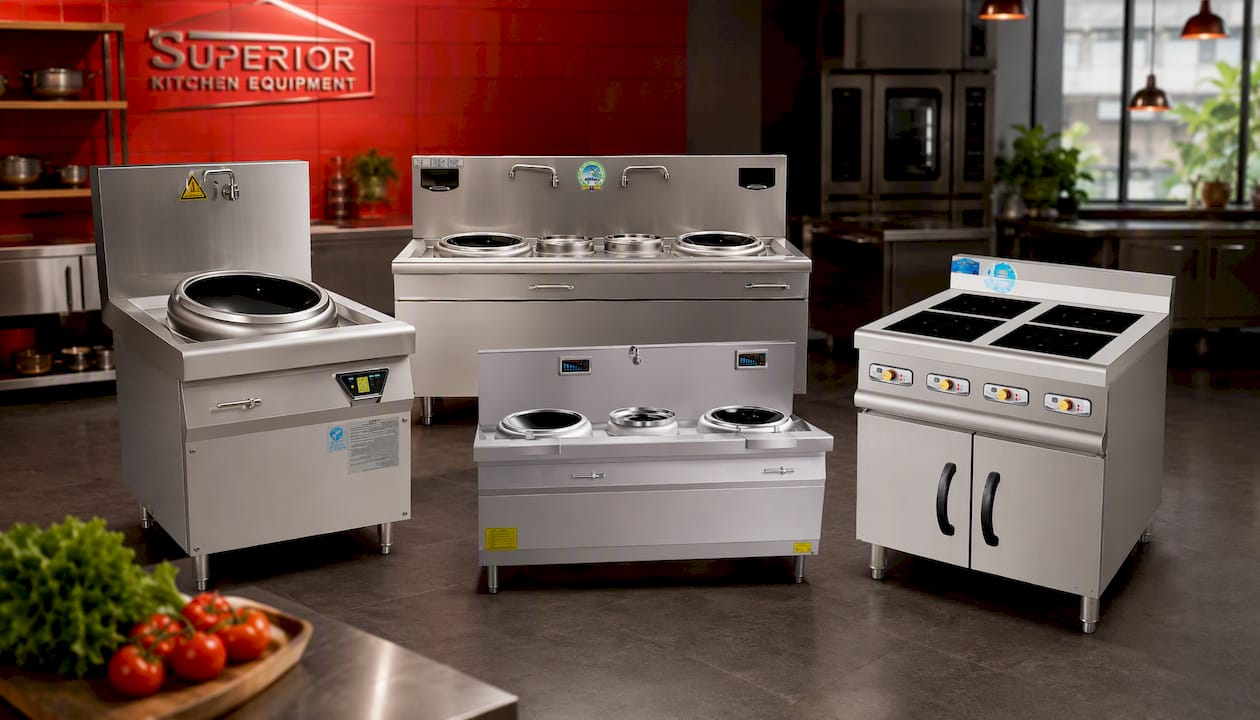
Whether you’re replacing a full gas line or adding a single wok station, our range covers it: the Standing Induction Wok Range for flame-free wok output, the Standing Induction Cooker for general replacement work, and the Heavy Duty Kwali Induction for high-volume manufacturing lines. Book a showroom visit to test units against your own cookware, or request a site survey to confirm your electrical capacity before you order.
Sources
- Strategies to transition to induction cooking in restaurants (project report)
- Gas vs Electric vs Induction: brutal guide to choosing your commercial range (Chef’s Icon)