

Single-phase power suits homes and light commercial premises with lower power demands, while three-phase becomes the practical choice for large motors, heavy kitchen equipment, or continuous industrial loads. The dividing line isn’t about which system is “better” in general terms. It’s about matching supply to load.
- Motor guidance: individual motors above roughly 2–5 kW (around 3 HP) usually need three-phase to start and run efficiently.
- Site-level guidance: whole-site demand beyond typical small-load levels generally tips the balance towards three-phase.
- Next step: check your main fuse or consumer unit, then speak to a certified electrician before committing to any equipment purchase or supply upgrade.
Key Takeaways
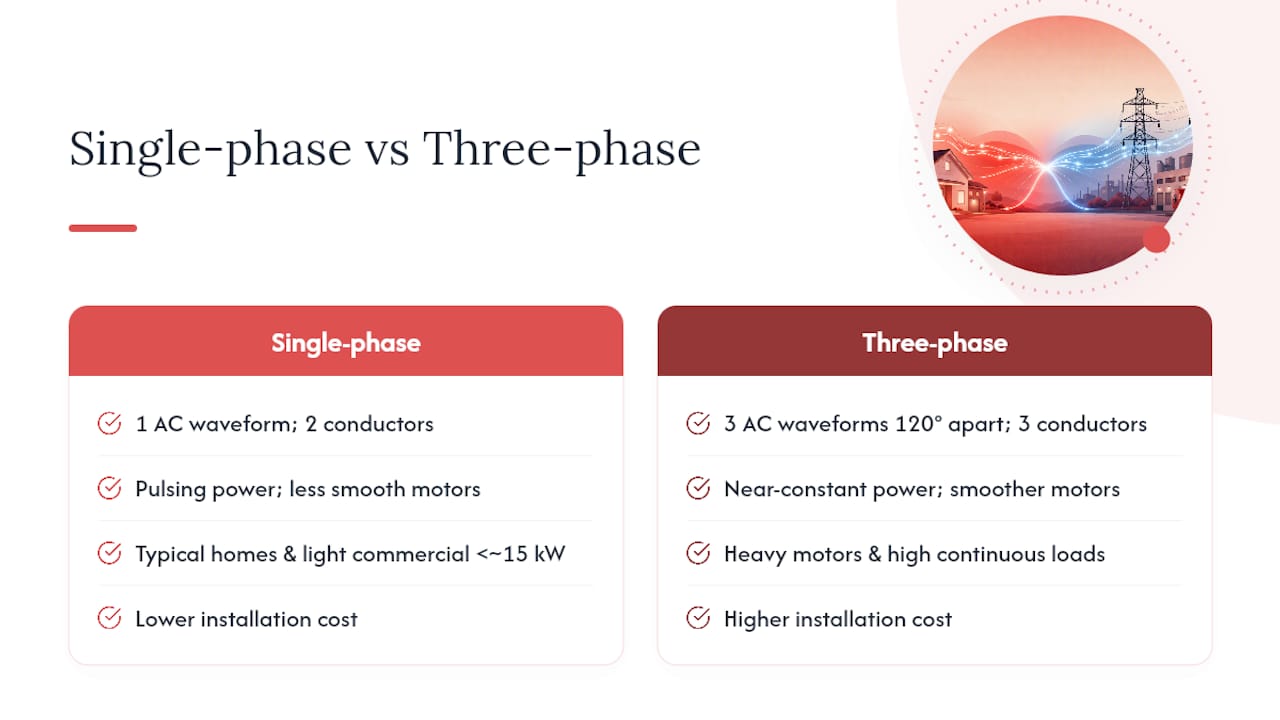
Single-phase suits typical homes and light loads under roughly 15 kW, while three-phase is the practical choice for heavy motors, commercial kitchens, and sustained industrial demand.
| Point | Details |
|---|---|
| Check the fuse count first | One main fuse usually means single-phase; three fuses mean three-phase supply. |
| Mind the √3 factor | Three-phase draws about 57.7% of the current per conductor at equal power. |
| Use kW thresholds as guidance | Around 2–5 kW per motor and roughly 15 kW site-wide are common crossover points. |
| Motors favour three-phase | Three-phase self-starts smoothly; single-phase motors need a start capacitor. |
| Check appliance ratings with Superiorkitchenequipment | Confirm wattage on induction cookers, bain maries, and gas stoves before buying. |
Table of Contents
- What is single-phase power and how does it work?
- What is three-phase power and why is the structure different?
- Three phase vs single phase: what actually differs?
- When should you choose single-phase or three-phase?
- Why do three-phase motors start and run more smoothly?
- How can you tell which supply your property has?
- How do you upgrade to 3 phase power if you need more capacity?
- What should commercial kitchens check before buying equipment?
- Get help specifying the right equipment for your supply
- Frequently asked questions
- Sources
What is single-phase power and how does it work?
Single-phase AC delivers power through a single sinusoidal waveform, carried on a live and a neutral conductor (with an earth for safety). It’s the standard domestic and light commercial supply almost everywhere, with typical nominal voltages under IEC convention, and split-phase voltages used in North America (https://www.fluke.com/en-us/learn/blog/power-quality/single-phase-vs-three-phase-power).
- Wiring is straightforward: live, neutral, earth.
- Power output pulses twice per cycle, dropping to zero at each crossing point rather than staying constant.
- It’s the default for lighting, small appliances, and most household circuits.
| Region/Standard | Typical nominal voltage |
|---|---|
| IEC (UK, EU, much of Asia) | nominal line to neutral voltage |
| North America | split-phase nominal voltage |
That pulsing waveform matters more than it sounds. It’s fine for resistive loads like heating elements and lighting, but it’s a weaker match for anything that needs smooth, continuous torque.
What is three-phase power and why is the structure different?
Three-phase power runs three separate sinusoidal waveforms, each offset by 120 degrees, so at any given instant at least one phase is delivering near-peak power. The combined effect is a near-constant total power output rather than the pulsing profile of single-phase.
- Configured as either wye (star), which includes a neutral, or delta, which typically doesn’t.
- Common nominal voltages include 400 V line-to-line under IEC convention, with regional variants in North American systems.
- Uses three live conductors (plus neutral and earth in wye setups) rather than the two of single-phase.
This structure is why three-phase is the backbone of electricity generation and transmission worldwide. Smoother power delivery means less conductor material is needed to carry the same load, and heavy equipment runs with far less vibration and mechanical strain.
Three phase vs single phase: what actually differs?
The gap between the two systems comes down to four engineering factors: how power is delivered, how much current each conductor carries, how motors start, and how complex the installation becomes.
| Factor | Single-phase | Three-phase |
|---|---|---|
| Power delivery | Pulsating, drops to zero twice per cycle | Near-constant, phases overlap |
| Efficiency & conductor use | Higher current per conductor for equal power | Lower current per conductor, less copper for same load |
| Motor suitability | Needs capacitor or auxiliary winding to start | Self-starting via rotating magnetic field |
| Typical applications | Homes, small offices, light appliances | Large motors, commercial kitchens, data centres, HVAC |
| Installation complexity/cost | Simpler, cheaper to install and maintain | More wiring, higher upfront cost, often needs utility coordination |
| Typical voltages/wiring | IEC and North American typical nominal voltages | 400 V L–L (IEC); regional NA variants |
The current difference is the part most people underestimate. At the same delivered power, same voltage, and same power factor, three-phase draws roughly 1/√3, or about 57.7%, of the current per conductor compared with single-phase.
The √3 factor, worked through: a high-power load on single-phase at nominal residential voltages requires substantially higher conductor current than the equivalent load split across three-phase conductors at typical commercial voltages. That’s the entire commercial case for three-phase in one calculation.
- Lower current per conductor means thinner cables, smaller breakers, and lower long-term cabling costs.
- Three-phase transmission moves more power with less conductor material, which is why grids use it, not household circuits.
- The trade-off is installation complexity: three-phase wiring and switchgear cost more to install than single-phase.
When should you choose single-phase or three-phase?
Single-phase remains the economical, straightforward choice for homes, small offices, and any premises running mostly lighting, small kitchen appliances, or light electronics. Three-phase becomes worthwhile once motors, compressors, or sustained heavy loads enter the picture.
Typical single-phase use cases: houses, flats, small retail units, light offices, small cafés with modest equipment.
Typical three-phase use cases: commercial kitchens with multiple heavy appliances, large HVAC plant, workshops with industrial motors, data centres, food manufacturing lines.
As a working guide, individual motor loads above roughly 2–5 kW (about 3 HP) generally need three-phase to start reliably and run efficiently, while whole-site demand above approximately 15 kW is where three-phase usually becomes the more economical option overall. Treat both figures as guidance, not fixed rules. Actual load, diversity, and future plans all shift the calculation.
Before deciding, run through this checklist:
- Estimate your total connected load, including anything you plan to add within the next two to three years.
- Note whether you’re running (or planning to run) any motor-driven equipment, compressors, or heavy heating elements.
- Weigh the upgrade cost against the operational savings and capacity you’d gain.
- Get a firm quote from your utility and a certified electrician before committing either way.
Pro Tip: If you’ve got one or two motors that need three-phase but the rest of your site runs fine on single-phase, a variable frequency drive (VFD) or rotary phase converter can sometimes let you run that equipment without a full service upgrade. It’s rarely a permanent fix for growing sites, but it buys time and avoids unnecessary capital spend.
Why do three-phase motors start and run more smoothly?
Three-phase motors are self-starting because their three offset waveforms create a rotating magnetic field the rotor can lock onto immediately. Single-phase motors have no such rotating field on their own, so they need a start capacitor or auxiliary winding just to get moving.
- Three-phase: rotating magnetic field, self-starting, steady torque, minimal vibration.
- Single-phase: needs a capacitor or shaded-pole winding, produces more pulsation and mechanical stress over time.
- For commercial equipment run for long hours, three-phase motors tend to last longer and need less maintenance under continuous duty.
- A VFD or soft starter smooths the ramp-up on either system and is worth specifying on any motor over a few kilowatts.
How can you tell which supply your property has?
The fastest, safest check is at your main service head or consumer unit.
- Count the incoming main fuses: a single main fuse usually indicates single-phase; three fuses indicate a three-phase supply.
- Check the meter and any labelling on the incoming service cable or consumer unit.
- Count the incoming live conductors if labelling is unclear or missing.
- If in doubt, ask your distribution network operator or utility directly. They hold your connection records.
Pro Tip: Never open or probe inside your service head or meter box yourself. This is live equipment and the job of a certified electrician or your utility, not a DIY task.
How do you upgrade to 3 phase power if you need more capacity?
Upgrading isn’t a same-day job, and it usually involves both your electrician and your utility.
- Calculate your true load, including headroom for future equipment.
- Get a qualified electrician to assess your existing wiring and consumer unit.
- Contact your utility to check three-phase availability at your site and request a quote.
- Apply for the necessary permits and schedule installation.
- Have the system tested and loads balanced across all three phases before full use.
- Phase converter: cheaper short-term fix for one or two motors; less efficient than a genuine three-phase supply.
- Transformer tap: can work where nearby three-phase infrastructure already exists; cost depends heavily on distance from the network.
- VFDs: don’t create three-phase power from scratch, but let single-phase-fed motors run more smoothly and efficiently.
Pro Tip: Never treat this as DIY work. Live supply changes need a certified electrician, proper isolation procedures, and in most jurisdictions, formal permits and utility sign-off.
What should commercial kitchens check before buying equipment?
Kitchen equipment spans a huge power range, and that range determines what supply you need before you even open the showroom door.
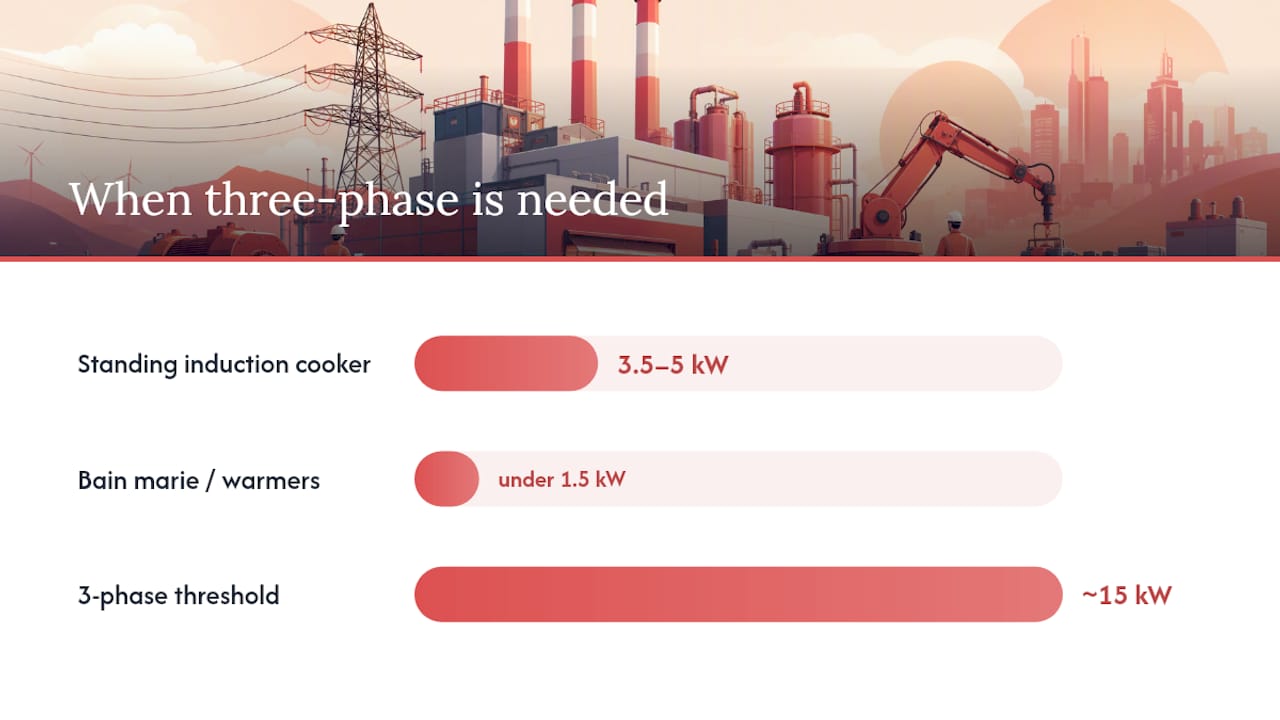
- Standing induction cookers commonly draw 3,500 to 5,000 W each, which adds up fast across a busy line.
- Standing bain maries and food warmers usually draw far less, often under 1.5 kW, and rarely force a supply upgrade on their own.
- Gas stoves need minimal electrical input beyond ignition and controls, making them one of the lowest-demand appliance categories electrically.
Running two or three induction cookers alongside ovens and extraction fans is exactly the scenario that pushes many kitchens past the roughly 15 kW threshold where three-phase becomes worthwhile.
Pro Tip: Before purchasing, check the exact wattage and motor rating on every major appliance, including the Standing Induction Cooker, the Standing Bain Marie 4 Hole Warmer, and the 2 Ring Standing Gas Stove, against your actual supply capacity, not just your kitchen’s floor plan.
A pragmatic view on choosing between them
Where a kitchen or workshop has real motor loads, or growth plans within the next few years, I’d lean towards three-phase even at extra upfront cost. For a straightforward residential or light commercial fitout with no heavy motors, single-phase remains the sensible default. Either way, get a proper load calculation and a certified electrician’s opinion before you buy.
Get help specifying the right equipment for your supply
Choosing equipment before checking your electrical supply is one of the most expensive mistakes a kitchen buyer can make, and it’s one Superiorkitchenequipment helps customers avoid every week by matching appliance specifications to actual site capacity before money changes hands.
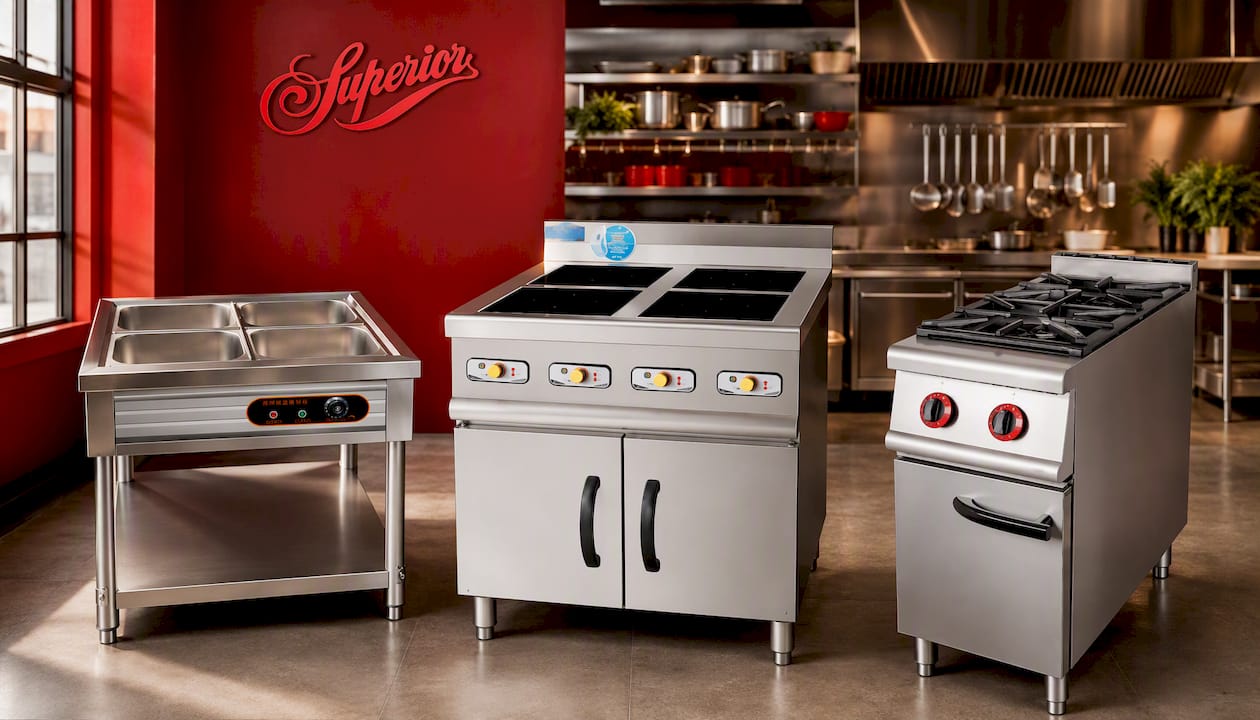
Whether you’re running a single-phase café or a three-phase commercial kitchen, our range covers both ends of the power spectrum. The Standing Induction Cooker and Standing Bain Marie 4 Hole Warmer suit kitchens planning heavier electrical loads, while the 2 Ring Standing Gas Stove is a solid option where electrical demand needs to stay low. Visit our showroom to see the full range in person, and we’ll help you work out what your existing supply can handle. This is a promotional section from Superiorkitchenequipment; installation and any supply upgrade work should always be carried out by a certified electrician.
Frequently asked questions
What’s the main difference between single phase and three phase power? Single-phase carries one pulsing AC waveform on two conductors; three-phase carries three waveforms 120° apart across three conductors, giving near-constant power delivery and smoother motor operation.
Is three-phase always better than single-phase? No. Three-phase suits heavy motors and high continuous loads, but it costs more to install and is unnecessary for typical homes and light commercial premises under roughly 15 kW.
How do I know if I have single-phase or three-phase power? Check your main service head or consumer unit: one main fuse typically means single-phase, while three fuses indicate three-phase. A certified electrician or your utility can confirm this.
Can I convert my supply from single-phase to three-phase? Yes, but it requires coordination with your utility, a certified electrician’s assessment, permits, and installation costs. Phase converters and VFDs are sometimes viable alternatives for isolated motor loads.
Does a commercial kitchen always need three-phase power? Not always. Small kitchens with light equipment like gas stoves and bain maries may run comfortably on single-phase. Kitchens running multiple high-wattage induction cookers usually need three-phase.
Sources
- Three-phase electric power
- What’s the difference between a single phase and three phase electricity supply? | UK Power Networks
- Single Phase vs Three Phase Power: Key differences | Trilpeak