
Every job runs on six categories: cooking and prep gear, hot and cold holding equipment, serving and display tools, disposables, transport and packing systems, and safety and sanitation supplies. A proper catering equipment checklist treats each category as a separate load-out check, backed by an instant-read thermometer, a three-compartment sink for on-site cleanup, and stock you have actually seen and tested at a showroom like Superiorkitchenequipment’s before it goes on the van. What follows breaks down exactly what belongs in each group and how to size it.
TL;DR:
- Proper equipment sizing depends on whether you are cooking on-site or finishing prepped food, with portable induction cookers favored for their efficiency and safety.
- Temperature control in transit requires insulated carriers and cold storage based on actual menu volume, not just guest count, to prevent food safety failures.
- Packing and unloading must follow a logical order, with labeled totes and photo documentation to avoid missed items and streamline setup at the venue.
- Keep a buffer of disposables and consumables of 10-20% to accommodate headcount changes or breakage, stored in labeled containers for quick access.
- Visiting a showroom allows for in-person testing of equipment, ensuring it withstands transport and setup while optimizing energy grants and reducing purchase risk.
Table of Contents
- Core cooking and prep equipment for catering jobs
- Hot and cold holding, warming and transport equipment
- Serving, display and tableware for buffet and plated events
- Disposables, consumables and the spares nobody remembers
- Transport, packing systems and venue setup
- Safety, sanitation and compliance items
- Sizing equipment, budgeting and the buy-versus-rent decision
- Where to see this equipment before you buy it
- A practical timeline for the days before service
- How Superiorkitchenequipment fills the gaps in your checklist
- Sources
Core cooking and prep equipment for catering jobs
The kit that goes on the van depends entirely on whether you are cooking on-site or finishing food that arrives already prepped. Either way, weight and power draw decide what actually works. Portable induction cookers have become the default for off-site catering because they run cooler, use less energy than gas burners, and avoid the fire-risk paperwork that open flames trigger at most venues. Combi or convection ovens earn their place only when the menu genuinely needs them, since they are heavy, need proper ventilation, and take up van space you might need for holding equipment instead.
Your smallwares list matters just as much as the heavy equipment:
- Chef’s knife, paring knife and a boning knife, sharpened before every job
- Vegetable peelers, box grater and mixing bowls in at least three sizes
- Cutting boards colour-coded for protein, produce and ready-to-eat items
- Tongs, spatulas, ladles and a whisk, doubled up for high-volume services
- An induction cooker rated for at least 5000W if you are finishing hot dishes on-site
As a rule of thumb, budget one burner or induction hob per 40 to 50 covers for hot finishing work, and one instant-read thermometer per station, not per kitchen. Nobody should be walking across a venue floor to check a temperature while a dish sits in the danger zone.
Hot and cold holding, warming and transport equipment
Temperature control is where catering jobs are won or lost, and it starts before you leave the kitchen. Insulated carriers, often called Cambros in the trade, hold food at safe temperatures for hours during transit, and they work far better than trying to keep a chafer lit in the back of a van. Hot boxes serve the same purpose for larger batches. On arrival, chafing dishes with sterno fuel remain the standard for buffet service, though electric warmers are worth the extra plug if the venue has reliable power, since they hold temperature more evenly over a long service window.
Cold-chain planning needs the same rigour. Coolers packed with enough ice for the full event duration, plus refrigerated storage sized to your actual menu volume rather than guest count, prevent the slow temperature creep that ruins cold appetisers and desserts. Portable induction and insulated holding gear are consistently cited as what separates smooth off-site catering from chaotic catering, because they remove the two biggest points of failure: heat loss and power dependency.
Pro Tip: Hot foods must stay above 140°F (60°C) and cold foods below 40°F (4°C) throughout service. Probe every chafer and cooler on arrival, not just before you leave the kitchen.
Before service starts, run through this on arrival:
- Probe-check every hot-holding unit and confirm it reads above the safe minimum
- Verify cooler temperatures and top up ice if the drive ran long
- Confirm chafer fuel supply is enough for the full service window, with spares packed
- Check that a backup power or fuel source exists if the venue’s supply fails
Size hot-holding equipment by the number of hot dishes and how often you expect to replenish them, not by headcount alone. Guest counts alone routinely under-provision chafers because a 200-cover job with five hot dishes needs very different holding capacity to the same headcount with two.
Serving, display and tableware for buffet and plated events
Guest flow depends on serving equipment that lets your team move fast without bottlenecking the line. Chafers anchor buffet service, but they need the right accessories around them: ladles sized to portion control, serving tongs that do not mangle delicate items, and a carving set if the menu includes a roast. Serving trays and risers give a buffet visual depth and stop every dish looking flat under venue lighting.
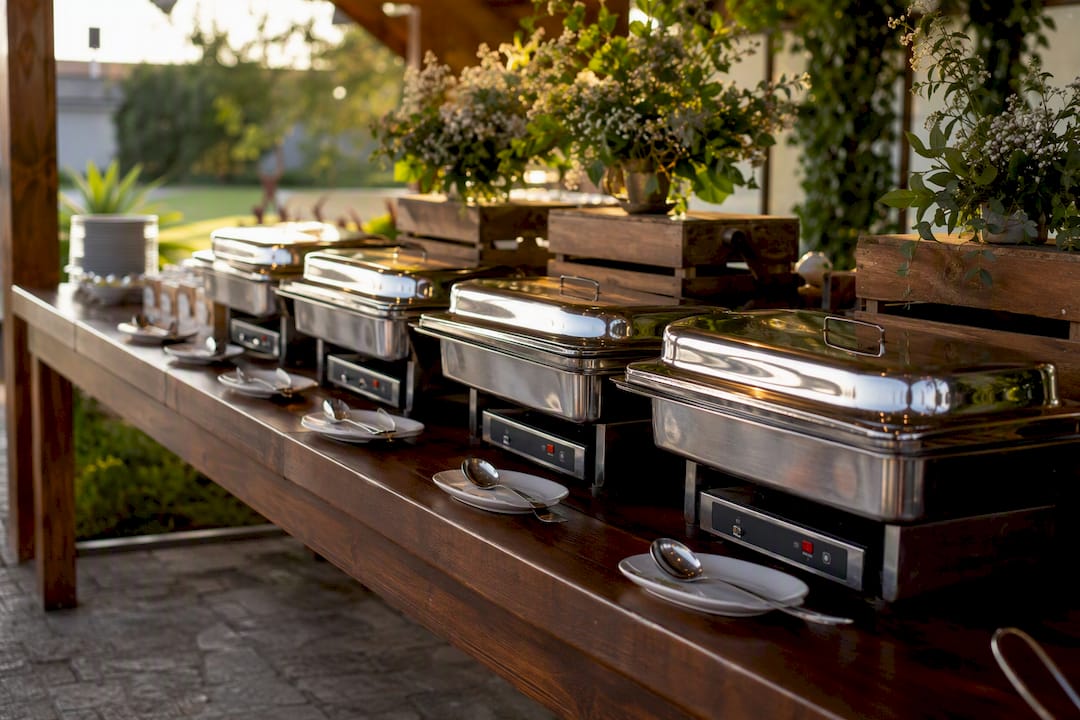
Dinnerware choices depend on service style. Plated dinners need a full setting per cover; buffets can often get away with fewer place settings in rotation if your team clears efficiently. Whatever the format, pack 10 to 20% more plates, glassware and cutlery than your guest count, because breakage, double-ups and last-minute headcount changes are routine, not exceptional.
A few presentation details separate professional service from amateur setups:
- Menu cards for each dish, especially where allergens or dietary tags matter
- Sneeze guards on any exposed buffet station, non-negotiable at most venues now
- Linen weights for outdoor events, since a gust of wind and an unweighted tablecloth is a familiar disaster
- Extra serving spoons and tongs staged at the pass, not just at the buffet
Disposables, consumables and the spares nobody remembers
Disposables fail quietly. Nobody notices you packed enough napkins until you run out with forty guests still in line. Keep a standing stock of disposable plates, cutlery, napkins, to-go containers and beverage cups, and treat chafer fuel, lighters, cling film, foil, tape and disposable gloves as consumables you replenish after every job, not before the next one.
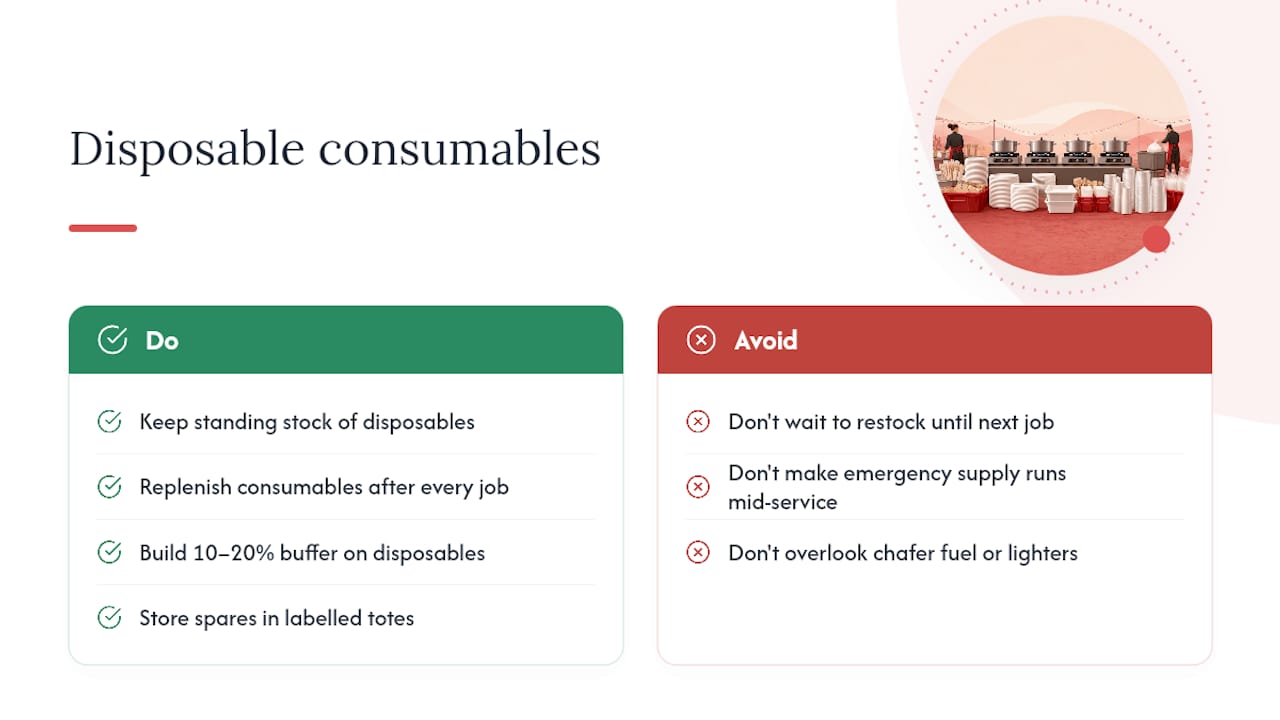
Buffer quantities matter more here than anywhere else in the checklist. Building in 10 to 20% extra stock on all disposables covers headcount surprises without you having to make an emergency supply run mid-service. Store spares in labelled totes so a last-minute count takes seconds, not a full inventory search.
Transport, packing systems and venue setup
Loading order decides how smoothly your team unloads at the other end. Pack heaviest and least fragile items first, glass and stemware last in dedicated glass racks, and label every tote and bus bin by station so nobody is rifling through six boxes to find serving spoons. Carts and dollies save backs and time; non-slip mats under prep stations prevent accidents once the floor gets wet.
On arrival, run this setup routine before anything else happens:
- Confirm venue power outlets and their load capacity match your equipment
- Check water access if you need it for cleanup or beverage service
- Walk the layout and confirm your station plan still fits the space
- Unload in reverse order so the first items needed come off last
- Probe-check hot and cold holding units immediately after setup
Pro Tip: Photograph your loaded van before every job. When something goes missing mid-service, that photo tells you in seconds whether it was left behind or is buried somewhere in the load.
Safety, sanitation and compliance items
A hand-wash station, hand sanitiser, disposable gloves and disposable aprons are the baseline expectation at almost every venue now, and most event coordinators will ask about them before you even set up. Beyond hygiene, pack a fire extinguisher rated for kitchen fires, a stocked first-aid kit, and any PPE your team needs for hot equipment or knife work.
Run a short pre-service sanitation check every time:
- Hand-wash station set up and stocked with soap and paper towels
- Sanitiser solution mixed correctly and test strips on hand if required
- Gloves changed between raw and ready-to-eat handling, every single time
- Hot-holding above 140°F (60°C) and cold-holding below 40°F (4°C), logged
- Fire extinguisher accessible and within its inspection date
Checklist templates with simple Yes/No/N/A tick boxes catch these gaps before they become incidents, and keeping a dated log gives you a paper trail if a venue ever asks for one.
Sizing equipment, budgeting and the buy-versus-rent decision
Refrigeration and oven capacity should scale to covers, not guesswork. A rough rule: plan for one cubic foot of refrigerated storage per 10 to 15 covers for cold-heavy menus, and size ovens by batch count rather than total guest number, since a slow-cooked item needs far more oven time per cover than a quick sear.
Total cost of ownership matters more than sticker price. Energy use, maintenance intervals and downtime all add up over a piece of equipment’s life, and combi ovens and correctly sized refrigeration directly affect both throughput and food safety in high-volume operations. Where budget is genuinely tight, a partner supplier like MegaPalletsLiquidation can be worth checking for lower-cost display coolers, though buying energy-efficient equipment outright, where grants offset the cost, usually wins on a five-year horizon.
Renting still makes sense in specific cases:
- One-off portable cookers for a single large event you won’t repeat soon
- Extra chafers for a season’s peak that don’t justify a permanent purchase
- Specialised equipment you are testing before committing to a full buy
Where to see this equipment before you buy it
Reading specifications online only gets you so far when a piece of equipment has to survive daily transport and setup. Superiorkitchenequipment runs a showroom where caterers can see chillers, ovens, induction units and carriers in person before committing, and the team there can walk you through energy-efficiency grants that offset a meaningful share of the purchase cost on qualifying equipment.
Most items on this checklist map directly onto what’s in stock:
- Bulk cold storage needs point to the four-door combination chiller freezer
- On-site cooking and prep needs point to a commercial oven sized for batch volume
- Off-site finishing work points to a portable induction cooker rated for buffet service
Seeing the equipment run before it goes on your van removes most of the guesswork that a spec sheet alone can’t answer.
A practical timeline for the days before service
Four days out, confirm headcount, menu and rental gaps. Two days out, pull and probe-test every piece of holding equipment. The day before, pack in loading order and stage disposables with buffer stock. On the day, run your ten checks: power, water, layout, thermometers, fuel, gloves, sanitiser, fire extinguisher, first-aid kit, and a final headcount against your table settings.
Brief your staff on allergen tags and station assignments before doors open, not during setup. Most last-minute fixes trace back to one thing: nobody checked the chafer fuel before leaving the kitchen.
— David
How Superiorkitchenequipment fills the gaps in your checklist
Building this checklist is one thing. Sourcing equipment you can actually see running before you buy it is another, and that’s the gap Superiorkitchenequipment closes for working caterers. Rather than ordering blind from a catalogue, you walk the showroom, watch the induction units and ovens run, and leave with equipment you already know fits your workflow, backed by guidance on the energy-efficiency grants that can offset a meaningful share of the cost.
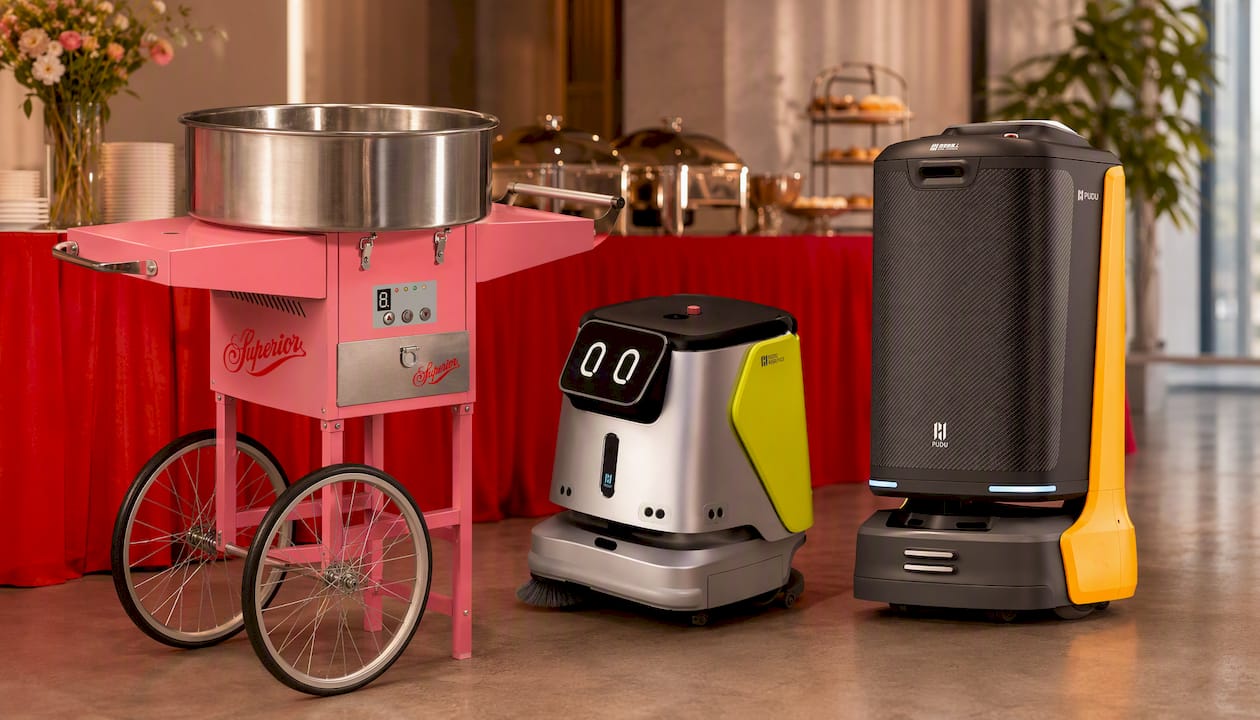
The catalogue stretches well beyond the core checklist too. A candy floss cart covers novelty stations for family events and fairs, while the Pudu CC1 robot and FlashBot robot show how far automation has moved into event service, from bussing tables to plated delivery. If your next job needs equipment beyond what’s already on your van, visit the showroom or browse the product pages, and get a quote before your next booking locks in.
Sources
- Catering supplies & equipment checklist — WebstaurantStore
- Cloud kitchen equipment: complete setup & equipment list — RestroWorks
- Catering equipment checklist — GoAudits