

Neither cabinet wins outright: an upright suits frequent service access with organised stock, while a chest suits bulk backup with better energy efficiency and outage resilience. Superior Kitchen Equipment sees most professional kitchens run both, splitting daily-use stock from reserve storage. Grant-eligible, energy-efficient models exist in both formats, so the choice comes down to workflow, not just cabinet type.
TL;DR:
- Chest freezers offer greater storage density and better energy efficiency, typically running 10 to 25% more efficiently than upright models.
- Upright freezers provide faster access and are better suited for kitchens with frequent door openings, while chest units excel in bulk storage.
- Selecting the correct size involves measuring usual stock volume, adding a 10 to 20% buffer, and verifying site conditions before purchase.
- Energy-efficient models with hydrocarbon refrigerants and manual defrost options can significantly lower running costs and qualify for grants.
- Viewing units in a showroom helps assess lid clearance, shelving, and noise levels, leading to more informed buying decisions.
Table of Contents
- Chest freezer vs upright freezer: operational trade-offs
- How do you choose the right freezer size and specification?
- Why showroom visits and grant support matter for buyers
- What actually decides this purchase
- Ready to compare cabinets in person?
- Sources
Chest freezer vs upright freezer: operational trade-offs
Storage density is where chest cabinets earn their keep. Because cold air sinks and pools rather than escaping every time a door opens, chest freezers typically deliver more usable litres per dollar and per square metre than an equivalent upright footprint. That said, the gross litre figure on a spec sheet rarely matches what you can actually pack in. Compressor housing, internal baskets, and irregular corners eat into that number, so treat any advertised capacity as a ceiling, not a working total.
Access speed tells the opposite story. Vertical shelving lets staff scan and grab in seconds, which is why upright freezers give faster, organised retrieval and suit kitchens where the cabinet gets opened dozens of times during a shift. A chest freezer, by contrast, asks staff to dig, and every extra second during service adds up across a busy line.
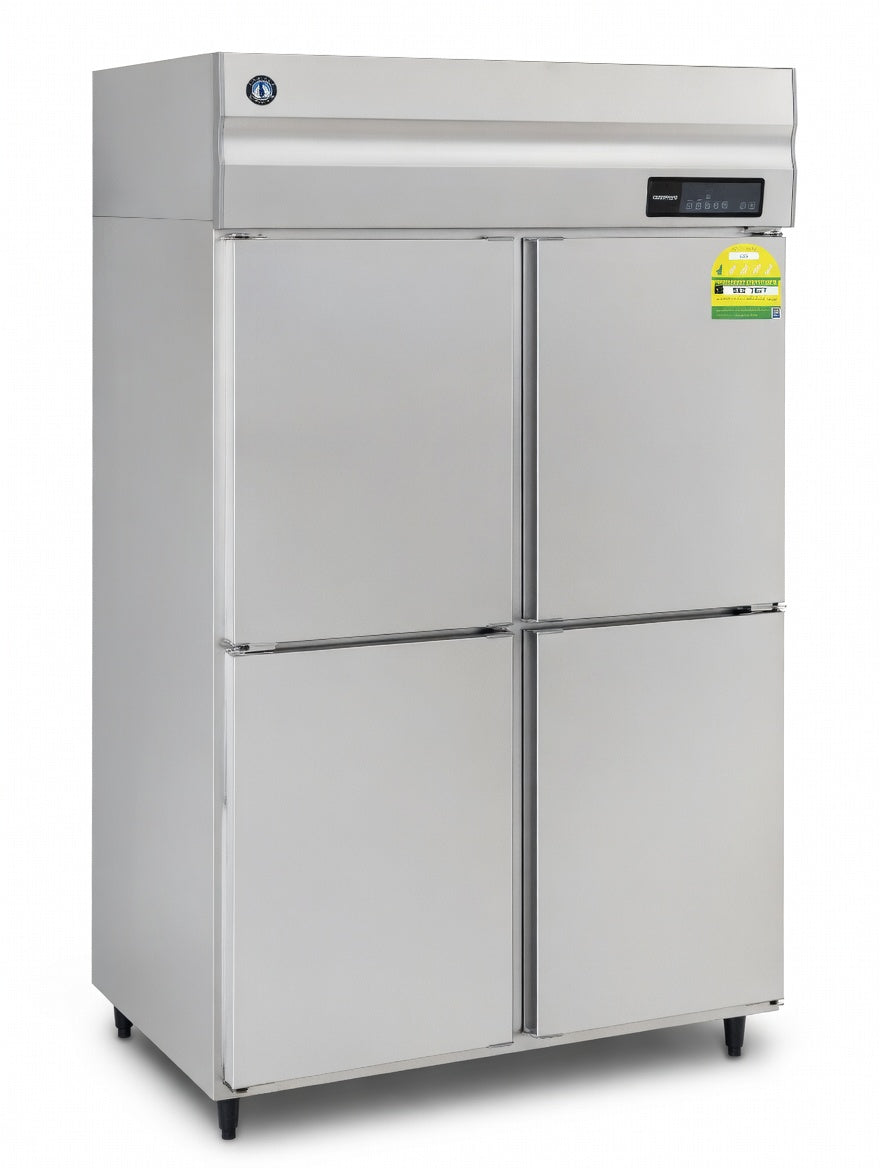
Energy is the trade-off that changes most minds. Chest designs are commonly more energy efficient than upright models, and manual defrost units with hydrocarbon refrigerants such as R-290 or R-600a push that gap further. Auto-defrost uprights burn extra electricity running heating elements through the day, which is convenient but costly at scale.
Statistic to remember: a chest freezer running 10 to 25% more efficiently than a comparable upright, multiplied across a commercial kitchen’s daily runtime, can shift an annual electricity line item by a meaningful margin, particularly for a food manufacturer running multiple units around the clock.
Power resilience follows the same physics. Cold air stays trapped low in a chest cabinet during an outage, so temperature holds longer than in an upright, where warm air rises straight through the shelving the moment the door seal is compromised or power drops.
Space constraints often decide the matter before energy figures even come into play:
- Chest units need a floor footprint plus lid swing clearance above, which rules them out under low ceilings or tight mezzanine storage.
- Upright cabinets need less floor space but more wall height and door swing room in front.
- Chest freezers tend to be easier to slot along a back wall in narrow back-of-house corridors.
- Upright units integrate more naturally into a line of matching commercial refrigeration.
Maintenance differs too. Chest interiors are harder to wipe down thoroughly because of the depth and the compressor housing at the base, while upright shelving comes apart for a proper deep clean far more easily, which matters for anyone running a formal food safety audit.
Pro Tip: Keep your fastest-moving stock in labelled baskets near the top of a chest freezer. It closes most of the access-speed gap with an upright without sacrificing the storage or energy advantage.
As a rule of thumb, catering operations and food manufacturers storing bulk ingredients favour chest units, while restaurants and cafés pulling stock constantly through service favour upright freezers.
How do you choose the right freezer size and specification?
Getting the size right the first time avoids the most expensive mistake in commercial refrigeration: buying a cabinet too small for real turnover and having to replace it within a year.
- Audit your actual stock. Measure typical delivery cartons and your weekly stock turn in litres rather than guessing from memory.
- Add an operational buffer. Build in 10 to 20% spare capacity on top of your measured volume to absorb delivery spikes, seasonal menus, or supplier delays.
- Convert to gross litres and round up. Choose the next size up from your calculated figure rather than the exact match, since usable volume always runs below the nameplate rating.
Before you order anything, walk the installation site with these checks in hand:
- Confirm ventilation clearance around the compressor, since restricted airflow raises energy use and shortens compressor life.
- Check ceiling height against lid swing if you’re installing a chest freezer.
- Map the delivery route from the loading bay to the final position, including doorways and any steps.
- Verify your electrical supply matches the unit’s specification before installation day, not after.
When you’re comparing models on paper, run through this specifier checklist:
- Climate class rating matched to your kitchen’s ambient temperature, not a generic figure.
- Defrost type, weighing manual defrosts’ energy savings against auto-defrost’s lower labour requirement.
- Refrigerant type, with R-290 and R-600a hydrocarbon refrigerants generally the more efficient modern choice.
- Energy rating, requested as a specific kWh figure for the exact model, not a category average.
- Compressor access and spare-part availability, since a cabinet that’s hard to service will cost you in downtime later.
Ask any supplier directly about warranty length and callout response times, whether they offer a service plan, and whether you can see the model running in a showroom before you commit. Ask for documentation behind any energy claim and for guidance on under-sizing and poor ventilation, which remain the most common causes of high running costs and premature compressor failure. Treat vague answers on any of these points as a reason to walk away from the quote.
Why showroom visits and grant support matter for buyers
Buying refrigeration on spec sheets alone is how kitchens end up with the wrong unit. Superiorkitchenequipment runs a showroom specifically so restaurant owners, caterers, and food manufacturers can see cabinet depth, lid clearance, and shelving layout before committing budget to a purchase.
Energy-efficient models reduce total cost of ownership two ways: lower monthly electricity bills, and, where eligible, grant support that can offset a meaningful share of the original equipment cost. Always ask a supplier for the documentation behind an energy claim and for written guidance on which grant schemes a given model qualifies under.
| Product | Best suited to |
|---|---|
| 2 Door Upright Hoshizaki Freezer | Kitchens needing frequent, organised access with a compact footprint |
| 4 Door Upright Hoshizaki Freezer | High-volume restaurants or caterers needing more shelving without a bulk chest layout |
| 1.8m Hoshizaki Counter Freezer (75cm) | Tight front-of-house or narrow galley layouts where floor space is limited |
For pure bulk backup storage, a chest freezer still does the heaviest lifting per pound spent, particularly for food manufacturers holding large batches between production runs.
What actually decides this purchase
Most advice on chest versus upright treats it as a contest with a single winner, and that framing does buyers a disservice. The research consistently points the same direction: match cabinet type to how often the door opens, not to which cabinet sounds more efficient on a spec sheet.
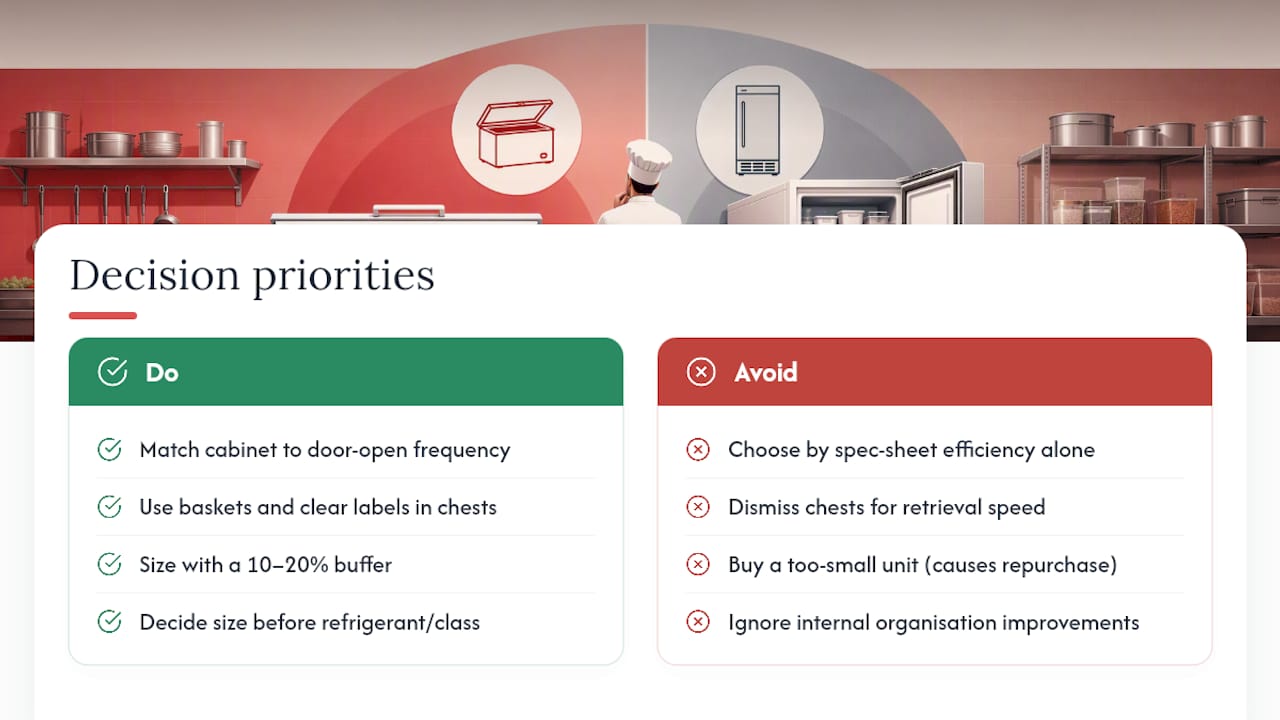
Where conventional advice falls short is in underselling organisation. A well-labelled chest freezer with baskets closes much of the access-speed gap with an upright, at a fraction of the running cost. Buyers who dismiss chest units purely on retrieval speed are often leaving real energy savings on the table for a convenience they could recover with better internal layout.
If there’s one priority worth acting on first, it’s sizing. Buying too small forces a second purchase within a year, while buying with a sensible 10 to 20% buffer built in rarely goes wrong. Get that right before agonising over climate class or refrigerant type.
— David
Ready to compare cabinets in person?
Spec sheets only tell you so much. Superiorkitchenequipment’s showroom lets you stand in front of a chest freezer and an upright side by side, open the doors, and judge access speed for your own team before you spend a penny. That’s the advantage a page of comparisons can’t give you: a hands-on read on lid clearance, shelf depth, and noise level in the space you’ll actually be running it.
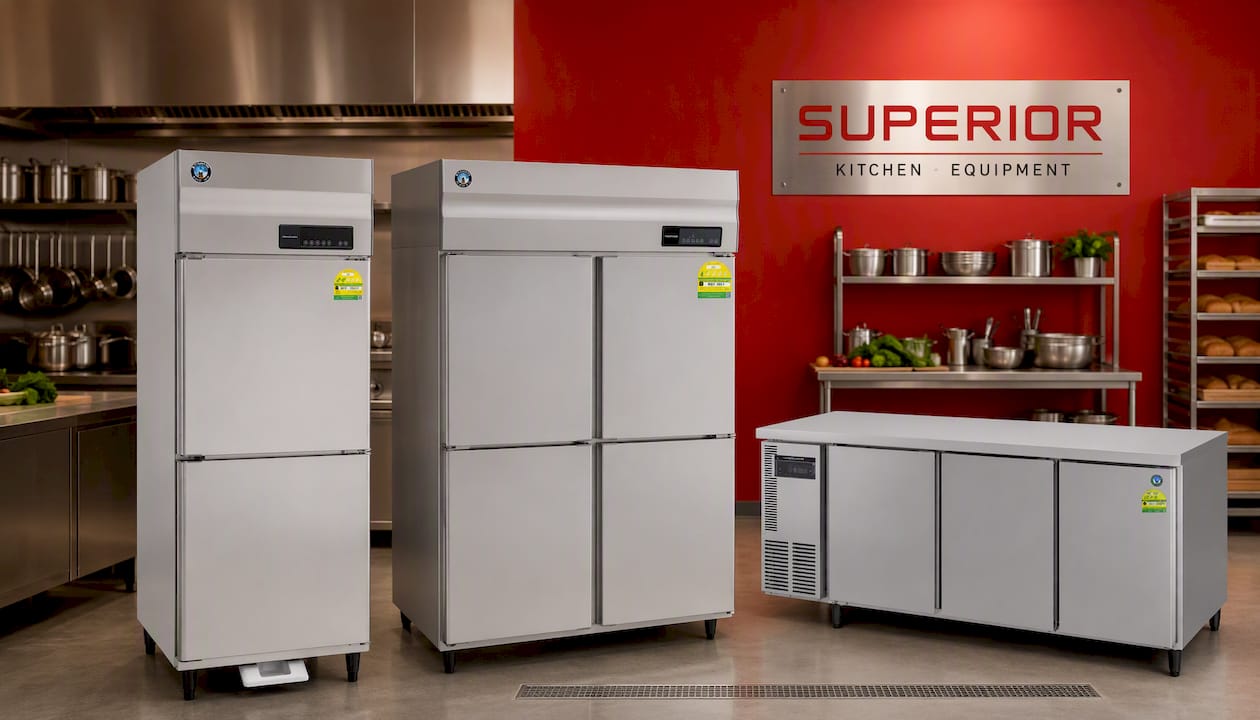
If frequent-access storage is the priority, the 2 Door Upright Hoshizaki Freezer or the larger 4 Door Upright Hoshizaki Freezer covers organised daily stock, while the 1.8m Hoshizaki Counter Freezer (75cm) fits tighter front-of-house layouts without sacrificing capacity. Book a showroom visit, request a site measurement, or ask for documentation on energy-efficiency grants before you finalise your order. Get in touch with Superiorkitchenequipment to arrange your visit or request a quote today.
Sources
- Commercial Chest Freezer vs Upright Freezer: Which for Your Venue? | 2026
- Energy efficient freezer guide: cut freezer energy costs
- Chest freezer vs upright freezer: which is better for your business?