

The standard sheet pan sizes are full (26×18 in / 660×457 mm), half (18×13 in / 457×330 mm), quarter (13×9.5 in / 330×241 mm) and eighth (9.5×6.5 in / 241×165 mm), based on conventional US dimensions. The half-sheet is the size most home ovens are built around and the one worth owning first. One caution before you buy: rim height eats into the flat cooking surface, and exterior dimensions must clear your oven’s interior width, depth and rack spacing.
TL;DR:
- Half-sheet pans (18×13 inches) are the most versatile and fit most domestic ovens, making them the best first purchase for home bakers.
- Rim height, typically around 1 inch, reduces the usable flat surface and varies between manufacturers, so checking exterior dimensions is crucial before buying.
- Material choice affects heat conduction and durability, with heavier-gauge aluminum recommended for convection ovens to prevent warping and ensure even cooking.
- Measurement of your oven’s interior width, depth, and rack spacing is essential to avoid purchasing pans that do not fit properly or block airflow.
- Professional kitchens should verify exact exterior dimensions, rim style, and rack clearance, rather than relying solely on nominal size labels like full or half, to prevent fitting issues.
Table of Contents
- Standard sheet pan dimensions and metric conversions
- Which sheet pan size should you buy?
- Sheet pan versus cookie sheet: what’s the real difference?
- How material and rim height affect your results
- How to check your oven fits before you buy
- GN sizes and how they compare to US sheet pans
- Buying pans for a commercial kitchen: what actually matters
- What buyers get wrong about sheet pan sizing
- Get your pan sizing right before you order
- Sources
Standard sheet pan dimensions and metric conversions
Sizing gets confusing fast because different retailers round differently, and rim height changes the usable area even when the outer measurement stays the same. Here’s the reference that matters, drawn from Wikipedia’s sheet pan dimensions:
- Full sheet: 26×18 in (660×457 mm) — the commercial standard, rarely fits a domestic oven.
- Half sheet: 18×13 in (457×330 mm) — the most common home and professional size.
- Quarter sheet: 13×9.5 in (330×241 mm) — good for small batches and toaster ovens.
- Eighth sheet: 9.5×6.5 in (241×165 mm) — used for single portions or garnish prep.
- 2/3 sheet: roughly 16×22 in, a mid-size option some manufacturers list between half and full.
- Jelly-roll pan: 10×15 in, a slightly shallower home variant often sold alongside half-sheets.
- 9×13 in pan: technically a baking dish rather than a sheet pan, but frequently confused with the quarter sheet.
Rim height on most rimmed pans is typically close to 1 inch, though shallower jelly-roll styles may have slightly lower rims. Treat every figure above as approximate. Vendors round to the nearest half inch or nearest 5mm, and a “half sheet” from one supplier can be a centimetre or two off another’s. Always check the exterior measurement printed on the product listing before you order, particularly if the pan needs to slide into a rack or alongside other trays.
Which sheet pan size should you buy?
Matching pan size to task saves cupboard space and prevents the classic mistake of buying full-size pans that never fit the oven. Work through use-cases in this order:
- Start with a half-sheet (18×13 in) for cookies, roasted vegetables, sheet-pan dinners and reheating. It’s the size that fits comfortably in nearly every domestic oven with room to spare.
- Add a quarter-sheet if you bake small batches, toast nuts, or use a toaster oven that can’t accommodate anything larger.
- Consider a 10×15 in jelly-roll pan for cakes, roulades, or recipes that specifically call for a shallower rim.
- Move to a 2/3 sheet or full sheet only if your oven interior is genuinely large. Measure before buying. Many “large” domestic ovens still can’t clear a full 26×18 in pan with the door shut.
- Reserve eighth-sheets for garnish work, small roasts, or portion-controlled baking where a full sheet would waste oven space and energy.
Domestic ovens vary more than people expect. A half-sheet fits almost universally, which is why it’s the pan most recipe writers assume you own. Anything larger demands you check your oven’s actual interior dimensions first, not just the size advertised on the box.
Sheet pan versus cookie sheet: what’s the real difference?
The two get used interchangeably, but the construction differs in ways that affect performance. A sheet pan has a rolled rim, typically 1 inch (25 mm), running around all four sides, while a cookie sheet usually has just one short angled edge and is open on three sides.
- Sheet pans contain liquid. The rim stops fat, juice or marinade from running off, which makes them the better choice for roasting.
- Cookie sheets slide more easily. The open sides let you transfer cookies straight onto a cooling rack without lifting.
- Browning behaviour differs slightly. Cookie sheets expose more of the food’s edge to direct airflow, which some bakers prefer for crisp bases.
If your recipe involves any liquid at all, reach for the rimmed pan.
How material and rim height affect your results
Aluminium, stainless steel and non-stick each behave differently under heat, and the choice affects both cooking results and how long the pan lasts. Aluminium conducts heat fast and evenly, which is why most commercial kitchens default to it. Stainless steel heats more slowly and unevenly but resists warping and denting better over years of hard use. Non-stick coatings simplify cleanup but degrade faster under high heat and abrasive scrubbing.
- Rim height directly reduces usable flat area. Each rim typically sacrifices 10 to 20 mm of baking surface along that edge, a loss that matters proportionally more on smaller pans.
- Rolled rims improve grip and rigidity but add some extra dimension to the overall footprint. Factor that into tight oven fits.
- Heavier gauge metal resists warping under repeated high-heat cycles, particularly in convection ovens where forced air stresses thinner sheets.
Pro Tip: If you’re buying for convection use, choose a heavier-gauge aluminium pan rather than the lightest one on the shelf. Thin pans can warp under forced-air cycling, and a warped pan cooks unevenly no matter how good your recipe is.
How to check your oven fits before you buy
Getting the measurements right takes five minutes and saves a return shipment. Work through it in this order:
- Measure your oven’s interior width and depth at the narrowest point, not the widest, since hinges and heating elements often intrude.
- Measure the gap between racks if you plan to use multiple pans at once.
- Add your intended pan’s exterior dimensions and confirm at least 2 inches (50 mm) of clearance on every side for air circulation.
- Check for obstructions: door hinges, side racks, temperature probes and convection fan housings can all reduce usable width.
- If your oven has a convection fan, confirm the pan doesn’t block airflow across the back panel, which causes patchy browning.
Ovens like Superiorkitchenequipment’s electric convection oven publish exact interior dimensions for this reason. Cross-check them against your pan’s exterior size rather than assuming “half sheet” means the same thing everywhere.
GN sizes and how they compare to US sheet pans
Professional kitchens outside the US mostly work in Gastronorm (GN) sizing rather than the full/half/quarter system, and the two don’t map perfectly onto each other.
- GN 1/1: 530×325 mm, the full-size reference tray most GN equipment is built around.
- GN 1/2: roughly 325×265 mm, a common mid-size option.
- GN 1/3: roughly 325×176 mm, used for narrower inserts.
- GN 1/4: roughly 265×162 mm, suited to small-batch service.
- Depths: typically 20, 40, 65, 100, 150 or 200 mm, depending on what’s being held or cooked.
A GN 1/1 is close to but not identical to a US half-sheet. If you’re outfitting a kitchen with both GN inserts and US-style sheet pans, buy by exterior millimetre measurement rather than trusting the size name alone. Naming conventions vary enough between suppliers that “half” or “1/1” can mean subtly different things depending on where the equipment was made.
Buying pans for a commercial kitchen: what actually matters
Specifying pans for a foodservice operation means going beyond “half” or “full” as a description. Rack tolerances, rolled rim styles and dishwasher compatibility all vary between suppliers, and a pan that’s technically the right size can still scrape or jam in a speed rack built to slightly different tolerances.
Before ordering for a commercial kitchen, confirm three things: the pan’s exact exterior dimensions, the rack spacing it needs to clear, and whether the rim style suits your dish machine. This is also worth clarifying when you hear the term “bun pan,” which can mean a shallow tray in one supplier’s catalogue and a full-size sheet pan in another’s. Equipment like Superiorkitchenequipment’s convection fan blower oven is built with defined rack spacing precisely so operators can match pans to it without guesswork. A supplier who can walk through those tolerances with you, rather than just quoting a nominal size, saves a lot of wasted stock.
What buyers get wrong about sheet pan sizing
Most sizing guides treat the nominal name (half, full, quarter) as the whole answer, and that’s where the trouble starts. Two “half sheets” from different manufacturers can differ by a centimetre or more once you account for rim style, and that difference is exactly what jams a rack or leaves a gap too wide for even heat.
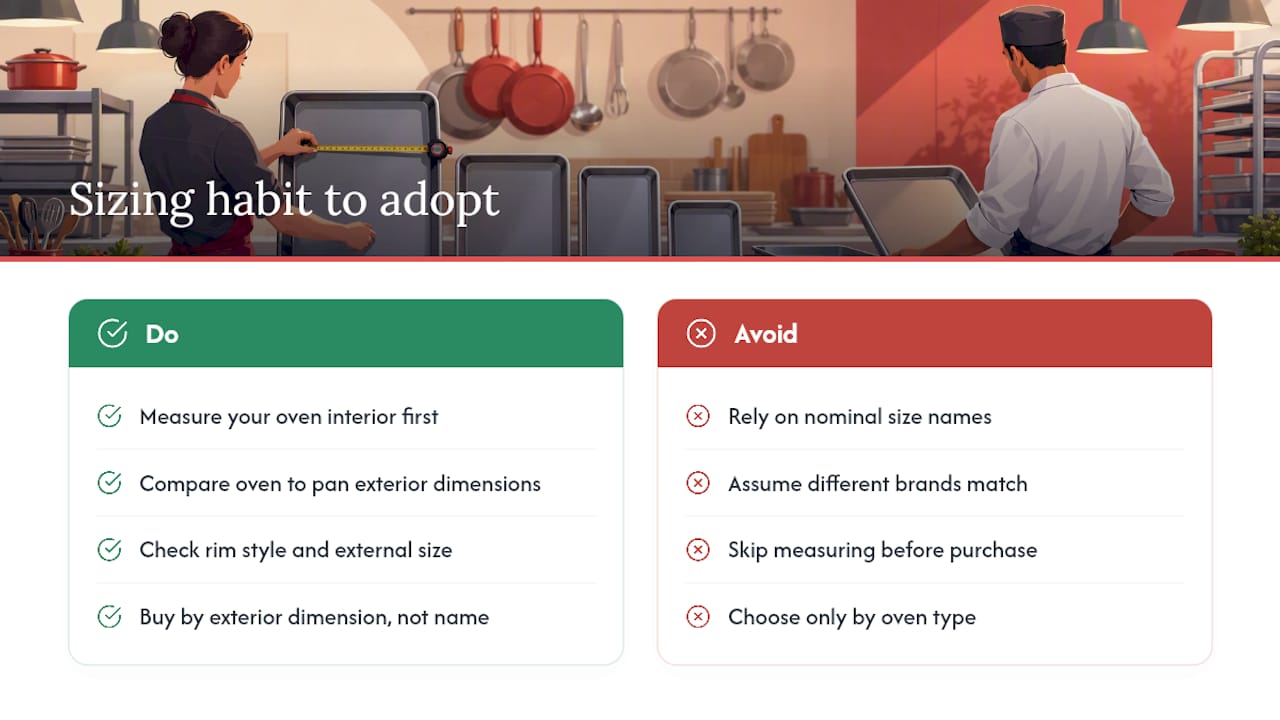
The conventional advice, buy the size that matches your oven type, isn’t wrong, but it skips the step that actually prevents returns: measuring your own oven’s interior and comparing it against a pan’s stated exterior dimensions, not its category name. A quarter-sheet from one brand can be larger than another brand’s “small half-sheet.” Names are marketing; millimetres are fact.
If there’s one priority to take from this, it’s to measure first and buy by exterior dimension always, whether you’re outfitting a single home oven or a bank of commercial units. That habit alone eliminates most of the sizing complaints that fill product review pages, and it costs nothing but five minutes with a tape measure.
— David
Get your pan sizing right before you order
Sizing charts get you close, but nothing replaces seeing a pan against your actual oven and racks. Superiorkitchenequipment’s showroom lets you check exterior dimensions, rim style and rack clearance in person before you commit to a bulk order, which matters far more once you’re buying for a commercial kitchen rather than a single home tray.
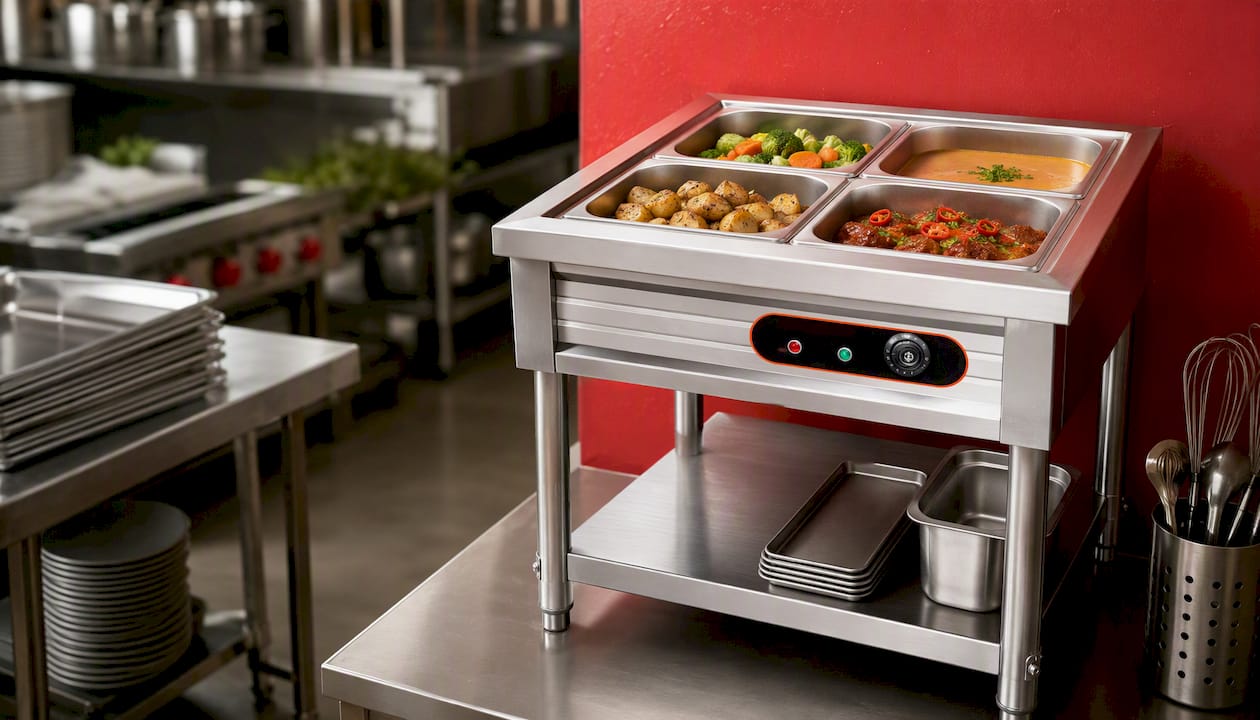
If you’re already outfitting a hot-holding station, the Standing Bain Marie 4 Hole Warmer is worth seeing alongside your sheet pan order, since compatible tray sizing across a service line saves a second round of measuring later. Before you contact the team, have three numbers ready: your oven or rack’s interior width and depth, the shelf spacing between racks, and the exterior dimensions of the pans you’re replacing. Bring those to a showroom visit or quote request through Superiorkitchenequipment’s main site, and the compatibility check takes minutes rather than a guessing game once the equipment arrives.
Sources
- Sheet Pan Versus Cookie Sheet: Your Baking Sheet Questions, Answered — Serious Eats
- Sheet pan — Wikipedia
- Your complete guide to baking pans — King Arthur Baking