

Choose 304 for anything wet, food-facing, or expected to last more than a few years. Choose 201 only for dry, indoor, decorative work where budget matters more than lifespan. The core reason is chemistry: 304 carries 8 to 10.5% nickel, while 201 substitutes most of that nickel with manganese and nitrogen, which weakens its resistance to moisture and chlorides.
- Chemistry driving the decision: higher nickel in 304 stabilises the passive oxide film that resists rust; 201’s manganese substitution cuts cost but also cuts corrosion resistance.
- Trade-off: 304 costs more upfront but resists pitting and lasts years longer; 201 is cheaper and harder, but degrades fast once moisture gets involved.
Before you commit to either grade on a purchase order, ask for a mill test certificate and, where the stakes justify it, an XRF spot check. The sections below cover the composition data, mechanical figures, and application rules that back this verdict.
Key Takeaways
304 outperforms 201 in every wet, food-contact, or long-service application because its higher nickel content sustains the passive film that resists chloride corrosion.
| Point | Details |
|---|---|
| Default to 304 for wet work | Sinks, food processing kit, and coastal or outdoor fixtures need 304’s corrosion resistance. |
| Reserve 201 for dry, low-risk uses | Indoor decorative trim and low-traffic furniture can tolerate 201’s shorter service life. |
| Verify before you buy | Request a mill test certificate and consider an XRF spot check to confirm nickel and manganese content. |
| Plan for work-hardening | 201 needs intermediate anneals during deep forming; 304 tolerates deeper draws without cracking. |
| Choose certified 304 equipment | Superiorkitchenequipment supplies cabinets, tables, and shelving in 304 with mill certificates available on request. |
Table of Contents
- Stainless steel 304 vs 201: composition and why it matters
- How do 304 and 201 compare on strength and ductility?
- Which grade resists corrosion better in real conditions?
- Fabrication: welding, forming and finishing differences
- Which grade fits which application, and what does that cost over time?
- Magnetic properties and implications for application
- Food safety and hygiene considerations for each grade
- Impact of nickel content differences on allergy potential and biocompatibility
- Why we specify 304 as the default for commercial kitchens
- Buying 304-specified kitchen equipment with documentation included
- Sources
Stainless steel 304 vs 201: composition and why it matters
The gap between these two grades starts with the periodic table, not the price list. 304 stainless steel (UNS S30400) typically runs 18 to 20% chromium and 8 to 10.5% nickel. 201 (UNS S20100) drops nickel to 3.5 to 5.5%, then fills the gap with 5.5 to 7.5% manganese and a touch more nitrogen to hold the austenitic structure together.
That substitution is the whole story. Nickel stabilises the passive chromium oxide layer that gives stainless steel its self-healing corrosion resistance, and it also improves toughness at low temperatures. Manganese and nitrogen can mimic some of that structural role, but they don’t rebuild the passive film the same way once it’s damaged by chlorides or acids. That’s why 201 tends to look identical to 304 on a showroom floor and behaves very differently after eighteen months near a dishwasher or a coastal window.
Watch for market variants like 201J1 and 201J5, which push nickel even lower to shave further cost. These are frequently sold into markets expecting standard 201 or, worse, mislabelled as 304. A B2B buyer’s comparison of the two grades notes that 201 typically costs significantly less than 304 from common mills, which is exactly the incentive that drives mislabelling. Never accept a verbal grade claim on a large order. Request a mill test certificate, and where the order size or application justifies it, run a handheld XRF check on delivery to confirm nickel and manganese fall within the expected band.
How do 304 and 201 compare on strength and ductility?
Numbers tell you more than marketing here. 201 tends to show comparable or higher yield strength but noticeably lower elongation, because 201 work-hardens faster than 304 as manganese and nitrogen strengthen the matrix at the expense of ductility.
That work-hardening behaviour has real fabrication consequences:
- 201 stiffens quickly under cold forming, which means deep-drawn parts risk cracking unless you plan intermediate anneals into the process.
- Springback is more pronounced with 201, so bends and folds need extra tooling allowance compared with 304.
- 304’s higher elongation makes it the safer default for deep drawing, spinning, or any shape with tight radii.
- 201’s higher as-formed strength can be genuinely useful for structural brackets or trim where corrosion exposure is minimal and stiffness matters more than longevity.
If your product needs a single deep-drawn bowl, a curved splashback, or anything shaped in one hit rather than assembled from flat panels, 304’s ductility is the difference between a clean run and a scrapped batch. If you’re bending flat trim or stamping a bracket that never sees water, 201’s strength can work in your favour, provided your press tooling accounts for the springback.
Which grade resists corrosion better in real conditions?
304 wins this comparison decisively, and the margin widens fast once chlorides are involved. Nickel content governs how quickly the passive chromium oxide film re-forms after it’s scratched or chemically attacked. 304’s higher nickel content gives it a genuine re-passivation advantage; 201’s lower nickel and higher reliance on manganese leaves it exposed once that film is broken, particularly in the presence of chloride ions from salt air, cleaning chemicals, or splashing water.
Typical service life: in indoor, dry conditions, 304 can last 15 to 25 years while 201 often manages 5 to 10 years. In humid or coastal settings, that gap collapses. 201 can show visible pitting or surface rust within 6 to 12 months, while properly passivated 304 continues performing for years under the same exposure.
Three rules of thumb follow from that data:
- Never specify 201 for anything that sees standing water, steam, or repeated washdown. Commercial dishwashing stations, sinks, and food-processing lines belong in 304 territory without exception.
- Treat coastal or high-humidity siting as an automatic upgrade trigger. If the fixture sits within reach of salt air, chloride-laden cleaning agents, or condensation, 201’s failure mode arrives in months rather than years.
- Reserve 201 for dry, low-consequence indoor work. Decorative trim, indoor panelling, and furniture that never meets liquid can tolerate 201’s shorter lifespan because the cost of eventual replacement is low.
Pitting resistance equivalent number (PREN) calculations, which weigh chromium, molybdenum, and nitrogen content, generally favour 304 over 201 for chloride environments, though neither grade approaches the performance of molybdenum-bearing duplex or 316 alloys where seawater exposure is constant. For most commercial kitchens, the practical question isn’t which alloy beats saltwater outright. It’s which one survives a nightly bleach wipe-down and an industrial dishwasher cycle without staining within the first year.
Fabrication: welding, forming and finishing differences
Welding either grade successfully starts with matching filler metal to base metal, but the risk profile differs. 304 welds predictably with standard 308/308L filler and tolerates the heat input typical of commercial kitchen fabrication without major surprises. 201 can be welded too, but its faster work-hardening and different thermal expansion behaviour make post-weld cracking more likely if the fabricator doesn’t manage heat input and cooling rate carefully.
Pro Tip: Always specify post-weld pickling and passivation for welded 304 assemblies, not just for 201. Welding burns off the passive film locally, and skipping the passivation step leaves a corrosion-prone heat-affected zone even on premium-grade steel.
Forming behaviour reinforces the same pattern seen in the mechanical data:
- Deep-drawn components (sink bowls, curved panels) favour 304 for its ductility and lower risk of splitting.
- 201 fabrication involving multiple forming stages often needs intermediate annealing to restore ductility before the next bend.
- Both grades benefit from citric or nitric acid passivation after fabrication to rebuild the passive oxide layer disturbed by cutting, grinding, and welding.
- Routine maintenance with non-chloride cleaners extends service life on both grades, but the margin for error is far smaller on 201.
Which grade fits which application, and what does that cost over time?
Match the grade to the environment first, then let cost break the tie only when the environment allows either option. Application guidance from industry comparisons consistently places 304 in food contact, wet, coastal, and outdoor roles, with 201 acceptable only for dry, low-consequence indoor use.
- Kitchen sinks, worktables, food processing equipment: 304, no exceptions. Constant water and cleaning chemical exposure make 201 a false economy here.
- Shelving in wet or humid storage areas: 304. Dry, climate-controlled storage rooms can sometimes tolerate 201.
- Railings and trim in coastal or outdoor settings: 304, ideally with a higher-molybdenum alloy considered for direct sea exposure.
- Decorative indoor trim, dry elevator panels, low-traffic furniture: 201 is a reasonable, cost-effective choice.
On upfront price, 201 undercuts 304 by roughly 35 to 45% at the mill level. That gap looks attractive until you run the lifecycle maths: replacing a 201 fixture every 5 to 10 years against a 304 fixture lasting 15 to 25 years usually erases the initial saving within one replacement cycle, especially once labour and downtime for swapping equipment enter the equation.
| Use case | Recommended grade | Why |
|---|---|---|
| Sinks, prep surfaces, food processing kit | 304 | Constant moisture and food contact demand corrosion resistance |
| Indoor dry shelving | Either, environment dependent | 201 acceptable if genuinely dry and low-consequence |
| Outdoor or coastal fixtures | 304 (or higher alloy) | Chloride exposure defeats 201’s passive film quickly |
| Decorative indoor trim | 201 acceptable | Low moisture exposure, replacement cost is manageable |
Magnetic properties and implications for application
Neither grade is a reliable magnet test on its own, and this trips up more buyers than any other identification myth. Both 304 and 201 are austenitic stainless steels, meaning both are largely non-magnetic in their annealed state. A magnet sticking weakly to a sheet doesn’t confirm 201 over 304, because cold working, welding, and forming can induce a degree of magnetism in either grade by shifting some austenite into magnetic martensite at the surface.
201 tends to show slightly more induced magnetism after cold forming than 304, because its lower nickel content makes the austenitic phase somewhat less stable under mechanical stress. That gives the magnet test a rough directional value: a strongly magnetic finished part is more likely to be 201 or a lower grade than a genuinely non-magnetic one is likely to be 304. But “rough directional value” is a long way from proof, and a fabricator who has cold-worked 304 heavily around welds and edges can produce a part that reads as magnetic despite being genuine 304.
For any application where magnetic interference matters, such as equipment sited near sensitive instrumentation, this distinction matters less than the corrosion behaviour, but it’s still worth noting on a spec sheet. For everyday procurement decisions, treat the magnet test as a cheap first screen that can raise suspicion, never as a substitute for a mill test certificate or an XRF check.
Food safety and hygiene considerations for each grade
Both grades pass food-contact standards when new, but they don’t stay equally hygienic over years of service. The relevant hygiene risk isn’t the metal itself; it’s what happens to the surface once the passive film is compromised. A pitted or rusting surface, which appears far sooner on 201 in wet foodservice conditions, creates microscopic crevices where bacteria can lodge and survive routine cleaning.
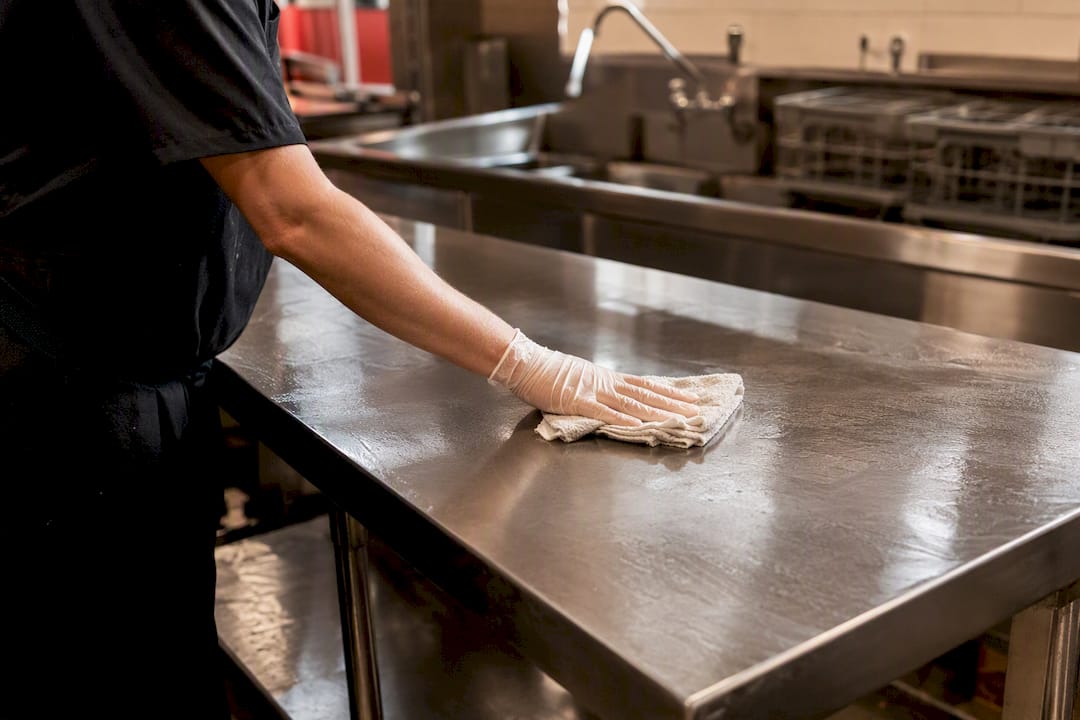
304’s superior resistance to pitting and crevice corrosion means its surface stays smoother and more genuinely cleanable for longer, which is precisely why food-contact standards and commercial kitchen specifications default to it. Once 201 starts showing surface rust, typically within 6 to 12 months in humid or heavily washed environments, that discoloured, roughened surface becomes materially harder to sanitise effectively, regardless of how diligently staff scrub it.
This is also where mislabelled material becomes a genuine food safety issue rather than just a procurement headache. A buyer who believes they’ve installed 304 food-contact equipment, when the supplier actually delivered 201, may be running a hygiene risk they don’t know exists until visible pitting appears. That’s the practical argument for mill test certificates on every food-contact order, not just large ones: the certificate is the only reliable link between what’s specified and what’s actually installed.
Impact of nickel content differences on allergy potential and biocompatibility
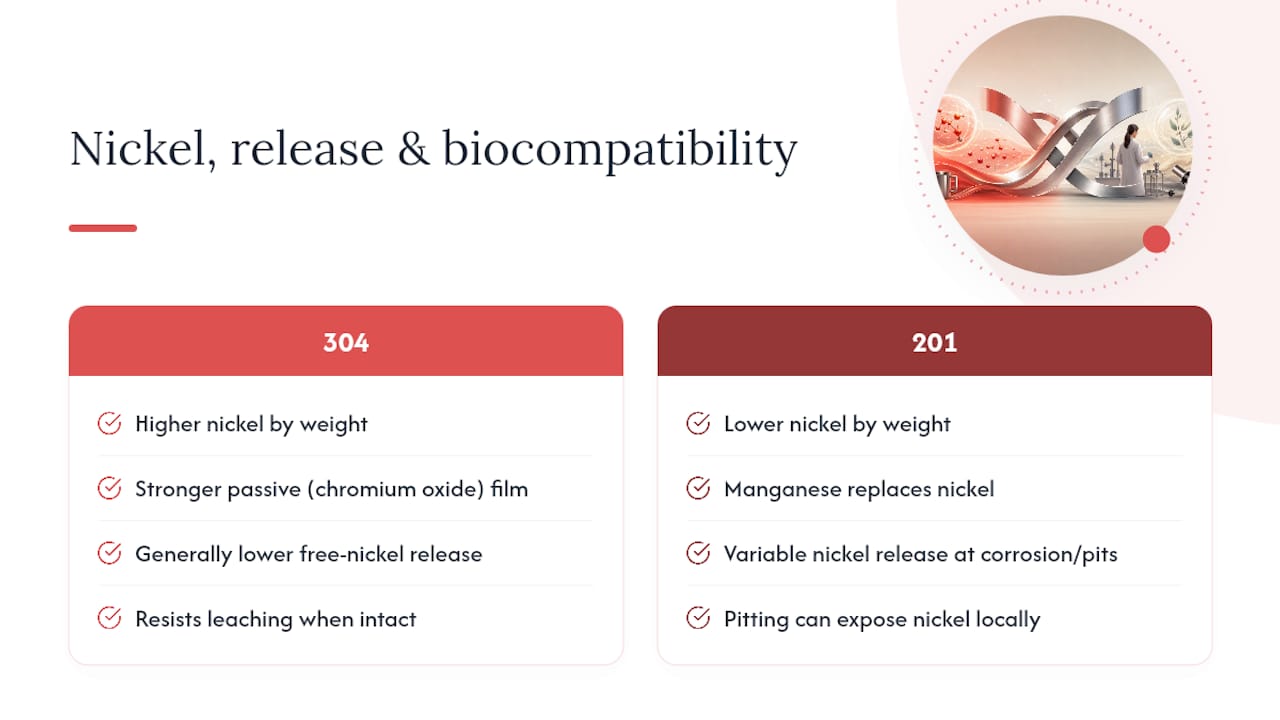
Nickel allergy is common enough, affecting a meaningful share of the population through contact dermatitis, that the composition gap between these two grades is worth understanding properly rather than assuming “less nickel automatically means safer.” The reality is more nuanced. In both 304 and 201, nickel is locked within a stable metallic alloy and bound into the passive chromium oxide surface layer, which limits how much nickel actually leaches out under normal contact conditions.
304, despite containing more nickel by weight, generally releases less free nickel over time than a poorly finished or corroding surface would, because its stronger passive film keeps nickel bound rather than exposed. A pitted or corroding 201 surface, ironically, can present a more variable nickel-release profile at localised corrosion sites, even though its bulk nickel content is lower. For most kitchen equipment applications involving indirect food contact through cookware, worktables, and prep surfaces, this distinction rarely becomes a practical issue, but it matters for equipment with prolonged direct skin contact, such as handles and fittings.
Manganese, the element that replaces nickel in 201’s formulation, carries its own biocompatibility profile and isn’t automatically a safer substitute; it’s simply a different set of trade-offs rather than a straightforward allergy fix. If nickel sensitivity is a specific concern for staff or end users, the practical answer isn’t switching grades casually. It’s maintaining the passive film through proper passivation and avoiding surface damage that exposes fresh metal, on either grade.
Why we specify 304 as the default for commercial kitchens
Working through kitchen equipment specifications day in and day out, the pattern is consistent: the jobs that fail early are almost always the ones where 201 got specified for a wet or food-contact role to save money on the purchase order, then failed within a year or two once pitting set in. We specify 304 as the default for anything touching food, water, or sustained cleaning cycles, and we only accept 201 where the application is genuinely dry and the consequence of early failure is low, such as decorative trim well away from splash zones.
The procurement checklist we apply is simple: require a mill test certificate on every order, spot-check with XRF on larger deliveries, and insist on passivation and proper post-weld cleaning before anything ships. Skipping any one of those steps is how buyers end up paying 304 prices for material that behaves like 201 within eighteen months.
— David
Buying 304-specified kitchen equipment with documentation included
Superiorkitchenequipment builds its foodservice range around exactly the grade logic covered above, so you don’t have to chase down mill certificates after the fact. Our Stainless Steel Cabinet range, Customized Stainless Steel Table line, and Stainless Steel Shelving are typically supplied in 304 because they’re built for wet, high-traffic commercial kitchens where 201 would fail early.
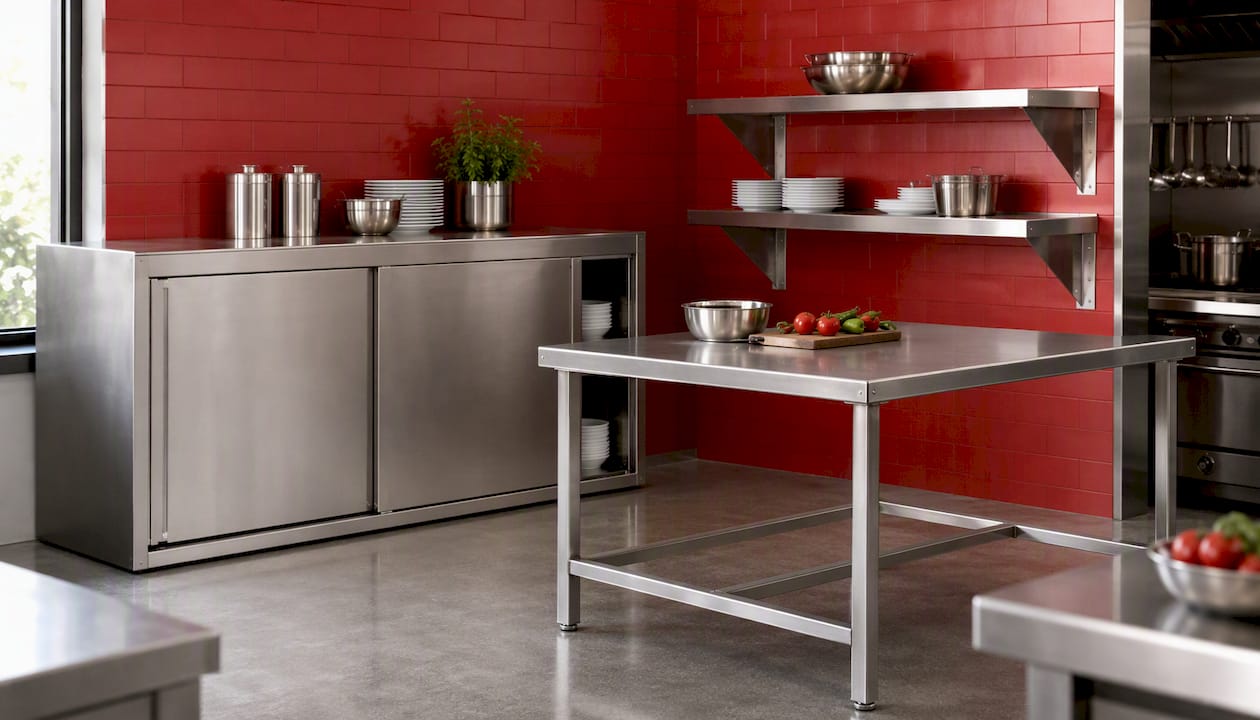
Each of these product lines can come with mill test certificates on request, and our showroom lets you inspect the actual finish and welding quality before you commit to an order, rather than judging from a spec sheet alone. If you’re speccing a fit-out and want documentation confirmed before you order, get in touch about your cabinet, table, or shelving requirements and we’ll talk through the grade and certification you need.
Sources
- 304 vs 201 Stainless Steel: A B2B Buyer’s Comparison
- 304 vs 201 Stainless Steel: Key Differences and Uses